
Uncategorized
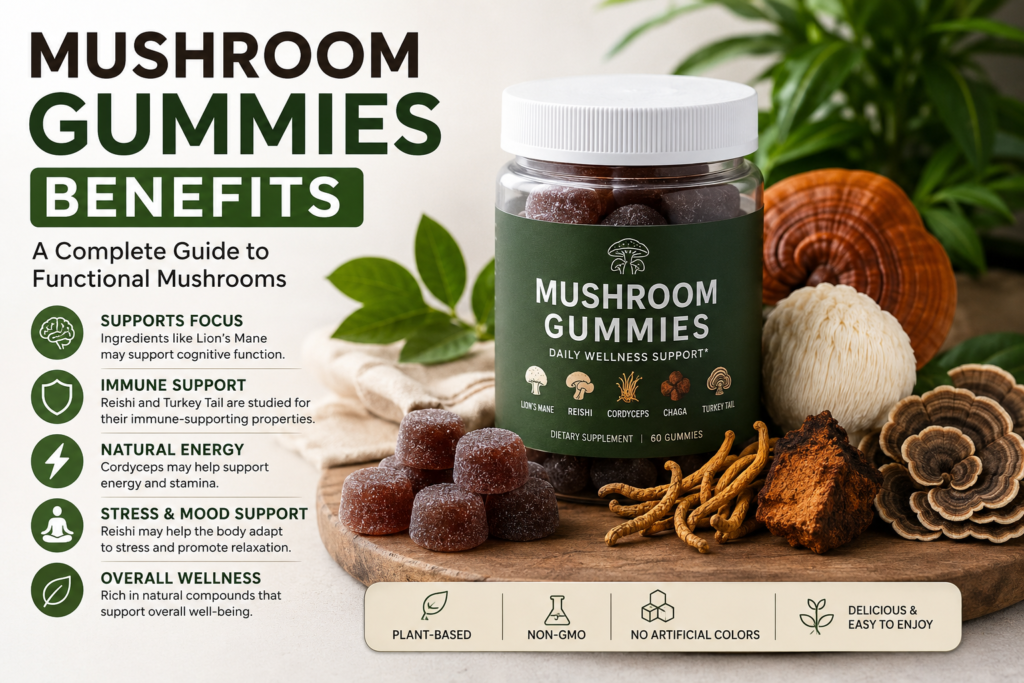
Mushroom Gummies Benefits: A Complete Guide to Functional Mushrooms
Aug
Mushroom Gummies Benefits: 10 Powerful Facts & Research
Mushroom Gummies Benefits are attracting growing interest among people looking for a convenient way to add mushroom-based dietary supplements to their wellness routines. Unlike capsules or powders, gummies provide a chewable format that can combine mushroom ingredients with flavors and other formulation ingredients.
But what are the actual Mushroom Gummies Benefits, and what does the research tell us? The answer depends heavily on the mushroom species, preparation, amount, product formulation, and the individual using the supplement.
Popular functional mushrooms such as Lion’s Mane, Reishi, Cordyceps, Chaga, and Turkey Tail have all attracted scientific or traditional interest. However, evidence is not equally strong for every mushroom or every proposed use. Research on a mushroom itself also does not automatically prove that a particular commercial gummy will produce the same result.
This guide explains the potential Mushroom Gummies Benefits associated with different mushroom species, how mushroom gummies compare with other supplement formats, what to look for on product labels, how to evaluate product quality, and the safety considerations worth understanding before choosing a product.
Important: Mushroom gummies are dietary supplements. They should not be considered a replacement for prescription medicines, professional medical care, or a balanced diet. The evidence for individual mushroom ingredients varies, and consumers should evaluate health claims carefully.
Mushroom Gummies Benefits: What to Know First
The most important thing to understand about Mushroom Gummies Benefits is that mushroom gummies are a broad product category rather than one standardized supplement.
One product might contain Lion’s Mane extract, while another may contain Reishi powder or a blend of several mushroom species. Some products may also contain vitamins, herbs, sweeteners, flavors, or other formulation ingredients.
Consequently, consumers should not assume that every mushroom gummy provides the same potential benefits.
The National Center for Complementary and Integrative Health explains that evidence for dietary supplements varies and that products used in research may differ from products available commercially.
The most responsible way to discuss Mushroom Gummies Benefits is therefore to examine the individual mushroom, preparation, serving information, product formulation, and available evidence.
For a broader introduction to the category, read our Functional Mushroom Gummies guide.
If you want to explore the category, visit Shop Magic Mushroom Gummies.
What Are Mushroom Gummies?
Mushroom gummies are chewable dietary supplement products containing mushroom-derived ingredients.
Depending on the formulation, they may contain:
- Whole mushroom powder.
- Mushroom extract.
- A combination of mushroom powders and extracts.
- Multiple mushroom species.
- Additional vitamins or botanical ingredients.
- Sweeteners and flavoring ingredients.
- Gelling ingredients such as pectin or gelatin.
The gummy format is primarily a delivery method. It does not automatically make a mushroom ingredient more effective than a capsule, powder, tea, or another preparation.
What matters most is the actual formulation when evaluating Mushroom Gummies Benefits.
Why Are Mushroom Gummies So Popular?
One reason consumers search for Mushroom Gummies Benefits is the convenience of the gummy format.
Convenience
Gummies can be consumed without mixing a powder into a beverage or swallowing a capsule.
Flavor
Many mushroom gummies are flavored, which can make them easier to consume for people who dislike the natural taste of mushrooms.
Portability
Properly packaged gummies can be convenient to carry when traveling or away from home.
Simple Serving Instructions
Most products identify a serving size, making it relatively easy to understand how the manufacturer intends the product to be used.
These are practical advantages of the format rather than proof of a specific health effect.
Potential Mushroom Gummies Benefits
Depending on the mushrooms included, products may be marketed around areas such as:
- General wellness.
- Cognitive function.
- Focus.
- Energy and exercise-related wellness.
- Stress management.
- Immune-system support.
- Antioxidant activity.
- Overall dietary wellness.
However, these categories should not be interpreted as guaranteed outcomes.
Some mushroom species have promising research behind them, while others have considerably less human evidence. Even where human studies exist, the preparation used in a study may differ from the gummy sold commercially.
These differences are important when evaluating Mushroom Gummies Benefits because a scientific finding involving one mushroom preparation does not automatically establish the same result for every commercial product.
For responsible supplement information, consult the NCCIH guidance on using dietary supplements wisely.
Lion’s Mane Mushroom Gummies
Lion’s Mane, commonly identified as Hericium erinaceus, is one of the most frequently discussed functional mushrooms in relation to cognition and nervous-system research.
Research has investigated Lion’s Mane in areas including cognitive performance, mood, neurological mechanisms, and other biological processes.
That makes Lion’s Mane particularly relevant when discussing potential Mushroom Gummies Benefits associated with cognitive wellness.
However, research on Lion’s Mane should not be confused with proof that every Lion’s Mane gummy improves memory, concentration, or another specific function.
The product’s preparation, serving amount, and formulation matter.
For a dedicated discussion, see Benefits of Lion’s Mane Gummies.
Reishi Mushroom Gummies
Reishi refers to mushrooms in the Ganoderma group and has a long history of traditional use.
Modern research has examined Reishi and its compounds in a variety of laboratory and clinical contexts.
Reishi gummies are commonly positioned toward general wellness and immune-related support, but consumers should distinguish traditional use and laboratory research from established clinical outcomes.
A product containing Reishi should therefore be evaluated based on its actual label and preparation rather than the mushroom name alone.
This distinction is important when assessing the potential Mushroom Gummies Benefits associated with Reishi products.
Cordyceps Mushroom Gummies
Cordyceps is another mushroom frequently included in functional mushroom products.
It has attracted interest in research involving exercise, metabolism, and other biological processes.
Some consumers are particularly interested in Cordyceps when researching energy and physical-performance-related wellness.
However, the evidence depends on the specific species and preparation studied. A commercial gummy should not automatically be assumed to reproduce findings from a particular research preparation.
For that reason, consumers should examine the mushroom species and ingredient information carefully when evaluating potential Mushroom Gummies Benefits.
Chaga Mushroom Gummies
Chaga is another mushroom used in some functional mushroom formulations.
Scientific research has examined Chaga for various biological activities, including antioxidant-related mechanisms.
Much of the evidence surrounding specific biological mechanisms comes from laboratory or preclinical research, meaning it should not automatically be translated into a guaranteed human health outcome.
If Chaga appears in a mushroom gummy blend, check the amount and preparation rather than assuming that its presence alone establishes a particular benefit.
Turkey Tail Mushroom Gummies
Turkey Tail, commonly associated with Trametes versicolor, is another mushroom found in functional mushroom products.
It has received scientific attention particularly because of compounds associated with immune-related research.
However, the evidence surrounding an isolated mushroom ingredient should not automatically be applied to every commercial gummy containing that mushroom.
Product formulation and the amount of the ingredient remain important considerations when evaluating Mushroom Gummies Benefits.
Mushroom Blends
Some products combine several mushroom species in one gummy.
A blend may include combinations such as:
- Lion’s Mane.
- Reishi.
- Cordyceps.
- Chaga.
- Turkey Tail.
A blend is not automatically better than a single-mushroom product.
When evaluating a blend, determine whether the label identifies the amount of each mushroom individually or simply provides a combined proprietary blend amount.
Greater transparency makes it easier to compare products and understand what you are actually purchasing.
Mushroom Gummies and Focus
Focus is one of the common reasons consumers investigate Mushroom Gummies Benefits.
Lion’s Mane is particularly associated with cognitive research, which has contributed to its popularity in products marketed toward mental wellness.
However, consumers should avoid assuming that taking a mushroom gummy guarantees improved concentration or productivity.
The evidence for cognitive effects varies by mushroom, study, preparation, and population.
For a dedicated guide, see Mushroom Gummies for Focus.
Mushroom Gummies and Energy
Energy is another frequently discussed area of mushroom supplement use.
Cordyceps is commonly associated with research involving exercise and performance, although results depend on the preparation and population studied.
It is important to distinguish supporting normal energy or exercise-related wellness from treating fatigue caused by a medical condition.
Persistent or unexplained fatigue deserves professional evaluation rather than relying solely on a dietary supplement.
These distinctions are important when evaluating Mushroom Gummies Benefits related to energy.
Read our Mushroom Gummies for Energy guide for more information.
Mushroom Gummies for Daily Wellness
Some consumers use mushroom supplements as part of a broader wellness routine rather than for one specific goal.
This can include maintaining a balanced diet, staying physically active, getting adequate sleep, and making other healthy lifestyle choices.
Dietary supplements should complement—not replace—those fundamentals.
The FDA provides consumer information about dietary supplements, including labeling and responsible use.
For this reason, potential Mushroom Gummies Benefits should be viewed as one part of an overall wellness approach rather than a replacement for healthy lifestyle habits.
Learn more in our Mushroom Gummies for Daily Wellness guide.
Mushroom Gummies and Immune Support
Immune support is frequently mentioned in mushroom supplement marketing.
Several mushroom species have been investigated for biological effects involving immune pathways.
However, evidence supporting supplement claims varies widely, and research on immune-related supplements does not always provide strong evidence for specific health outcomes.
Therefore, “immune support” should not be interpreted as a guarantee that mushroom gummies prevent infections or treat illness.
Consumers should also be cautious about products making disease-treatment or disease-prevention claims.
When considering Mushroom Gummies Benefits related to immune support, focus on the actual ingredient, preparation, evidence, and product labeling.
See Mushroom Gummies for Immune Support for a more focused discussion.
Mushroom Gummies and Stress
Stress and mood are additional areas in which certain mushroom species have been investigated.
Some consumers choose mushroom supplements as part of a broader approach to wellness and stress management.
However, a dietary supplement should not be presented as a guaranteed treatment for anxiety, depression, or another mental health condition.
Healthy stress-management strategies can include adequate sleep, physical activity, social connection, relaxation practices, and professional care when needed.
Potential Mushroom Gummies Benefits related to stress should therefore be discussed cautiously and should not be confused with treatment for a mental health condition.
Read Mushroom Gummies for Stress Relief for more information.
Mushroom Gummies and Cognitive Support
Cognitive wellness is another major reason people investigate Mushroom Gummies Benefits.
Lion’s Mane has received particular attention in cognitive research, while other mushroom species have been investigated in different biological contexts.
But research findings should always be interpreted in context.
A study involving a particular mushroom preparation does not necessarily prove that another product with the same mushroom name will have the same effect.
Consumers should therefore focus on the actual product formulation and avoid guaranteed claims.
This evidence distinction is essential when evaluating potential effects for cognitive support.
See Mushroom Gummies for Cognitive Support for the narrower topic.
What Does the Research Say?
The research surrounding Mushroom Gummies Benefits is best understood by separating evidence about mushrooms from evidence about commercial gummy products.
| Evidence Type | What It Can Tell Us | Important Limitation |
|---|---|---|
| Laboratory research | Can investigate biological mechanisms and compounds. | Does not establish the same effect in humans. |
| Animal studies | Can provide preliminary evidence. | Results cannot automatically be applied to people. |
| Human studies | Provide more direct evidence about people. | Results depend on study design, population, preparation, and dose. |
| Commercial product | Shows what consumers actually receive. | May differ from research preparations. |
The NCCIH dietary supplement information explains that supplements available to consumers can differ in important ways from products investigated in research.
Additional scientific literature can be explored through PubMed, the biomedical literature database maintained by the U.S. National Library of Medicine.
This distinction is important because evidence involving an individual mushroom should not automatically be interpreted as proof that every gummy containing that mushroom produces the same result.
Mushroom Gummies Ingredients
Understanding the ingredient list is an essential part of evaluating Mushroom Gummies Benefits.
A product may contain:
- Mushroom powder.
- Mushroom extract.
- Multiple mushroom species.
- Sweeteners.
- Natural or artificial flavors.
- Pectin.
- Gelatin.
- Acids.
- Coloring ingredients.
- Additional vitamins or botanicals.
Do not evaluate a product solely by the mushroom name printed on the front of the package.
Read the entire ingredient list and nutrition information.
The complete formulation can affect how consumers should interpret potential effects.
Our Functional Mushroom Gummies Ingredients guide provides a deeper look at the different formulation components.
Mushroom Powder vs Extract
One important distinction when evaluating Mushroom Gummies Benefits is whether the product uses mushroom powder or an extract.
Mushroom Powder
Powder generally refers to dried mushroom material that has been processed into a powdered form.
Mushroom Extract
An extract is produced through an extraction process that may concentrate or separate particular components.
These preparations should not automatically be considered equivalent.
If a scientific study uses a particular preparation, consumers should not assume that a different preparation will produce identical results.
How to Read a Mushroom Gummy Label
Learning to read the label is one of the most useful skills for evaluating potential Mushroom Gummies Benefits.
Check the Serving Size
Find out how many gummies make one serving.
Check Servings Per Container
This tells you how many labeled servings are in the package.
Identify the Mushrooms
Look for the exact mushroom species.
Check the Amount
Review the amount per serving when provided.
Read the Other Ingredients
Look at sweeteners, flavors, gelling agents, colors, and other ingredients.
Review Directions
Follow the manufacturer’s labeled directions.
The FDA dietary supplement resources provide additional information about supplement labels and consumer considerations.
How to Evaluate Product Quality
Quality and transparency matter when choosing mushroom gummies and evaluating potential Mushroom Gummies Benefits.
Useful information includes:
- Exact mushroom species.
- Ingredient amounts.
- Serving size.
- Servings per container.
- Preparation type.
- Complete ingredient list.
- Manufacturer information.
- Directions.
- Storage instructions.
- Relevant testing information.
Consumers should also be cautious with phrases such as “guaranteed,” “instant,” or “cures.”
Dietary supplement marketing should not be confused with the evidence required for medicines.
The FDA explains that dietary supplements are regulated differently from drugs and that consumers should carefully review product information.
Mushroom Gummies vs Capsules
Gummies and capsules can both deliver mushroom ingredients, but they offer different experiences.
| Feature | Gummies | Capsules |
|---|---|---|
| Format | Chewable. | Swallowed. |
| Flavor | Usually flavored. | Generally little or no flavor. |
| Additional ingredients | May contain sweeteners, flavors, and gelling ingredients. | Often has a simpler delivery format. |
| Convenience | Ready to chew. | Ready to swallow. |
Neither format is automatically superior.
The better option depends on personal preference, formulation, dietary needs, serving information, and other individual considerations.
The format itself does not establish additional Mushroom Gummies Benefits.
Read Functional Mushroom Gummies vs Capsules for a detailed comparison.
Safety and Side Effects
Safety should always be part of the discussion about Mushroom Gummies Benefits.
NCCIH notes that dietary supplements can interact with medications or pose risks for people with certain medical conditions. Many supplements have also not been adequately studied in pregnancy, breastfeeding, or children.
Possible Digestive Effects
Some people may experience digestive discomfort after taking a dietary supplement. The cause could relate to the mushroom ingredient or another component of the formulation.
Allergic Reactions
Anyone with known mushroom or ingredient allergies should carefully review the product label.
Medication Interactions
Dietary supplements can interact with prescription or over-the-counter medicines. Discuss supplement use with a healthcare professional if you take medication.
Pregnancy and Breastfeeding
Many dietary supplements have not been adequately tested in pregnant or breastfeeding populations. Professional advice is appropriate before use.
Surgery
Tell healthcare providers about supplements you use before surgery because some supplements can affect bleeding or the response to anesthesia.
For a more detailed guide, visit Functional Mushroom Gummies Side Effects.
Additional information is available through the NCCIH guide to using dietary supplements wisely.
How to Choose Mushroom Gummies
Choosing a mushroom gummy should involve more than looking at the front of the package. A careful evaluation can help you better understand the potential Mushroom Gummies Benefits associated with a particular formulation.
- Identify the mushroom species. Know exactly what mushrooms are included.
- Check the preparation. Determine whether the product uses powder, extract, or a blend.
- Review the serving size. Know how many gummies make one serving.
- Read the complete ingredient list. Look beyond the mushroom ingredients.
- Evaluate the claims. Be cautious about guaranteed medical or dramatic results.
- Check transparency. Look for useful manufacturer and product information.
- Consider testing information. Understand what was tested and what the testing actually establishes.
- Compare cost per serving. Package price alone does not tell you the true cost of use.
- Consider your circumstances. Medication use, allergies, pregnancy, breastfeeding, and medical conditions may require professional guidance.
For a more detailed purchasing framework, read our Functional Mushroom Gummies Buying Guide.
Explore Mushroom Gummies
If you want to explore the mushroom gummy category, visit Shop Magic Mushroom Gummies.
Always review the current product page, ingredient list, serving information, and product-specific instructions before making a purchasing decision.
It is also important to distinguish conventional functional mushroom supplements from products marketed using psychoactive mushroom terminology. Product names can vary, so consumers should verify exactly what a product contains and how it is represented.
Reviewing the actual product information is essential when comparing potential Mushroom Gummies Benefits across different products.
Frequently Asked Questions
What are Mushroom Gummies Benefits?
The potential Mushroom Gummies Benefits depend on the mushrooms and other ingredients in the product. Research has investigated different mushrooms in areas including cognitive function, immune-related pathways, exercise, mood, and general wellness, but evidence varies between species and preparations.
Are mushroom gummies good for daily wellness?
Some consumers include mushroom gummies as part of a broader wellness routine. However, dietary supplements should complement rather than replace a balanced diet, sleep, exercise, and other healthy habits.
Which mushroom is best for cognitive support?
Lion’s Mane is one of the mushrooms most frequently investigated for cognitive-related outcomes. However, evidence remains developing and a commercial gummy should not be assumed to guarantee a cognitive effect.
Can mushroom gummies give you energy?
Some mushroom species, particularly Cordyceps, have been investigated in exercise and performance-related research. However, results vary and persistent fatigue should be evaluated by a healthcare professional.
Do mushroom gummies support the immune system?
Several mushrooms have been investigated for immune-related biological activity. However, research evidence varies and consumers should not interpret “immune support” as a guarantee against illness.
Are mushroom gummies better than capsules?
Not necessarily. Gummies offer a flavored chewable format, while capsules may provide a simpler delivery method. The appropriate option depends on personal preference and product formulation.
Are mushroom gummies safe?
Safety depends on the specific ingredients and the individual using the product. Supplements can interact with medications and may pose risks in certain circumstances. Consult a healthcare professional when appropriate.
How many mushroom gummies should I take?
Follow the serving instructions on the specific product label. Different products can have different serving sizes and concentrations.
Do mushroom gummies contain extracts?
Some do and some use mushroom powders or blends. Check the individual product label to determine the preparation.
Can children take mushroom gummies?
Do not assume that an adult dietary supplement is appropriate for children. Many supplements have not been adequately studied in children, so professional guidance is appropriate.
Can I take mushroom gummies with medication?
Some dietary supplements can interact with prescription or over-the-counter medicines. Discuss the specific product with a doctor or pharmacist if you take medication.
Where can I learn more about functional mushroom gummies?
Start with our Functional Mushroom Gummies guide and then explore the individual supporting articles covering specific uses and mushroom species.
Conclusion
Mushroom Gummies Benefits depend on several factors, including the mushroom species, preparation, serving size, formulation, and quality of the available evidence.
Lion’s Mane, Reishi, Cordyceps, Chaga, and Turkey Tail are among the mushrooms commonly discussed in functional mushroom products, but research strength differs between species and intended uses.
The best approach is to look beyond marketing claims. Check the exact mushroom species, preparation, serving size, ingredient list, directions, manufacturer information, and available evidence.
It is also important to remember that commercial supplements can differ from the products used in scientific studies. NCCIH recommends informed decision-making and notes that supplements may interact with medications or present risks for certain people.
The FDA likewise provides consumer guidance about dietary supplements, including the importance of reading labels and understanding how supplements differ from medicines.
Ultimately, the most responsible way to evaluate Mushroom Gummies Benefits is to consider the evidence for the specific mushroom, examine the actual formulation, and avoid assuming that every product will produce the same outcome.
If you want to learn more before making a decision, continue with our Functional Mushroom Gummies pillar guide and the supporting articles throughout this cluster.
You can also Shop Magic Mushroom Gummies while reviewing the current product information, ingredient list, serving information, and applicable product instructions.
Disclaimer
This article is provided for educational and informational purposes only. It is not intended as medical, legal, nutritional, or professional advice. The evidence for individual mushroom ingredients varies, and product formulations can differ between manufacturers. Always review current product labels and manufacturer information. Consult an appropriately qualified healthcare professional if you have questions about supplements, medications, pregnancy, breastfeeding, allergies, medical conditions, or individual health needs.
