
Uncategorized
Vegan Mushroom Chocolate Bars
Aug
Vegan Mushroom Chocolate Bars: 9 Ultimate Checks for Better Choices
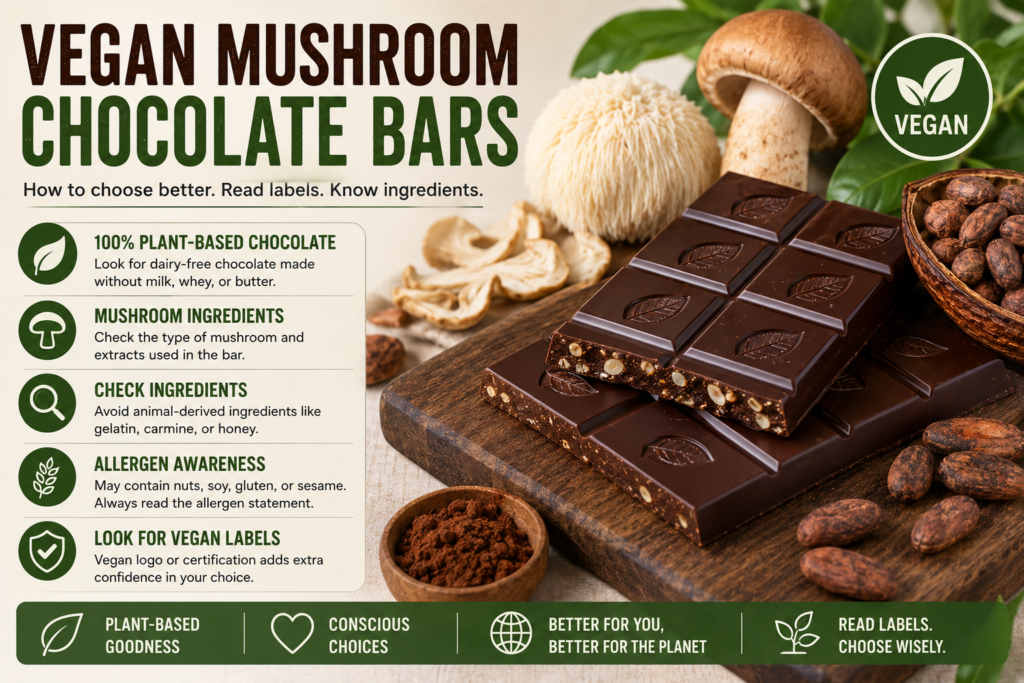
Choosing Vegan Mushroom Chocolate Bars requires more than looking for the word “vegan” on the front of a package. Chocolate products can contain milk ingredients, honey, whey, butter, or other animal-derived components depending on how they are formulated. Additional ingredients used to create flavors, fillings, textures, or coatings can also affect whether a product fits a vegan diet.
This guide explains how to evaluate Vegan Mushroom Chocolate Bars by examining ingredients, allergen information, chocolate formulation, sweeteners, fillings, manufacturing information, labeling, storage, and other practical considerations.
It is important to remember that mushroom chocolate products are not all made the same way. Two chocolate bars can have very different ingredient lists even when they use similar marketing language. The safest approach is to evaluate the specific product rather than assuming that every mushroom chocolate bar is vegan.
Whether you follow a fully vegan diet, avoid dairy, or simply want to understand what is inside your chocolate product, the checklist below can help you make a more informed comparison.
Vegan Mushroom Chocolate Bars: What Makes a Chocolate Bar Vegan?
A vegan chocolate bar is generally formulated without animal-derived ingredients. However, the exact formulation matters more than the appearance of the product.
Traditional chocolate can contain ingredients such as milk or milk powder. Other formulations may use plant-based ingredients instead. Depending on the recipe, chocolate can also contain cocoa solids, cocoa butter, sugar, vanilla, emulsifiers, nuts, seeds, fruit, or other ingredients.
When evaluating Vegan Mushroom Chocolate Bars, the mushroom ingredient is only one part of the equation. The chocolate base and every additional ingredient also need to be considered.
A product can contain mushrooms and still not be vegan if another ingredient in the formulation comes from an animal source.
Why the Ingredient List Matters
The ingredient list is one of the most useful tools available to consumers.
FDA explains that food labels can help consumers identify major food allergens and that consumers should read the entire ingredient list rather than relying only on a front-of-package statement. Major food allergens identified by U.S. law include milk, eggs, fish, crustacean shellfish, tree nuts, wheat, peanuts, soybeans, and sesame.
For a chocolate product, this means checking the complete list for ingredients that may conflict with your dietary requirements.
When reviewing Vegan Mushroom Chocolate Bars, look beyond the words “chocolate” and “mushroom.”
9 Important Checks for Vegan Mushroom Chocolate Bars
| Check | What to Look For | Why It Matters |
|---|---|---|
| 1. Chocolate base | Check for milk and dairy ingredients | The chocolate itself may contain animal-derived ingredients |
| 2. Milk ingredients | Milk powder, whey, casein, butter, cream | These ingredients are not vegan |
| 3. Sweeteners | Review the specific sweetener used | Formulations can differ |
| 4. Fillings | Caramel, cream, nougat, or other fillings | Fillings can introduce non-vegan ingredients |
| 5. Flavor ingredients | Flavors, coatings, and inclusions | Additional ingredients can change the formulation |
| 6. Allergen information | Read the complete allergen information | Useful for people with food allergies |
| 7. Manufacturing information | Vegan statements or certification where provided | Can provide additional information about the product |
| 8. Storage | Follow product-specific storage instructions | Chocolate quality can change with unsuitable conditions |
| 9. Product-specific labeling | Read the current package information | Formulations can change |
1. Check the Chocolate Base
The first thing to examine when looking for Vegan Mushroom Chocolate Bars is the chocolate itself.
Not every chocolate product is automatically vegan. Some chocolate formulations contain milk or milk-derived ingredients, while others are made without them.
Look at the ingredient list rather than relying only on the product’s color, appearance, or marketing description.
Terms that deserve attention include:
- Milk.
- Milk powder.
- Milk solids.
- Whey.
- Butter.
- Cream.
- Casein or caseinates.
- Other clearly identified dairy ingredients.
If an ingredient is unfamiliar, do not automatically assume that it is vegan. Look for a clear explanation from the manufacturer or consult a reliable ingredient reference.
2. Watch for Hidden Dairy Ingredients
Dairy is one of the most important things to check when evaluating vegan chocolate.
Milk may be obvious on a label, but dairy-derived ingredients can also appear in less familiar forms.
For example, a chocolate filling, cream layer, caramel-style center, coating, or flavored ingredient may introduce milk-derived components even when the main chocolate appears suitable for a vegan diet.
This is why checking the complete ingredient list is more useful than looking only at the first few ingredients.
FDA advises people with food allergies to read the entire ingredient list because not every relevant allergen decision can be made from a product’s front label alone.
When choosing Vegan Mushroom Chocolate Bars, make ingredient reading part of your normal shopping process.
3. Check the Sweeteners and Other Ingredients
The chocolate base is not the only part of the product that matters.
Some chocolate bars contain additional sweeteners, flavorings, fruit, nuts, seeds, crisped ingredients, fillings, or coatings.
Each of these components can change the overall formulation.
Instead of assuming that a chocolate bar is vegan because the main ingredients appear plant-based, examine the complete list.
This is particularly important for products with multiple layers or fillings.
4. Pay Attention to Fillings and Coatings
Plain chocolate can have a relatively simple ingredient list, but filled chocolate bars may contain many additional components.
Possible additions include:
- Caramel-style fillings.
- Cream fillings.
- Nougat-style centers.
- Cookie pieces.
- Milk-based coatings.
- Chocolate chips.
- Flavored creams.
- Nut or seed pastes.
- Fruit preparations.
Some of these may be compatible with a vegan diet while others may not be.
The specific formulation is what matters.
5. Understand Vegan Labels and Certifications
A vegan statement can be useful, but consumers should still understand what the statement means for the specific product they are considering.
Some manufacturers provide a vegan statement directly on the package. Others may use an independent certification or display a recognizable vegan certification mark.
Certification can provide additional information, but consumers should still check the current packaging because formulations and manufacturing processes can change.
If you have a severe allergy rather than a dietary preference, the distinction between ingredients and potential cross-contact becomes especially important.
Vegan and allergen-free are not interchangeable terms.
Vegan Does Not Automatically Mean Allergen-Free
This is one of the most important points in any Vegan Mushroom Chocolate Bars discussion.
A product can be vegan while containing an allergen.
For example, a vegan chocolate bar can contain tree nuts, peanuts, soy, wheat, or sesame depending on its formulation.
FDA identifies nine major food allergens under U.S. law and emphasizes the importance of reading food labels for allergen information.
Therefore, people with food allergies should not treat the word “vegan” as a substitute for allergen checking.
Always read the ingredient list and allergen statement relevant to the product.
6. Check for Cross-Contact Information
Another consideration is how a product is manufactured.
A chocolate product may be made in a facility that also handles milk, nuts, soy, wheat, or other allergens.
This does not necessarily mean that the product contains those ingredients, but the manufacturer’s allergen and cross-contact information may be important to people with serious allergies.
For someone following a vegan diet for ethical or dietary reasons, the manufacturer’s vegan statement may be the most relevant information.
For someone managing a severe allergy, additional questions about manufacturing and cross-contact may be necessary.
These are two different considerations and should not be confused.
7. Examine the Mushroom Ingredient
The mushroom component is another part of the label that deserves attention.
“Mushroom chocolate” is a broad description rather than a guarantee that every product contains the same mushroom ingredients.
Different products may use different mushroom species, extracts, powders, blends, or other ingredients.
Some products may also contain ingredients unrelated to mushrooms.
Therefore, when evaluating Vegan Mushroom Chocolate Bars, look for the actual mushroom ingredient information provided by the manufacturer.
Do not assume that two products have identical formulations merely because both use the word “mushroom” in their names.
8. Consider the Rest of the Ingredient Panel
After checking the chocolate and mushroom ingredients, continue through the entire ingredient panel.
Look for:
- Sweeteners.
- Flavorings.
- Emulsifiers.
- Fruit.
- Nuts.
- Seeds.
- Fillings.
- Coatings.
- Coloring ingredients.
- Other processing ingredients.
The objective is not to assume that these ingredients are problematic. The objective is to know what the product actually contains.
9. Check the Current Product Label
Product information can change.
Manufacturers may update recipes, packaging, suppliers, serving information, or other details.
For that reason, information found on an old product listing, social media post, or third-party website should not automatically override the current product packaging.
The current label is the best place to start when evaluating Vegan Mushroom Chocolate Bars.
Vegan Mushroom Chocolate Bars: Simple Ingredient Checklist
| Question | What to Do |
|---|---|
| Does the chocolate contain milk? | Check the complete ingredient list. |
| Does the product contain dairy-derived ingredients? | Look for milk, whey, butter, cream, casein, and similar ingredients. |
| Does it contain fillings? | Review every filling and coating ingredient. |
| Does it contain allergens? | Read the allergen statement and entire ingredient list. |
| Is it labeled vegan? | Look for the manufacturer’s vegan statement or certification where provided. |
| Does the product contain mushrooms? | Review the actual mushroom ingredient information. |
| Are there additional ingredients? | Read the entire ingredient panel. |
| Has the recipe changed? | Check the current package rather than relying on old information. |
Vegan Chocolate vs Dairy Chocolate
The biggest formulation difference between vegan and conventional chocolate often involves the use of milk or milk-derived ingredients.
| Feature | Vegan Chocolate | Conventional Chocolate |
|---|---|---|
| Milk ingredients | Formulated without animal-derived milk ingredients | May contain milk or milk-derived ingredients |
| Chocolate base | Depends on manufacturer | Depends on manufacturer |
| Sweeteners | Varies by product | Varies by product |
| Flavorings | Varies by product | Varies by product |
| Allergens | Can still contain allergens | Can contain allergens |
| Certification | May have vegan certification or manufacturer statement | May not carry a vegan statement |
Are All Mushroom Chocolate Bars Vegan?
No.
The word “mushroom” describes the mushroom component of the product, not whether the entire formulation is vegan.
A mushroom chocolate bar may contain dairy, honey, or other animal-derived ingredients depending on the recipe.
That is why consumers looking for Vegan Mushroom Chocolate Bars should evaluate the complete ingredient list and relevant product labeling.
Do not assume that a product is vegan simply because its marketing emphasizes mushrooms, plants, natural ingredients, or wellness.
Are Dark Chocolate Mushroom Bars Always Vegan?
No.
Dark chocolate is often associated with plant-based formulations, but the term “dark chocolate” does not by itself establish that a particular product is vegan.
Some dark chocolate products may contain milk ingredients or other components that do not fit a vegan diet.
Always check the actual label.
Can Vegan Mushroom Chocolate Bars Contain Milk Allergens?
A product labeled vegan should be formulated without intentionally included animal-derived ingredients, but people with serious milk allergies should also review the manufacturer’s allergen and cross-contact information.
FDA emphasizes that consumers with food allergies should read the entire ingredient list and applicable allergen information.
For severe allergies, the safest approach is to obtain product-specific information directly from the manufacturer when the label does not answer your question.
Can Vegan Mushroom Chocolate Bars Contain Nuts?
Yes.
Vegan and nut-free are two different claims.
A vegan chocolate bar may contain almonds, hazelnuts, peanuts, cashews, or other nuts depending on its formulation.
It may also be produced in a facility that handles nuts.
Consumers with nut allergies should therefore check the ingredient list and allergen information carefully.
Can Vegan Mushroom Chocolate Bars Contain Soy?
Yes.
Soy can appear in chocolate products and other food formulations.
A product can therefore be vegan while still containing soy.
If you avoid soy, check the complete ingredient list and allergen statement rather than relying on the vegan label alone.
Vegan Mushroom Chocolate Bars and Dietary Preferences
People choose vegan products for different reasons.
Some follow a vegan diet for ethical reasons. Others avoid dairy because of dietary preferences or intolerance. Some simply prefer plant-based food products.
These different goals can affect what information matters most.
| Preference | Information to Prioritize |
|---|---|
| Vegan diet | Animal-derived ingredients and vegan product statements |
| Milk avoidance | Milk and dairy-derived ingredients |
| Nut avoidance | Nut ingredients and allergen information |
| Soy avoidance | Soy ingredients and allergen information |
| General ingredient awareness | Complete ingredient panel |
| Severe food allergy | Ingredient, allergen, and manufacturer cross-contact information |
How to Read a Vegan Mushroom Chocolate Label
A useful way to read a product label is from beginning to end.
- Identify the product.
- Read the complete ingredient list.
- Look for milk and other animal-derived ingredients.
- Review allergen information.
- Check whether a vegan statement or certification is provided.
- Review mushroom ingredients.
- Check storage instructions.
- Review manufacturer information.
- Check warnings or other product-specific information.
This process is more reliable than judging a product by its front label alone.
Storage of Vegan Mushroom Chocolate Bars
Once you have selected a suitable product, storage becomes another practical consideration.
Chocolate can be sensitive to excessive heat and humidity. High temperatures can cause chocolate to soften or melt, while unsuitable storage conditions can affect texture and appearance.
Always follow the manufacturer’s storage instructions for the specific product.
For additional information about storing chocolate products, see our Mushroom Chocolate Bar Storage Guide.
You can also learn more about shelf life in our How Long Do Mushroom Chocolate Bars Last guide.
Vegan Does Not Mean Automatically Healthy
It is also important to separate dietary suitability from health claims.
A product being vegan tells you something about its formulation, but it does not automatically establish that the product is nutritious, low in sugar, low in calories, or suitable for every person.
Similarly, the presence of mushrooms does not automatically establish a particular health outcome.
NCCIH explains that the amount of scientific evidence for dietary supplements varies widely and that supplements sold commercially can differ from products tested in research.
NCCIH also notes that “natural” does not necessarily mean safe.
For that reason, consumers should evaluate the actual ingredients and product information instead of relying on broad health or natural-product marketing claims.
Important Safety Considerations
If a mushroom chocolate product is marketed as a dietary supplement or contains supplemental ingredients, consumers should consider the same basic supplement-safety principles that apply to other products in that category.
NCCIH notes that dietary supplements can interact with medications and may pose risks for people with certain medical conditions. Many supplements have also not been adequately studied in pregnancy, breastfeeding, or children.
Anyone taking prescription or over-the-counter medications, managing a medical condition, preparing for surgery, pregnant or breastfeeding, or considering a supplement for a child should discuss the product with an appropriate healthcare professional.
For more information, see the NCCIH resource Using Dietary Supplements Wisely.
NCCIH’s Safe Use of Complementary Health Products and Practices resource also provides general information about potential risks, including interactions and product-specific safety considerations.
How to Choose Vegan Mushroom Chocolate Bars
A practical buying process can be summarized in five steps.
- Start with the ingredient list. Look for milk, whey, butter, cream, and other animal-derived ingredients.
- Check the vegan statement. Look for a clear manufacturer statement or certification where available.
- Review allergens. Vegan does not mean allergen-free.
- Evaluate the mushroom ingredients. Check what the product actually contains rather than relying on the word “mushroom.”
- Review storage and product information. Follow the manufacturer’s current instructions.
This simple process can make choosing Vegan Mushroom Chocolate Bars much easier.
Vegan Mushroom Chocolate Bars: Quick Buying Checklist
| Before Buying | Check |
|---|---|
| Vegan status | Look for a clear vegan statement or certification where available |
| Chocolate | Check for milk and dairy-derived ingredients |
| Fillings | Review all fillings, coatings, and inclusions |
| Allergens | Read the complete allergen information |
| Mushroom ingredients | Review the actual listed ingredients |
| Other ingredients | Read the entire ingredient panel |
| Storage | Follow product-specific instructions |
| Current information | Use the current product label rather than outdated listings |
Common Mistakes When Buying Vegan Mushroom Chocolate Bars
Mistake 1: Assuming All Dark Chocolate Is Vegan
Dark chocolate can still contain milk or other non-vegan ingredients. Always check the label.
Mistake 2: Looking Only at the Front of the Package
Marketing language is not a substitute for the complete ingredient list.
Mistake 3: Assuming Vegan Means Allergen-Free
Vegan products can contain nuts, soy, wheat, sesame, or other allergens.
Mistake 4: Ignoring Fillings
Caramel, cream, nougat, cookies, coatings, and other additions can change the formulation.
Mistake 5: Relying on Old Product Information
Recipes and packaging can change. Check the current product label.
Mistake 6: Assuming Natural Means Safe
NCCIH specifically cautions that natural does not automatically mean safe. Product-specific ingredients and individual circumstances matter.
Related Evergreen Mushrooms Resources
If you want to learn more about mushroom chocolate products, continue with our Mushroom Chocolate Bar Guide.
For storage information, read the Mushroom Chocolate Bar Storage Guide.
For shelf-life information, see How Long Do Mushroom Chocolate Bars Last.
Readers exploring Polkadot products can also visit the Polkadot Mushroom Chocolate Bars collection.
Frequently Asked Questions About Vegan Mushroom Chocolate Bars
Are all mushroom chocolate bars vegan?
No. Mushroom chocolate bars can contain dairy, honey, or other animal-derived ingredients depending on the formulation. Always check the current ingredient list and product labeling.
What makes a mushroom chocolate bar vegan?
A vegan formulation avoids animal-derived ingredients. The exact ingredients and any vegan statement or certification should be checked on the individual product.
Is dark chocolate always vegan?
No. Dark chocolate can still contain milk or other non-vegan ingredients. Check the complete ingredient list.
Can vegan mushroom chocolate contain milk?
A product formulated as vegan should not intentionally contain animal-derived milk ingredients, but consumers with serious milk allergies should also review the manufacturer’s allergen and cross-contact information.
Can vegan mushroom chocolate contain nuts?
Yes. Vegan and nut-free are different characteristics. A vegan chocolate product may contain almonds, hazelnuts, peanuts, or other nuts.
Can vegan mushroom chocolate contain soy?
Yes. A product can be vegan while containing soy. People avoiding soy should check the complete ingredient list and allergen information.
Does vegan mean allergen-free?
No. Vegan products can contain major food allergens such as nuts, soy, wheat, or sesame. Always review the allergen information relevant to your needs.
How can I tell whether a mushroom chocolate bar is vegan?
Read the complete ingredient list, look for animal-derived ingredients, review allergen information, and check whether the manufacturer provides a vegan statement or certification.
Are vegan mushroom chocolate bars healthier?
Not necessarily. Vegan describes the absence of animal-derived ingredients, not a guarantee about sugar, calories, nutritional value, or health effects.
Does “natural” mean a mushroom chocolate product is safe?
No. NCCIH explains that natural does not necessarily mean safe. Safety depends on the specific product, ingredients, individual circumstances, and other factors.
Should I check the label every time I buy the product?
Yes. Formulations and packaging can change. The current product label is the most useful source for current ingredient and allergen information.
Where can I learn more about mushroom chocolate bars?
Start with the Evergreen Mushrooms Mushroom Chocolate Bar Guide, then explore the related storage and shelf-life resources available on the site.
Final Thoughts on Vegan Mushroom Chocolate Bars
Finding suitable Vegan Mushroom Chocolate Bars does not have to be complicated, but it does require more than looking at the front of a package.
Start with the chocolate base and then work through the complete ingredient list. Look for milk and other animal-derived ingredients, examine fillings and coatings, review allergen information, and check whether the manufacturer provides a vegan statement or certification.
Remember that vegan and allergen-free are not the same thing. A vegan product can still contain nuts, soy, wheat, sesame, or other allergens, so people with allergies should always read the relevant labeling carefully.
The mushroom ingredient itself should also be evaluated. Products using the same general mushroom terminology can have different formulations, so the specific ingredient list is more useful than the product name alone.
Storage is another practical consideration. Chocolate can be sensitive to heat and humidity, so follow the manufacturer’s storage instructions and keep the original packaging available for reference.
For additional educational information, visit our Mushroom Chocolate Bar Guide, review our Mushroom Chocolate Bar Storage Guide, or explore the How Long Do Mushroom Chocolate Bars Last article.
If you are specifically exploring Polkadot chocolate products, you can also visit the Polkadot Mushroom Chocolate Bars collection.
Ultimately, the best way to choose Vegan Mushroom Chocolate Bars is to focus on the actual product: its ingredients, labeling, allergen information, manufacturer details, storage instructions, and any applicable vegan certification or statement.
Taking a few extra minutes to read the label can help you make a much more informed choice.
