
Uncategorized
Mushroom Chocolate Bar vs Gummies
Aug
Mushroom Chocolate Bar vs Gummies: 7 Helpful Differences
Choosing between a chocolate-based mushroom product and a gummy can be difficult when both formats appear to offer similar convenience. This Mushroom Chocolate Bar vs Gummies comparison looks at the practical differences between the two formats, including texture, ingredients, packaging, storage, convenience, labeling, portability, and what shoppers should consider before choosing a product.
Chocolate bars and gummies are different food formats, so the experience of handling, storing, and consuming them can vary considerably. The differences become even more important when additional ingredients are included in the formulation.
There is no universal rule that one format is automatically better than the other. The right choice depends on the specific product, its ingredients, its labeling, its storage requirements, and the preferences of the individual buyer.
This guide provides a practical Mushroom Chocolate Bar vs Gummies comparison without assuming that every mushroom chocolate bar or gummy has the same ingredients or characteristics.
Mushroom Chocolate Bar vs Gummies: What Is the Difference?
At the simplest level, the main difference is the format used to deliver the listed ingredients.
A mushroom chocolate bar uses a chocolate-based format that may contain mushroom ingredients and other components included by the manufacturer. A gummy uses a soft, chewable format that may contain sweeteners, flavorings, colors, gelling agents, and other ingredients depending on the formulation.
The U.S. Food and Drug Administration explains that dietary supplements can be sold in several forms, including gummies, capsules, powders, liquids, and other formats when they meet the applicable definition and labeling requirements. Consumers should therefore look beyond the physical format and review the actual product label.
This distinction is important because two products that appear similar from a marketing perspective can have substantially different formulations.
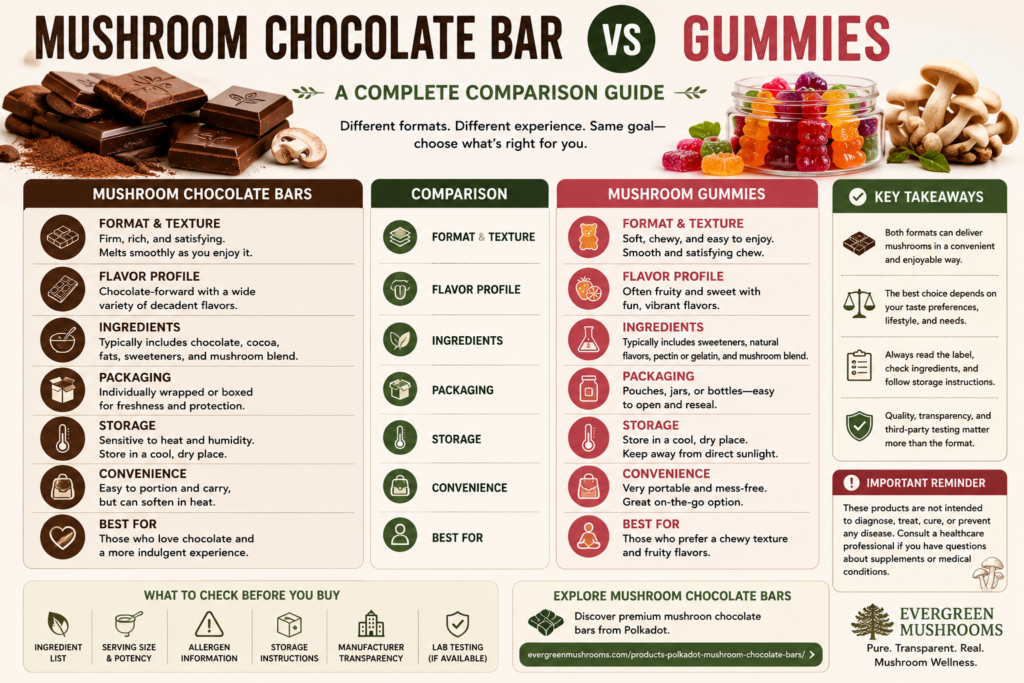
Mushroom Chocolate Bar vs Gummies: Quick Comparison
| Factor | Mushroom Chocolate Bars | Mushroom Gummies |
|---|---|---|
| Format | Chocolate-based bar or pieces | Soft, chewable gummy format |
| Texture | Firm, creamy, smooth, or textured depending on formulation | Soft, chewy, firm, or jelly-like depending on formulation |
| Flavor | Chocolate-centered flavors and other additions | Often fruit-inspired or confectionery-style flavors |
| Ingredients | Chocolate plus the other listed ingredients | Gelling agents, sweeteners, flavors, and other listed ingredients may be present |
| Storage | Can be sensitive to heat and humidity | Storage requirements depend on formulation and packaging |
| Packaging | Wrappers, foil, boxes, or combinations | Bags, jars, pouches, bottles, or other containers |
| Portability | Convenient but may soften in heat | Convenient but still requires appropriate storage |
1. Texture and Eating Experience
One of the most obvious differences in a Mushroom Chocolate Bar vs Gummies comparison is texture.
Chocolate bars typically have a firm structure when stored appropriately. Depending on the formulation, the chocolate can be smooth, creamy, crunchy, or contain additional inclusions.
Gummies have a completely different texture. They are generally soft and chewy, although the exact texture depends on the ingredients and manufacturing process.
Personal preference can therefore play a major role in choosing between the two formats.
Chocolate Texture
- Usually firm when stored appropriately.
- Can become softer in warm conditions.
- May have a smooth or creamy mouthfeel.
- Can include nuts, fruit, fillings, or other inclusions depending on the product.
Gummy Texture
- Generally soft and chewy.
- May range from firm to very soft.
- Usually designed around a chewable texture.
- Texture can vary significantly between manufacturers.
When making a Mushroom Chocolate Bar vs Gummies comparison based on texture, there is no objective winner. The preferred format depends largely on what the individual consumer enjoys.
2. Flavor Differences
Flavor is another major distinction between the two formats.
Chocolate provides a naturally rich flavor base that can work with ingredients such as vanilla, caramel, nuts, fruit, mint, or other flavor combinations.
Gummies commonly use fruit-inspired or confectionery-style flavor profiles, although the exact flavor depends entirely on the individual product.
It is better to examine the actual flavor description and ingredient list than to assume that every chocolate bar or gummy tastes the same.
A person who enjoys chocolate may naturally prefer the chocolate format, while someone who prefers fruity or chewy confectionery flavors may prefer gummies.
3. Ingredient Lists Can Be Very Different
The ingredient list is one of the most important parts of a Mushroom Chocolate Bar vs Gummies comparison.
A chocolate product may contain chocolate or cocoa ingredients, sweeteners, flavorings, fats, nuts, fruit, fillings, or other components.
A gummy may contain sweeteners, gelling agents, flavorings, colors, acids, and other ingredients used to create its texture and flavor.
Some products may also contain mushroom ingredients or other added ingredients.
Because formulations vary, never assume that two products contain equivalent ingredients simply because they are marketed toward a similar audience.
Instead, read the complete product label before making a purchasing decision.
4. Label Reading Matters More Than the Format
A chocolate bar is not automatically better because it is chocolate, and a gummy is not automatically better because it is convenient.
The label provides considerably more useful information than the physical format alone.
When comparing products, look for:
- Complete ingredient information.
- Serving information when applicable.
- Manufacturer or distributor information.
- Allergen information.
- Storage instructions.
- Product warnings.
- Net quantity.
- Relevant supplement labeling when applicable.
The U.S. Food and Drug Administration provides consumer information about dietary supplements, including labeling and the different forms in which these products may be sold. Visit the FDA Questions and Answers on Dietary Supplements for additional information.
FDA also advises consumers to carefully consider the information provided on supplement labels and to discuss supplement use with a healthcare professional when appropriate. This makes label comparison an important part of any Mushroom Chocolate Bar vs Gummies evaluation.
5. Storage Requirements Can Differ
Storage is an important consideration when comparing chocolate bars and gummies.
Chocolate can be sensitive to heat, humidity, sunlight, and temperature fluctuations. A chocolate product exposed to excessive heat may soften, melt, or experience changes in appearance and texture.
Gummies can also be affected by unsuitable temperatures and humidity, depending on their formulation and packaging.
For either format, the manufacturer’s storage instructions should take priority over general advice.
For detailed chocolate storage information, see our Mushroom Chocolate Bar Storage Guide.
You can also read How Long Do Mushroom Chocolate Bars Last for additional information about chocolate shelf life and quality.
In a practical Mushroom Chocolate Bar vs Gummies comparison, storage conditions are therefore an important factor that should not be overlooked.
6. Portability and Convenience
Both formats can be convenient, but they have different practical characteristics.
Chocolate bars are easy to package and transport, but heat can be an important consideration. A bar left in a warm environment can become soft or lose its original shape.
Gummies can also be portable and may be packaged in secure bags, jars, pouches, or other containers.
However, gummies are not immune to environmental conditions. They should still be stored according to their product-specific instructions.
When comparing portability, consider:
- Ambient temperature.
- Packaging strength.
- Exposure to direct sunlight.
- Humidity.
- How long the product will remain outside its normal storage environment.
This means convenience in a Mushroom Chocolate Bar vs Gummies comparison is not determined solely by size or packaging.
7. Packaging and Handling
Packaging protects the product from the surrounding environment and can also provide important information to consumers.
Chocolate bars may use wrappers, foil, boxes, or combinations of these materials.
Gummies may be packaged in jars, pouches, bags, bottles, or other containers.
After opening either product, keeping the package properly closed can help reduce unnecessary exposure to air, moisture, odors, and handling.
Do not throw away the original package immediately because it may contain important information about ingredients, storage, dates, manufacturer details, warnings, and other product information.
Mushroom Chocolate Bar vs Gummies for Different Preferences
| Preference | Potentially More Suitable Format | Reason |
|---|---|---|
| Enjoys chocolate flavor | Chocolate bar | Chocolate provides the primary flavor and texture |
| Prefers chewy textures | Gummy | Gummies are designed around a soft, chewy texture |
| Likes chocolate-style flavors | Chocolate bar | Chocolate pairs naturally with many dessert-style flavors |
| Prefers fruit-style flavors | Gummy | Many gummies use fruit-inspired flavor profiles |
| Concerned about heat | Compare individual storage instructions | Both formats can be affected by unsuitable conditions |
| Focused on ingredients | Compare labels | The formulation matters more than the physical format |
Are Mushroom Chocolate Bars Better Than Gummies?
There is no universal answer.
The word “better” depends on what the individual consumer values.
A person who enjoys chocolate may prefer a mushroom chocolate bar because of its familiar flavor and texture.
Another person may prefer gummies because they enjoy a chewy texture and fruit-style flavors.
Neither preference automatically establishes that one format is superior.
The more useful comparison is based on the actual product, including its ingredients, labeling, storage requirements, quality information, and manufacturer details.
This is an important point in any Mushroom Chocolate Bar vs Gummies comparison: the product itself matters more than the category name.
Are Mushroom Gummies Better Than Chocolate Bars?
The same principle applies in the opposite direction.
Gummies can be attractive to people who prefer soft, chewy products, but the format itself does not guarantee a better formulation.
When comparing gummies with chocolate bars, examine the ingredient list and label instead of relying solely on appearance or marketing language.
The National Center for Complementary and Integrative Health provides consumer guidance about dietary supplements and notes that products can vary considerably. Its consumer information about dietary supplements is a useful reference when evaluating product claims and labeling.
Consumers should therefore evaluate the specific product rather than assuming that one format is inherently safer or better than another.
Chocolate Bars vs Gummies: Which Is Easier to Store?
Neither format should automatically be considered easier to store.
Chocolate has well-known sensitivity to heat and can develop texture or appearance changes when exposed to unsuitable temperatures.
Gummies have their own storage requirements that depend on their formulation and packaging.
The best approach is to compare the manufacturer’s storage instructions for the exact products being considered.
If you are storing chocolate specifically, read our Mushroom Chocolate Bar Storage Guide.
The storage question is therefore another important part of the Mushroom Chocolate Bar vs Gummies decision.
Chocolate Bars vs Gummies: Which Is More Convenient?
Convenience depends on the situation.
A chocolate bar can be easy to carry in its original packaging, but warm conditions may make transportation more difficult.
Gummies can also be convenient to carry, especially when packaged in a secure container.
For either format, packaging and storage conditions matter more than the product category alone.
Someone who frequently travels through warm environments may place more importance on storage requirements, while someone primarily choosing based on taste may care more about texture and flavor.
What About Ingredients and Allergens?
Ingredient awareness is particularly important when comparing different product formats.
Chocolate products may contain ingredients such as milk, soy, nuts, or other common allergens depending on their formulation.
Gummies may contain ingredients such as gelatin or other gelling agents, as well as flavorings, colorings, acids, and sweeteners.
Consumers with allergies or dietary restrictions should read the complete ingredient and allergen information before choosing a product.
Never assume that a product is vegan, vegetarian, dairy-free, gluten-free, nut-free, or allergen-free simply because it is a gummy or chocolate bar. Those characteristics depend on the individual formulation.
How to Compare Two Mushroom Products Properly
If you are deciding between a chocolate bar and a gummy, use a consistent comparison process.
- Read the complete ingredient list.
- Check serving and package information when applicable.
- Review storage instructions.
- Look for allergen information.
- Review manufacturer information.
- Check relevant warnings and directions.
- Compare packaging and product condition.
- Consider your preferred texture and flavor.
This approach is more useful than choosing based only on the physical format.
A thoughtful Mushroom Chocolate Bar vs Gummies comparison should focus on the actual characteristics of the products being considered.
Mushroom Chocolate Bar vs Gummies: Ingredient Comparison
| Category | Chocolate Bar | Gummy |
|---|---|---|
| Primary base | Chocolate or cocoa-based formulation | Gummy confectionery-style base |
| Sweeteners | Depends on formulation | Depends on formulation |
| Flavoring | Chocolate and additional flavors may be used | Fruit and other flavors may be used |
| Texture ingredients | Depends on chocolate formulation | Gelling and texturizing ingredients may be used |
| Additional ingredients | May include nuts, fruit, fillings, or other ingredients | May include acids, colors, flavors, or other ingredients |
| Mushroom ingredient | Depends on individual product | Depends on individual product |
Does the Format Tell You What Is Inside?
No.
The physical format is not a substitute for reading the label.
Two mushroom chocolate products can have substantially different ingredient lists. Two mushroom gummies can also differ significantly from one another.
This is why the exact product label matters when comparing products.
FDA explains that dietary supplement labels contain information about dietary ingredients and other ingredients when a product meets the applicable definition of a dietary supplement.
For consumers, this means the label is a more reliable starting point than assuming that every product in the same category contains the same ingredients.
Important Safety Considerations
Consumers should consider more than taste and convenience when comparing products that contain additional ingredients.
NCCIH explains that dietary supplements can interact with medications and may present risks for some people. Consumers can review its supplement safety information for additional guidance.
This is particularly important for people who take prescription or over-the-counter medications, have health conditions, are pregnant or breastfeeding, or have questions about a specific ingredient.
Consumers should avoid assuming that a product is safe simply because it is marketed as natural or because it comes in a familiar food format.
Read the label carefully and seek professional advice when you have questions about ingredients, medications, individual health circumstances, or potential interactions.
Pros and Cons of Mushroom Chocolate Bars
| Potential Advantages | Potential Considerations |
|---|---|
| Familiar chocolate format | Can be sensitive to heat |
| Wide range of chocolate flavors | Ingredient lists can vary |
| Easy to package | May soften or melt in warm conditions |
| Appealing to chocolate lovers | Some formulations may contain common allergens |
Pros and Cons of Mushroom Gummies
| Potential Advantages | Potential Considerations |
|---|---|
| Soft and chewy format | Ingredient lists can vary |
| Often available in fruit-style flavors | Storage requirements vary |
| Convenient packaging | May contain sweeteners, colors, or gelling ingredients |
| Easy to carry | Specific product labeling should be reviewed |
How Storage Affects Both Formats
Both chocolate bars and gummies benefit from appropriate storage.
For chocolate, heat and humidity are particularly important considerations.
For gummies, the exact storage requirements depend on their ingredients, packaging, and manufacturer instructions.
For either format, avoid unnecessary exposure to extreme temperatures, direct sunlight, moisture, and damaged packaging.
If storage is one of your main concerns in a Mushroom Chocolate Bar vs Gummies comparison, compare the instructions printed on the exact products rather than relying on a general assumption about the category.
What Should You Look For on the Label?
When comparing a mushroom chocolate bar with a gummy, create a simple checklist.
- Product name.
- Complete ingredient list.
- Serving information when applicable.
- Net quantity.
- Manufacturer or distributor details.
- Allergen information.
- Storage instructions.
- Warnings.
- Relevant supplement labeling.
- Date information where provided.
FDA’s consumer guidance explains that dietary supplement labels contain specific information about ingredients, serving size, quantity, and other required details.
Taking the time to compare labels can make a Mushroom Chocolate Bar vs Gummies decision much more informed.
Quality and Transparency
Quality should not be judged solely by packaging, advertising, or the format of the product.
Look for clear product information and transparent labeling.
Useful information may include:
- Complete ingredient information.
- Clear manufacturer details.
- Storage instructions.
- Allergen information.
- Appropriate warnings.
- Clear product identity.
- Relevant testing information when provided.
Consumers should be cautious about products that make unusually broad health claims or provide little information about what is actually inside the package.
FDA notes that dietary supplements are not approved by FDA for safety and effectiveness before they are marketed in the same way that drugs are approved. This is another reason careful label reading and informed purchasing are important.
Mushroom Chocolate Bar vs Gummies: Which Should You Choose?
The answer depends on your priorities.
Choose a Chocolate Format If You Prefer:
- Chocolate flavor.
- Firm or creamy textures.
- Dessert-style flavor combinations.
- The familiar experience of eating chocolate.
Consider a Gummy Format If You Prefer:
- Soft and chewy textures.
- Fruit-inspired flavors.
- Confectionery-style products.
- A format that does not rely on chocolate as its primary base.
These are preference-based differences rather than claims that one format is inherently better.
Related Mushroom Chocolate Resources
Continue exploring the Evergreen Mushrooms educational resources:
- Mushroom Chocolate Bar Guide
- Mushroom Chocolate Bar Storage Guide
- How Long Do Mushroom Chocolate Bars Last
Readers specifically researching Polkadot products can also visit the Polkadot Mushroom Chocolate Bars collection.
Frequently Asked Questions About Mushroom Chocolate Bar vs Gummies
What is the main difference between mushroom chocolate bars and gummies?
The main difference is the physical format. Chocolate bars use a chocolate-based format, while gummies use a soft and chewy format. The ingredients and characteristics of individual products can vary considerably.
Are mushroom chocolate bars better than gummies?
There is no universal answer. The better option depends on personal preferences, ingredients, labeling, storage requirements, and the characteristics of the specific products being compared.
Are mushroom gummies better than chocolate bars?
Not automatically. Gummies may appeal to people who prefer soft, chewy textures, while chocolate bars may appeal to people who prefer chocolate flavors. The individual product label is more useful than the format alone.
Do mushroom chocolate bars and gummies have the same ingredients?
No. Their formulations can be very different. Chocolate bars may contain cocoa or chocolate ingredients, while gummies may contain gelling agents and different sweeteners or flavorings. Always check the exact ingredient list.
Which has better flavor, chocolate bars or gummies?
Flavor preference is subjective. Chocolate bars generally emphasize chocolate-based flavors, while gummies often use fruit or confectionery-style flavors. The specific formulation determines the actual taste.
Which is easier to store?
Neither format is automatically easier to store. Chocolate can be particularly sensitive to heat, while gummies also have product-specific storage requirements. Follow the manufacturer’s instructions for either format.
Can mushroom chocolate bars melt?
Yes. Chocolate can soften or melt when exposed to excessive heat. Proper storage can help protect its intended texture and appearance.
Can mushroom gummies be affected by heat?
Yes. Gummies can also experience texture or quality changes when exposed to unsuitable environmental conditions. The product label should provide the most appropriate storage guidance.
Should I compare the ingredients before choosing?
Yes. Comparing the complete ingredient list, allergen information, serving information where applicable, storage instructions, and manufacturer details can provide much more useful information than comparing the formats alone.
Are mushroom chocolate bars and gummies equally safe?
Safety depends on the specific ingredients, formulation, labeling, and individual circumstances rather than simply whether the product is a bar or gummy. Consumers should review product information carefully and seek professional advice when appropriate.
Does a natural mushroom product automatically mean it is safe?
No. The term “natural” does not automatically establish that a product is safe or appropriate for every person. Consider the complete ingredient list, product information, and your individual circumstances.
What should I check before buying a mushroom chocolate bar or gummy?
Check the complete ingredient list, manufacturer information, allergen information, storage instructions, serving information when applicable, warnings, and any other labeling provided with the product.
Final Verdict: Mushroom Chocolate Bar vs Gummies
The Mushroom Chocolate Bar vs Gummies comparison does not produce one universal winner.
Chocolate bars can appeal to people who prefer chocolate flavors and firmer textures. Gummies may appeal to people who prefer soft, chewy products and fruit-style flavors.
However, the physical format is only one part of the decision.
The more important comparison is between the individual products. Check the ingredient list, labeling, storage instructions, manufacturer information, allergen information, and applicable warnings before making a choice.
Storage is another important consideration. Chocolate can be particularly sensitive to excessive heat and humidity, while gummies also have product-specific storage requirements.
For chocolate-specific storage information, read our Mushroom Chocolate Bar Storage Guide.
If you want broader educational information about chocolate products, return to the Mushroom Chocolate Bar Guide.
Readers interested in Polkadot products can explore the Polkadot Mushroom Chocolate Bars collection.
Ultimately, the best choice is the product whose ingredients, labeling, storage requirements, and format match your individual preferences and circumstances.
A careful Mushroom Chocolate Bar vs Gummies comparison should therefore focus on the actual product rather than assuming that either format is automatically superior.
