
Uncategorized
Benefits of Adaptogenic Mushrooms
Aug
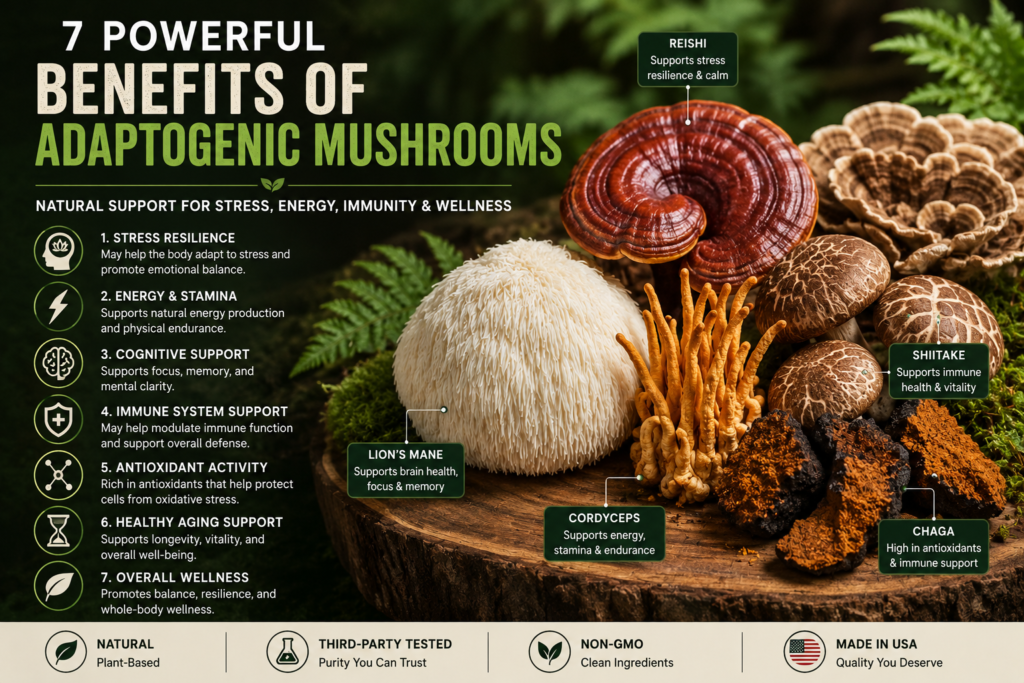
7 Powerful Benefits of Adaptogenic Mushrooms: Complete Guide
The Benefits of Adaptogenic Mushrooms have attracted growing interest among people looking for natural approaches to everyday wellness, stress management, energy, and healthy aging. Mushrooms such as Reishi, Cordyceps, and Lion’s Mane are frequently discussed in the functional mushroom space because researchers have investigated their bioactive compounds and potential effects on different biological systems.
However, the term “adaptogenic mushroom” should be used carefully. Adaptogens are generally described as substances that may help the body adapt to physical or psychological stress, but the scientific definition and evidence for adaptogenic activity remain subjects of research. Not every mushroom supplement should automatically be considered an adaptogen.
Understanding the Benefits of Adaptogenic Mushrooms therefore requires looking at both traditional use and modern scientific evidence. Research involving medicinal mushrooms includes laboratory studies, animal research, observational research, and human clinical trials. The strength of evidence varies considerably depending on the mushroom, preparation, dosage, and outcome being studied.
This guide examines seven commonly discussed areas of interest, explains how adaptogenic mushrooms differ from other functional mushrooms, discusses popular varieties, and provides practical information about choosing and using mushroom supplements responsibly.
Important: This article is educational and does not diagnose, treat, or cure medical conditions. Dietary supplements should not replace professional medical care or prescribed medication.
Benefits of Adaptogenic Mushrooms: What Does Adaptogenic Mean?
The Benefits of Adaptogenic Mushrooms are usually discussed in connection with the body’s response to everyday physical and psychological stress.
Shop Magic Mushroom GummiesThe term “adaptogen” traditionally refers to substances believed to help organisms adapt to stress and maintain physiological balance. Scientific reviews describe adaptogens as having potentially broad effects involving stress-response systems rather than acting through only one biological pathway.
However, research also points out that the concept of adaptogens has limitations. Human studies are still relatively limited for many substances, and different products can have substantially different compositions.
When discussing the Benefits of Adaptogenic Mushrooms, it is therefore better to describe the research as promising or developing rather than suggesting that mushroom supplements provide guaranteed stress protection.
Some mushrooms commonly marketed as adaptogenic include Reishi and Cordyceps. Lion’s Mane is usually categorized as a functional mushroom rather than a classic adaptogen, although it is often included in broader mushroom wellness formulas.
What Is an Adaptogen?
An adaptogen is generally described as a substance that may help an organism respond to stress and maintain balance during challenging conditions.
Research into adaptogens has traditionally focused on plant-based substances. A scientific review published in PubMed describes adaptogens as herbal medicinal and nutritional products associated with adaptability and resilience during stress.
Another critical review noted that although laboratory and animal research has identified numerous potential mechanisms, accurately determining adaptogenic efficacy in humans remains challenging.
This is important when considering the Benefits of Adaptogenic Mushrooms. A mushroom may have compounds that interact with stress-related pathways without there being enough human evidence to establish a specific health outcome.
Adaptogenic research is therefore best understood as an evolving field rather than a collection of guaranteed benefits.
Which Mushrooms Are Commonly Called Adaptogenic?
Several mushrooms are commonly described as adaptogenic or adaptogen-like in the functional mushroom industry.
Reishi
Reishi, scientifically known as Ganoderma lucidum, is one of the mushrooms most frequently associated with traditional wellness practices and modern functional mushroom products.
Researchers have investigated Reishi in areas including immune function, antioxidant activity, inflammation, and psychological stress.
Cordyceps
Cordyceps species, including Cordyceps militaris, have been investigated for their relationship with physical performance, energy metabolism, and other biological processes.
Lion’s Mane
Lion’s Mane, or Hericium erinaceus, is generally discussed as a functional mushroom rather than a classic adaptogen. Research has focused heavily on cognitive function, mood, nervous-system biology, and other areas.
Therefore, not every functional mushroom is technically an adaptogen, even though several may appear together in mushroom wellness products.
This distinction helps make discussions about the Benefits of Adaptogenic Mushrooms more accurate.
1. Stress Resilience Research
Stress resilience is one of the main reasons people research the Benefits of Adaptogenic Mushrooms.
Adaptogenic research generally focuses on how certain substances may influence the body’s response to physical or psychological stress.
Some mushroom research has explored stress-related outcomes, particularly with Reishi and Lion’s Mane.
For example, a small randomized controlled study involving Lion’s Mane investigated cognitive function, stress, and mood in healthy young adults. Researchers observed faster performance on one cognitive task after an acute dose and a trend toward reduced subjective stress after 28 days, although the study was small and the researchers emphasized the need for larger trials.
Research involving Reishi has also examined psychological stress and physical fitness measures in specific populations.
These findings are interesting, but they do not prove that all adaptogenic mushroom products reduce stress.
The Benefits of Adaptogenic Mushrooms in this area should therefore be considered potential research findings rather than guaranteed effects.
2. Energy and Physical Performance
Energy and physical performance are another reason consumers explore the Benefits of Adaptogenic Mushrooms.
Cordyceps has received particular attention in sports and exercise research.
A 2025 systematic review and meta-analysis of fungal supplementation in adult athletes examined randomized controlled trials involving mushrooms including Cordyceps and Lion’s Mane.
The researchers reported that Cordyceps supplementation was associated with improvements in several endurance-related outcomes, including endurance performance, ventilatory threshold, and VO2peak in the analyzed studies.
However, these findings do not mean that every Cordyceps product will improve athletic performance.
Differences in mushroom species, preparation, amount, study duration, participant characteristics, and exercise protocol can all influence results.
Consumers interested in the Benefits of Adaptogenic Mushrooms for exercise should therefore look at the actual research preparation and avoid assuming that all commercial supplements are equivalent.
3. Cognitive and Mental Performance
Cognitive wellness is another major area of interest when examining the Benefits of Adaptogenic Mushrooms.
Among functional mushrooms, Lion’s Mane has received particularly strong research attention in this area.
A 2025 systematic review of Hericium erinaceus included randomized controlled trials, pilot clinical trials, observational research, and laboratory studies. The review reported promising findings involving cognitive outcomes but also emphasized limitations in the available evidence.
A separate review examining mushrooms and mood or neurocognitive health analyzed 34 human studies. Intervention results were mixed, although several studies involving Lion’s Mane reported potential improvements in mood or cognitive outcomes.
These findings make cognitive wellness an interesting research area, but they should not be interpreted as proof that a mushroom supplement can prevent dementia, treat a neurological disorder, or guarantee improved concentration.
For more information about Lion’s Mane specifically, read our Benefits of Lion’s Mane Gummies guide.
The broader Benefits of Adaptogenic Mushrooms discussion should distinguish between mushrooms with established research interests and mushrooms that are specifically classified as adaptogens.
4. Immune-System Research
Immune-related research is another reason functional mushrooms attract attention.
Mushrooms contain a variety of compounds, including polysaccharides, that researchers have investigated for potential interactions with immune pathways.
Reishi has been particularly studied in this area, while other edible fungi have also been examined for immune-related biological activity.
However, immune-system research does not mean that a mushroom supplement prevents infections or replaces vaccination, medical treatment, or other evidence-based healthcare.
The Benefits of Adaptogenic Mushrooms in immune research should therefore be described cautiously.
Laboratory findings can help scientists identify mechanisms for further investigation, but human clinical evidence is needed before specific health claims can be established.
5. Antioxidant Research
Antioxidant activity is frequently discussed among the potential Benefits of Adaptogenic Mushrooms.
Many edible mushrooms contain compounds that have demonstrated antioxidant activity in laboratory research.
Antioxidants are relevant because oxidative processes are a normal part of biology. Researchers investigate whether compounds can influence pathways associated with oxidative stress and cellular protection.
However, laboratory antioxidant activity does not automatically translate into a measurable clinical benefit in humans.
A supplement should therefore not be marketed as a guaranteed treatment for oxidative stress or disease simply because a mushroom extract demonstrates antioxidant activity in a laboratory.
Instead, antioxidant mechanisms should be considered one area of ongoing mushroom research.
6. Healthy Aging Research
Healthy aging is another area connected to the Benefits of Adaptogenic Mushrooms.
Researchers have investigated mushrooms for potential antioxidant, inflammatory, neurological, metabolic, and immune-related mechanisms that could be relevant to healthy aging.
Reishi, Lion’s Mane, and Cordyceps have all been studied in different contexts, although the quality and amount of evidence varies significantly between mushrooms and outcomes.
For example, clinical research involving Reishi has examined several health-related outcomes, while research into Lion’s Mane has focused strongly on cognitive and neurological areas.
These studies provide reasons for continued research but do not establish that mushroom supplements extend lifespan or prevent age-related diseases.
A healthy aging strategy should also include nutritious food, physical activity, adequate sleep, social connection, routine medical care, and management of established health risks.
7. Overall Wellness and Adaptation
The seventh area commonly discussed in relation to the Benefits of Adaptogenic Mushrooms is general wellness.
The underlying concept of adaptogens is connected to the body’s ability to respond to changing physical and psychological demands.
People may therefore include functional mushroom products as part of broader routines involving exercise, nutrition, sleep, stress management, and daily wellness.
However, a general wellness benefit is difficult to measure and should not be confused with treatment of a specific disease.
The most reasonable way to view adaptogenic mushroom products is as one possible component of a broader lifestyle rather than a single solution for health or performance.
This approach also makes it easier to evaluate the Benefits of Adaptogenic Mushrooms without relying on exaggerated claims.
Reishi and Adaptogenic Research
Reishi is one of the mushrooms most commonly associated with adaptogenic products.
Its scientific name is Ganoderma lucidum, although taxonomy and commercial naming can vary depending on the species and preparation.
Researchers have investigated Reishi in areas including immune function, inflammation, antioxidant activity, psychological stress, and other health outcomes.
A 2025 systematic review and meta-analysis of clinical trials involving Ganoderma lucidum analyzed 17 randomized controlled trials involving 971 participants.
The researchers found significant effects for some measured outcomes but did not find significant effects across every health measure examined.
This is an important reminder that the Benefits of Adaptogenic Mushrooms are not universal or guaranteed across every outcome.
Reishi should be evaluated according to the specific preparation, serving amount, study population, and outcome being discussed.
Cordyceps and Adaptogenic Research
Cordyceps is another mushroom frequently included in discussions about adaptogenic products.
Research has investigated Cordyceps in relation to energy metabolism, endurance, oxygen utilization, immune pathways, and other biological functions.
The 2025 systematic review of fungal supplementation in athletes found evidence that Cordyceps supplementation improved several endurance-related measures in the analyzed studies.
These findings are encouraging but should still be interpreted in context.
A study involving a specific Cordyceps species or extract does not necessarily establish that another commercial product will produce the same result.
When researching the Benefits of Adaptogenic Mushrooms, consumers should therefore check the species and preparation rather than treating “Cordyceps” as a single standardized product.
Lion’s Mane and Functional Mushroom Research
Lion’s Mane is often included in mushroom wellness formulas, although it is more accurately described as a functional mushroom rather than automatically labeling it a classic adaptogen.
Its scientific name is Hericium erinaceus.
Research has focused heavily on cognitive function, mood, nervous-system biology, antioxidant mechanisms, and gut-related pathways.
A 2025 systematic review included five randomized controlled trials and three pilot clinical trials involving Lion’s Mane research, alongside laboratory and other studies.
The results were promising in some areas but also demonstrated the need for additional high-quality human research.
Consumers interested in Lion’s Mane can read our dedicated Benefits of Lion’s Mane Gummies article.
Understanding this distinction helps prevent the term adaptogenic from being applied too broadly to every functional mushroom.
What Does the Research Say?
The scientific evidence surrounding the Benefits of Adaptogenic Mushrooms is developing and varies considerably by mushroom.
One major challenge is that “adaptogenic mushroom” is not a standardized scientific category containing identical compounds or effects.
Different mushrooms contain different bioactive compounds and may influence different biological pathways.
| Mushroom | Common Research Areas | Evidence Consideration |
|---|---|---|
| Reishi | Immune, antioxidant, inflammation, stress, general health | Human evidence exists but varies by outcome. |
| Cordyceps | Endurance, energy metabolism, exercise performance | Some human research is promising. |
| Lion’s Mane | Cognition, mood, nervous system, gut research | Human evidence is developing. |
Another issue is product standardization.
A study may use a defined extract, while a commercial gummy may contain mushroom powder or a different extract. The amount of active compounds may also vary.
For this reason, the Benefits of Adaptogenic Mushrooms should always be discussed alongside the specific mushroom, preparation, and evidence available for that preparation.
Adaptogenic Mushroom Gummies
Gummies are becoming a popular way to consume functional mushroom ingredients.
One practical advantage is convenience. A gummy can provide a measured serving without requiring a powder to be mixed into a beverage.
However, consumers should remember that the gummy format itself does not establish effectiveness.
The potential Benefits of Adaptogenic Mushrooms depend more on the actual mushroom preparation and formulation than on whether the product comes in a gummy, capsule, powder, or another form.
Gummies may also contain sweeteners, flavors, pectin, gelatin, acids, colors, or other ingredients that consumers may want to review before use.
For more information about functional mushroom gummies, visit our Functional Mushroom Gummies guide.
Common Ingredients in Adaptogenic Mushroom Products
Adaptogenic mushroom products can contain one mushroom or a combination of several functional mushrooms.
Common ingredients may include:
- Reishi mushroom.
- Cordyceps mushroom.
- Lion’s Mane mushroom.
- Chaga mushroom.
- Maitake mushroom.
- Shiitake mushroom.
- Mushroom fruiting-body powder.
- Mushroom extracts.
- Botanical ingredients.
- Vitamins and minerals.
- Natural flavors.
- Sweeteners.
Not every combination is necessarily appropriate for every person.
Consumers should examine the complete label before using a multi-ingredient mushroom supplement.
The Benefits of Adaptogenic Mushrooms should be evaluated based on the actual formula rather than the marketing category alone.
How to Evaluate Quality
Quality and transparency are important when choosing functional mushroom products.
Look for clear information about:
- Mushroom species.
- Scientific names where available.
- Fruiting body or mycelial preparation.
- Powder or extract format.
- Amount per serving.
- Serving size.
- Complete ingredient list.
- Manufacturer information.
- Storage instructions.
- Best-by or expiration information.
- Testing information when available.
Be cautious about products that make extraordinary medical claims.
A product claiming to “cure” multiple unrelated diseases should receive additional scrutiny, particularly when the claims are not supported by high-quality human research.
When evaluating the Benefits of Adaptogenic Mushrooms, transparency is more useful than aggressive marketing language.
Safety and Possible Side Effects
Safety is an important part of understanding the Benefits of Adaptogenic Mushrooms.
Mushroom supplements can be tolerated by many people, but individual reactions can vary.
Possible concerns can include:
- Digestive discomfort.
- Allergic reactions.
- Interactions with medications.
- Sensitivity to other ingredients in a formula.
- Potential differences between concentrated extracts and whole mushroom powders.
People should not assume that a product is automatically safe simply because its ingredients are natural.
Anyone experiencing unusual or significant symptoms after using a supplement should stop using it and seek appropriate professional advice.
For broader information about functional mushroom products, see our Functional Mushroom Gummies Side Effects guide.
The Benefits of Adaptogenic Mushrooms should always be considered alongside potential risks and individual circumstances.
Mushroom Supplements and Medications
People who take prescription or over-the-counter medication should consider possible supplement interactions.
Dietary supplements can affect or be affected by medications, and the evidence available for specific mushroom combinations may be limited.
Before starting a mushroom supplement, discuss the product with a doctor or pharmacist when appropriate.
Before Surgery
Tell your healthcare team about supplements you use before surgery. Some supplements may affect bleeding, blood pressure, or the response to anesthesia.
Pregnancy and Breastfeeding
Many supplements have not been adequately studied in pregnant or breastfeeding populations. Professional guidance is appropriate before use.
Children
Do not assume that an adult mushroom supplement is appropriate for children. Discuss supplement use with an appropriate healthcare professional.
How to Choose Adaptogenic Mushroom Products
A simple checklist can make it easier to evaluate products and understand the potential Benefits of Adaptogenic Mushrooms.
| Factor | What to Check |
|---|---|
| Mushroom species | Identify exactly which mushroom is included. |
| Preparation | Check whether the product uses powder, extract, fruiting body, mycelium, or a combination. |
| Amount | Check the amount per serving. |
| Ingredients | Review the complete ingredient list. |
| Directions | Follow the manufacturer’s serving instructions. |
| Testing | Look for relevant quality or testing information when available. |
| Claims | Be cautious of guaranteed medical claims. |
Comparing products this way can help consumers focus on measurable product information instead of relying exclusively on the phrase “adaptogenic.”
That makes the discussion of the Benefits of Adaptogenic Mushrooms more practical and evidence-conscious.
Frequently Asked Questions
What are the Benefits of Adaptogenic Mushrooms?
The potential benefits discussed in research include stress-related responses, physical performance, cognitive wellness, immune-related pathways, antioxidant activity, and healthy aging. Evidence varies considerably by mushroom and outcome.
What is an adaptogenic mushroom?
The term generally refers to mushrooms marketed or discussed as supporting the body’s ability to adapt to stress. However, not every functional mushroom is technically classified as an adaptogen, and the scientific definition remains an evolving area of research.
Which mushrooms are considered adaptogenic?
Reishi and Cordyceps are commonly described as adaptogenic or adaptogen-like mushrooms. Lion’s Mane is more commonly classified as a functional mushroom, although it may appear in broader mushroom wellness formulas.
Can adaptogenic mushrooms reduce stress?
Some mushroom and adaptogen research has investigated stress-related outcomes, but evidence varies. A supplement should not be presented as a guaranteed treatment for chronic stress, anxiety, or another medical condition.
Can adaptogenic mushrooms increase energy?
Cordyceps has been studied in relation to exercise performance and endurance. Some human research is promising, but results depend on the species, preparation, serving amount, and study population.
Are adaptogenic mushrooms the same as functional mushrooms?
Not necessarily. Functional mushroom is a broad category, while adaptogenic refers to a particular concept involving stress adaptation. Some mushrooms may be discussed in both categories.
Are adaptogenic mushroom gummies effective?
The gummy format does not itself establish effectiveness. The potential effects depend on the mushroom species, preparation, amount, formulation, and available evidence.
Are adaptogenic mushroom supplements safe?
Many people tolerate mushroom supplements, but side effects and interactions are possible. People taking medications, pregnant or breastfeeding, preparing for surgery, or managing a health condition should seek appropriate professional advice.
Can I take several mushrooms together?
Some products combine multiple mushroom species, but combining ingredients does not automatically make a product more effective. Review the complete formulation and consider individual safety factors.
What should I look for in an adaptogenic mushroom product?
Look for clear information about the mushroom species, preparation, serving size, amount per serving, complete ingredients, manufacturer information, and relevant testing information.
Are adaptogenic mushrooms a replacement for medication?
No. Dietary supplements should not be used as replacements for prescribed medication or professional medical care.
Where can I learn more about mushroom gummies?
Start with our Mushroom Gummies Benefits guide for a broader overview of mushroom gummy research and wellness topics.
Conclusion
The potential Benefits of Adaptogenic Mushrooms have made Reishi, Cordyceps, and other functional mushrooms increasingly popular among people interested in everyday wellness.
Research has investigated mushrooms in connection with stress responses, exercise performance, cognition, immune pathways, antioxidant mechanisms, and healthy aging. Some findings are promising, but the quality and amount of evidence vary considerably.
It is also important to remember that not every functional mushroom is technically an adaptogen. The term is used broadly in the supplement industry, while scientific definitions and evidence remain an evolving subject.
The most responsible way to evaluate the Benefits of Adaptogenic Mushrooms is to look at the individual mushroom, its preparation, the amount used, the research available, and the actual ingredients in the product.
Consumers should also consider safety, potential medication interactions, allergies, and individual health circumstances.
For broader information about mushroom supplements, visit our Mushroom Gummies Benefits guide.
If you are specifically interested in Lion’s Mane, continue with our Benefits of Lion’s Mane Gummies guide.
For products and current product-specific information, explore the Evergreen Mushrooms mushroom gummies category.
Scientific evidence continues to develop, so future clinical studies may provide a clearer understanding of how different mushroom species and preparations affect human health and wellness.
