
Uncategorized
Functional Mushroom Gummies vs Capsules
Aug
Functional Mushroom Gummies vs Capsules: 7 Key Differences
Choosing between Functional Mushroom Gummies vs Capsules often comes down to convenience, formulation, serving information, taste, cost, and personal preference. Both formats can deliver mushroom-derived ingredients, but they are designed differently and may suit different types of supplement routines.
When comparing Functional Mushroom Gummies vs Capsules, the most useful approach is to look beyond the format and examine the ingredients, serving size, preparation, additional ingredients, and overall product information.
Neither format is automatically better for everyone. A more useful approach is to compare what each option offers and then examine the specific product label rather than judging a supplement solely by its delivery format.
This guide explains the practical differences between functional mushroom gummies and capsules, including ingredients, convenience, serving sizes, formulation, cost, portability, research, quality, and safety.
Understanding Functional Mushroom Gummies vs Capsules can help consumers make a more informed comparison between two popular supplement formats.
Important: Functional mushroom supplements are dietary supplements and should not be considered medicines or substitutes for professional medical care. Evidence can vary depending on the mushroom species, preparation, formulation, and intended use.
Functional Mushroom Gummies vs Capsules: An Overview
The comparison between Functional Mushroom Gummies vs Capsules is primarily a comparison of delivery formats. Both can contain mushroom-derived ingredients, but the surrounding formulation can be very different.
One important part of Functional Mushroom Gummies vs Capsules is understanding whether the products use mushroom powders, extracts, blends, or other preparations.
Gummies are generally designed to be chewed and may contain sweeteners, flavorings, gelling agents, acids, or other ingredients needed to create their texture and taste.
Capsules generally contain their ingredients inside a capsule shell. Depending on the product, the contents may include mushroom powder, mushroom extract, or a blend.
This means consumers should compare the complete labels rather than assuming that all gummies or all capsules are formulated in the same way.
For a broader introduction to the category, visit the Functional Mushroom Gummies pillar guide.
You can also explore the Shop Magic Mushroom Gummies category.
What Are Functional Mushroom Gummies?
Functional mushroom gummies are chewable dietary supplement products formulated with mushroom-derived ingredients. Depending on the product, the formulation may contain one mushroom species or a combination of several ingredients.
The gummy format is often chosen because it is convenient and does not require water, mixing, or measuring.
Flavor is another major difference. Manufacturers can use flavors and sweeteners to create a more approachable alternative to products that have a strong earthy taste.
However, the presence of a mushroom ingredient does not automatically tell you how much of that ingredient is supplied or what preparation is used.
Consumers should therefore read the supplement facts panel and ingredient list carefully.
When evaluating Functional Mushroom Gummies vs Capsules, the gummy format should be considered alongside the actual formulation rather than treated as an indicator of quality by itself.
What Are Mushroom Capsules?
Mushroom capsules are another common supplement format. The mushroom material is placed inside a capsule that is swallowed rather than chewed.
Capsules may contain mushroom powder, extract, or a combination of ingredients depending on the formulation.
One potential advantage is that capsules generally do not require flavoring to make the mushroom ingredient more palatable because the contents are enclosed inside the capsule shell.
For consumers who prefer a simple, flavor-free supplement format, capsules may therefore be appealing.
On the other hand, people who have difficulty swallowing capsules may find gummies easier to use.
These differences are important when considering Functional Mushroom Gummies vs Capsules because the preferred format can depend heavily on personal habits and preferences.
Ingredient Differences
One of the most important considerations when comparing Functional Mushroom Gummies vs Capsules is the actual ingredient list.
Look for:
- The mushroom species.
- The form of the mushroom ingredient.
- The amount per serving where provided.
- Other active ingredients.
- Sweeteners and flavoring ingredients.
- Capsule materials or gummy-forming ingredients.
Mushroom Species
A product may contain Lion’s Mane, Reishi, Cordyceps, Chaga, Turkey Tail, or other mushroom ingredients. A blend may contain several species.
Powder or Extract
The label may identify the ingredient as mushroom powder, extract, or another preparation. These should not automatically be treated as interchangeable.
Additional Ingredients
Gummies may require more ingredients to achieve their flavor and texture, while capsules can often use a comparatively simple surrounding formulation.
However, capsules can also contain additional ingredients, so consumers should review the complete label rather than assuming one format is always simpler.
For more information about reading labels, see our Functional Mushroom Gummies Ingredients guide.
Ingredient transparency is one of the most useful criteria when comparing Functional Mushroom Gummies vs Capsules.
Serving Size and Label Information
Serving size is an important part of any comparison between Functional Mushroom Gummies vs Capsules.
A container with 60 gummies does not necessarily provide 60 servings. The same principle applies to capsules.
One product could define a serving as one gummy, while another could define a serving as two gummies. Similarly, capsule products may recommend multiple capsules per serving.
| Label Factor | What to Check |
|---|---|
| Serving size | How many gummies or capsules constitute one labeled serving? |
| Servings per container | How many labeled servings are supplied? |
| Mushroom ingredient | Which species or species are included? |
| Amount per serving | Is the amount clearly stated? |
| Other ingredients | What else is included in the formulation? |
Comparing these details gives consumers a better basis for evaluating products than package size alone.
Serving information can make the comparison between Functional Mushroom Gummies vs Capsules much more meaningful because different products can use different serving sizes.
Convenience and Portability
Convenience is one of the biggest reasons consumers compare Functional Mushroom Gummies vs Capsules.
Convenience is another major consideration for people who want a simple supplement routine.
Gummies
Gummies can be convenient because they are ready to consume. They generally do not require water or preparation and can be easy to incorporate into a routine.
Capsules
Capsules are also portable and convenient, but they generally need to be swallowed with a suitable liquid.
For someone who travels frequently, either format may be practical. The better option depends largely on personal preference.
People who dislike swallowing capsules may favor gummies, while people who prefer a flavor-free format may favor capsules.
Convenience is therefore a personal consideration when evaluating Functional Mushroom Gummies vs Capsules, rather than proof that one format is inherently superior.
Taste and Texture
Taste can make a meaningful difference in a person’s supplement routine.
Some mushroom powders have an earthy or distinctive flavor. Gummies can use flavoring ingredients to create a more familiar taste.
Capsules largely separate the consumer from the flavor of the contents because the mushroom material is enclosed.
| Feature | Gummies | Capsules |
|---|---|---|
| Taste | Usually flavored. | Usually little or no mushroom taste. |
| Texture | Chewable. | Swallowed whole. |
| Preparation | Generally ready to consume. | Generally ready to swallow. |
This is ultimately a personal preference rather than a measure of effectiveness.
Someone who dislikes swallowing pills may prefer gummies, while someone who prefers not to consume flavored supplements may favor capsules.
Additional Ingredients
The surrounding formulation is another useful distinction when evaluating Functional Mushroom Gummies vs Capsules.
Gummies need structural and flavor components to create their characteristic texture and taste. Depending on the product, these may include sweeteners, flavors, pectin, gelatin, acids, or other ingredients.
Capsules can also contain additional ingredients, including capsule materials and excipients used during manufacturing.
Therefore, it is not accurate to assume that capsules always contain only mushrooms or that gummies always contain unnecessary ingredients.
The best approach is to read the complete ingredient list for the specific product.
This is particularly important when comparing Functional Mushroom Gummies vs Capsules for dietary preferences, allergies, or ingredient restrictions.
Cost and Value
Price is another factor when comparing Functional Mushroom Gummies vs Capsules.
A simple package-price comparison may not tell the whole story.
Consider:
- Price per container.
- Number of servings.
- Serving size.
- Mushroom ingredients.
- Preparation type.
- Additional ingredients.
For example, two products can have the same retail price but contain different numbers of servings. Conversely, a more expensive product may contain a different formulation or preparation.
Cost per labeled serving is therefore generally more useful than package price alone.
Consumers comparing Functional Mushroom Gummies vs Capsules should also consider whether the convenience and preferred format justify any price difference.
What About the Research?
Research should be interpreted carefully when comparing supplement formats.
The National Center for Complementary and Integrative Health provides educational information about dietary and herbal supplements and emphasizes the importance of considering evidence and safety.
A study involving a mushroom extract does not automatically establish that every gummy or capsule containing that mushroom will have the same properties.
The preparation, amount, duration, population, and study design all matter.
Why Format Alone Does Not Determine Results
A gummy and capsule could theoretically contain similar mushroom ingredients while differing in serving size, preparation, additional ingredients, and manufacturing process.
Consequently, the delivery format alone should not be treated as proof that one option is superior.
Consumers interested in supplements can also consult the U.S. Food and Drug Administration’s dietary supplement resources for general information about dietary supplements.
This is an important distinction when evaluating Functional Mushroom Gummies vs Capsules: research should be connected to the specific ingredient and preparation rather than the delivery format alone.
Gummies vs Capsules Comparison Table
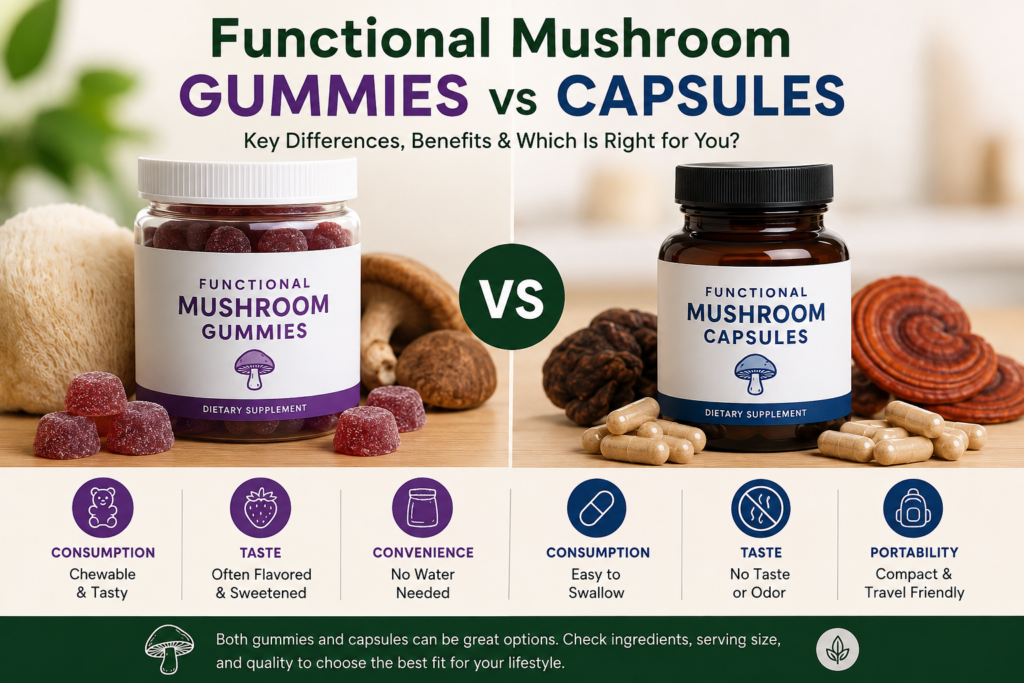
A side-by-side look at Functional Mushroom Gummies vs Capsules can make differences in consumption, taste, portability, ingredients, and serving information easier to understand.
| Category | Functional Mushroom Gummies | Mushroom Capsules |
|---|---|---|
| Consumption | Chewed. | Swallowed. |
| Flavor | Often flavored. | Generally flavor-free. |
| Preparation | Usually ready to consume. | Usually ready to swallow. |
| Portability | Highly portable. | Highly portable. |
| Additional ingredients | May include sweeteners, flavors, and texture agents. | May include capsule materials and excipients. |
| Serving comparison | Check gummies per serving. | Check capsules per serving. |
| Best suited to | People who prefer chewable, flavored supplements. | People who prefer capsules and little or no taste. |
How to Compare Product Quality
Whether you choose gummies or capsules, product quality should be evaluated using the information available on the label and from the manufacturer.
Check the Mushroom Species
Identify exactly which mushrooms are included.
Check the Serving Information
Understand how many gummies or capsules constitute a serving.
Review the Complete Ingredient List
Look beyond the headline ingredient and review the entire formulation.
Look for Clear Product Information
Useful information about ingredients, serving instructions, storage, and manufacturer details makes comparison easier.
Avoid Relying Only on Marketing Claims
Marketing language should not replace careful examination of the product information and available evidence.
These principles can help consumers make a more informed decision when comparing Functional Mushroom Gummies vs Capsules.
Our Best Functional Mushroom Gummies guide provides additional criteria for evaluating gummy products.
Safety Considerations
Both gummies and capsules are dietary supplement formats, so the relevant safety considerations depend largely on the ingredients rather than the physical shape of the product.
People who take medications, have medical conditions, have known allergies, are pregnant, or are breastfeeding should speak with a qualified healthcare professional before starting a new supplement.
Consumers should also follow the product’s labeled serving instructions and storage recommendations.
The NCCIH guidance on using dietary supplements wisely provides additional information for consumers evaluating supplements.
Safety should be considered alongside ingredients, serving information, convenience, and cost when comparing Functional Mushroom Gummies vs Capsules.
For more information about potential concerns, read our Functional Mushroom Gummies Side Effects guide.
Which Format Should You Choose?
There is no universal answer to whether gummies or capsules are better.
Consider your own preferences and the specific product information.
Choose Gummies If You Prefer
- A chewable format.
- Flavored supplements.
- A product that does not require swallowing a capsule.
- A simple, ready-to-consume format.
Consider Capsules If You Prefer
- A flavor-free supplement format.
- Swallowing a capsule rather than chewing a gummy.
- A formulation with fewer gummy-specific ingredients.
- A compact supplement format.
The most important consideration is not whether the product is a gummy or capsule. It is whether the specific formulation is transparent, appropriate for your preferences, and supported by useful product information.
This is ultimately the most practical way to approach Functional Mushroom Gummies vs Capsules.
Shop Magic Mushroom Gummies
If you prefer the gummy format, Evergreen Mushrooms has mushroom gummy products available through its dedicated category. Instead of linking individual products from this informational comparison, you can explore the full category to compare available options.
Frequently Asked Questions
What is the main difference between mushroom gummies and capsules?
The main difference is the delivery format. Gummies are chewed and are often flavored, while capsules are swallowed and generally have little or no taste.
Are gummies better than capsules?
Neither format is automatically better. The choice depends on the specific formulation, serving information, ingredients, and personal preference.
Do mushroom gummies contain more ingredients than capsules?
They may. Gummies often require ingredients for flavor, sweetness, texture, and stability. Capsules can also contain additional ingredients, so the complete label should always be checked.
Are mushroom capsules easier to compare?
Not necessarily. Both formats require consumers to examine the mushroom species, serving size, preparation, amount, and complete ingredient list.
Which format is easier to take while traveling?
Both can be portable. Gummies may appeal to people who want a chewable product that does not require water, while capsules may appeal to people who prefer a compact flavor-free format.
Do gummies and capsules contain the same mushroom ingredients?
They can, but there is no guarantee. Different products may use different mushroom species, preparations, blends, and serving sizes.
Should I compare price per container?
Package price alone is not enough. Compare price per labeled serving along with the ingredients and serving size.
Can the same mushroom be available in both formats?
Yes. A mushroom species can be included in different supplement formats, although the specific preparation and formulation may differ.
Which is better for someone who dislikes mushroom flavor?
Capsules may be preferable because the mushroom ingredients are enclosed inside the capsule shell. Some gummies are also flavored, but the exact formulation varies.
Where can I learn more about functional mushroom gummies?
Start with our Functional Mushroom Gummies pillar guide and then explore the related educational articles in the cluster.
Conclusion
The comparison between Functional Mushroom Gummies vs Capsules ultimately comes down to the specific formulation and the preferences of the person using it.
Gummies can offer a flavored, chewable, convenient format, while capsules provide a compact and generally flavor-free alternative. Neither format should automatically be considered superior simply because of how it is consumed.
The most useful comparison looks at mushroom species, preparation, serving size, ingredients, cost, transparency, and available evidence.
Once those factors are understood, choosing between gummies and capsules becomes a much more straightforward personal decision.
For consumers who value taste and convenience, gummies may be an attractive option. Those who prefer a flavor-free format may find capsules more suitable.
Ultimately, Functional Mushroom Gummies vs Capsules should be evaluated according to the specific product and the individual consumer rather than a blanket assumption that one format is always better.
For more information, return to our Functional Mushroom Gummies pillar guide or browse the Shop Magic Mushroom Gummies category.
Disclaimer
This article is provided for educational and informational purposes only. It is not intended as medical, legal, nutritional, or professional advice. The evidence for individual mushroom ingredients varies, and product formulations can differ between manufacturers. Always review current product labels and manufacturer information. Consult an appropriately qualified healthcare professional if you have questions about supplements, medications, pregnancy, breastfeeding, allergies, medical conditions, or individual health needs.
