
Uncategorized
Functional Mushroom Gummies Side Effects
Aug
Functional Mushroom Gummies Side Effects: What to Know
Functional Mushroom Gummies Side Effects are an important topic for anyone considering mushroom-based dietary supplements. Although gummies are convenient and easy to consume, they can contain active ingredients that may not be appropriate for everyone.
When researching Functional Mushroom Gummies Side Effects, it is important to remember that a gummy is a dietary supplement rather than a medicine. Possible effects can depend on the mushroom species, preparation, serving size, additional ingredients, and individual circumstances.
This guide explains what consumers should know about possible unwanted effects, ingredient-related concerns, supplement interactions, label reading, and situations where professional medical advice may be appropriate.
There is no single list of side effects that applies to every mushroom gummy. Products can contain completely different formulations, which is why evaluating the individual label matters.
A responsible approach to Functional Mushroom Gummies Side Effects is to look beyond the mushroom name and consider the complete formulation, serving information, directions, and your individual circumstances.
Important: This article is for educational purposes and does not diagnose, treat, or prevent any medical condition. If you are experiencing serious or unusual symptoms, seek appropriate medical care.
Functional Mushroom Gummies Side Effects: An Overview
The subject of Functional Mushroom Gummies Side Effects deserves attention because dietary supplements can contain ingredients that have biological effects.
The U.S. Food and Drug Administration provides information about dietary supplements, including potential interactions, adverse events, and situations where consumers should seek professional guidance.
The National Center for Complementary and Integrative Health also explains that scientific evidence varies between supplements and that commercially available products may differ from products studied in research. See the NCCIH information on dietary and herbal supplements.
For that reason, consumers should not assume that every mushroom gummy will produce the same effects.
A product containing Lion’s Mane, for example, can have a different formulation from a product containing Reishi or Cordyceps. Even products containing the same mushroom may use different preparations and serving sizes.
The best approach is therefore to evaluate the specific product rather than applying a universal list of reactions to every gummy.
For a broader introduction to the category, visit our Functional Mushroom Gummies guide.
After reviewing the safety information, you can explore the Shop Magic Mushroom Gummies category and review the current product labels for yourself.
Why Functional Mushroom Gummies Side Effects Can Vary
There are several reasons why Functional Mushroom Gummies Side Effects can differ between people and products.
Mushroom Species
Different mushroom species contain different compounds. A gummy containing one mushroom should not automatically be assumed to have the same effects as a gummy containing another.
Preparation
A product may contain mushroom powder, extract, or a blend. These preparations are not necessarily interchangeable.
Serving Size
The amount consumed can influence how an individual responds to a supplement. Consumers should follow the manufacturer’s labeled serving instructions.
Additional Ingredients
Gummies may contain sweeteners, flavors, acids, pectin, gelatin, colors, or other ingredients. A reaction may therefore relate to an ingredient other than the mushroom itself.
Individual Differences
Age, allergies, medications, medical conditions, and other personal factors can affect how someone responds to a dietary supplement.
This is why Functional Mushroom Gummies Side Effects should always be considered in the context of the complete product and the individual using it.
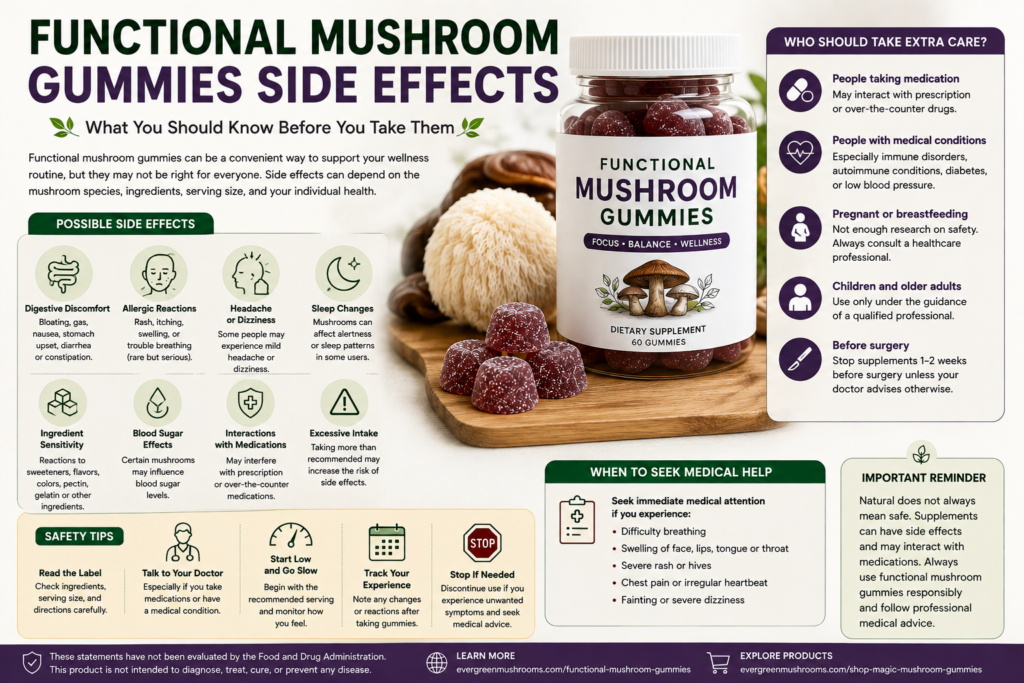
Possible Common Reactions
There is no universal side-effect profile for all functional mushroom gummies. However, consumers may notice unwanted reactions after taking a dietary supplement.
Possible concerns can include:
- Digestive discomfort.
- Nausea.
- Changes in bowel habits.
- Headache or other unexpected symptoms.
- Allergic or sensitivity reactions.
- Reactions related to additional ingredients.
- Interactions with medications or other supplements.
These possibilities do not mean that every person will experience them, nor do they establish that a particular mushroom gummy will cause a specific reaction.
If an unexpected symptom occurs after starting a supplement, consider the timing, the product’s ingredients, and any other new foods, supplements, or medicines that were introduced around the same period.
The FDA advises consumers to be alert for adverse events when taking dietary supplements and to seek medical advice when appropriate. See the FDA dietary supplement safety information.
Digestive Discomfort
Digestive symptoms are among the concerns consumers may consider when evaluating Functional Mushroom Gummies Side Effects.
Depending on the formulation, a gummy may contain mushroom material along with sweeteners, sugar alcohols, acids, flavoring agents, or other ingredients that can affect how an individual tolerates the product.
Possible digestive complaints may include:
- Stomach discomfort.
- Nausea.
- Bloating.
- Changes in bowel movements.
- Other gastrointestinal symptoms.
These symptoms are not specific to mushroom gummies, and they can have many possible causes.
Check the Complete Ingredient List
If digestive discomfort appears after beginning a new gummy, review the complete ingredient list rather than focusing only on the mushroom ingredient.
For example, a person may react differently to a particular sweetener or other formulation ingredient.
Do Not Automatically Increase the Serving
If a product causes discomfort, taking more is not a sensible way to address the problem. Follow the labeled instructions and seek professional advice when necessary.
Allergic or Sensitivity Reactions
Allergic reactions are another important consideration when discussing Functional Mushroom Gummies Side Effects.
People with known food allergies or sensitivities should review the complete ingredient list before consuming a supplement.
A gummy can contain several ingredients in addition to mushrooms, so consumers should not assume that the mushroom is the only ingredient capable of causing a reaction.
Possible Warning Signs
Symptoms of an allergic reaction can vary considerably. Serious symptoms such as difficulty breathing, swelling of the face or throat, or signs of a severe allergic reaction require urgent medical attention.
Do not attempt to manage a serious allergic reaction by simply changing the serving size.
Check Product Labels
If you have a known allergy, carefully review the product label and manufacturer information. When there is uncertainty about whether a product is appropriate for you, ask a healthcare professional.
Side Effects Related to Other Ingredients
One of the most overlooked aspects of Functional Mushroom Gummies Side Effects is that the mushroom itself may not be the only relevant ingredient.
Gummies need a structure, flavor, and texture, so formulations can contain ingredients such as:
| Ingredient Category | Why It May Be Included |
|---|---|
| Sweeteners | Provide sweetness and improve flavor. |
| Flavoring agents | Create the desired taste profile. |
| Pectin | Can provide gummy structure and texture. |
| Gelatin | Can provide structure and chewiness. |
| Acids | May contribute to flavor and formulation characteristics. |
| Coloring ingredients | Provide the product’s visual appearance. |
Consumers with specific dietary requirements or sensitivities should examine the complete ingredient list before making a decision.
For more information about gummy formulations, read our Functional Mushroom Gummies Ingredients guide.
Serving Size and Excessive Intake
Serving size is another important part of evaluating Functional Mushroom Gummies Side Effects.
A container might contain 30 gummies while the labeled serving size is two gummies. In that situation, the container contains 15 labeled servings.
Consumers should therefore read the Supplement Facts panel and serving directions carefully.
| Label Detail | What to Check |
|---|---|
| Serving size | How many gummies make up one serving? |
| Servings per container | How many labeled servings are included? |
| Amount per serving | How much of each listed ingredient is supplied? |
| Directions | What does the manufacturer recommend? |
The FDA notes that adverse events can occur when people take too much of some supplements or combine supplements with medicines or other supplements. See the FDA guidance on dietary supplement risks.
Following the labeled directions is therefore an important basic safety practice.
Mushroom Gummies and Medication Interactions
Medication interactions are one of the most important safety considerations surrounding dietary supplements and Functional Mushroom Gummies Side Effects.
The NCCIH explains that supplements can interact with prescription and over-the-counter medications. Some interactions can increase medication effects, decrease them, or create unwanted effects. Read the NCCIH guidance on how medications and supplements can interact.
This means someone taking medication should not assume that a mushroom gummy is automatically compatible with it simply because the product is sold as a supplement.
Tell Your Healthcare Providers
The NCCIH recommends telling healthcare providers about the dietary supplements and medications you take so they can help identify potential interactions.
This is especially important if you take multiple medicines or supplements.
Do Not Stop Prescription Medication
A dietary supplement should not be used as a replacement for prescribed medication without medical guidance.
If you are concerned about an interaction, speak with your doctor or pharmacist before making changes to your medication routine.
Who Should Take Extra Care
Certain groups should take additional care when considering Functional Mushroom Gummies Side Effects.
People Taking Medication
Discuss supplement use with a healthcare professional or pharmacist if you take prescription or over-the-counter medication.
People With Medical Conditions
Some supplements may pose risks for people with particular medical conditions. Your healthcare provider can help determine whether a specific product is appropriate.
Pregnant or Breastfeeding People
NCCIH notes that many dietary supplements have not been adequately tested in pregnant women, nursing mothers, or children. See the NCCIH dietary supplement information.
Anyone who is pregnant or breastfeeding should discuss supplement use with an appropriate healthcare professional.
Children
Do not assume that a supplement formulated for adults is appropriate for children. Discuss supplement use for a child with a qualified healthcare professional.
People Preparing for Surgery
Dietary supplements can be relevant before surgery because some may affect bleeding or anesthesia. Always tell your healthcare team about supplements you are taking.
Supplements Before Surgery
Surgery is an especially important situation when considering Functional Mushroom Gummies Side Effects and supplement safety.
The NCCIH explains that some dietary supplements can pose risks around surgery, including possible effects related to bleeding or anesthesia. See NCCIH: Using Dietary Supplements Wisely.
If you are scheduled for surgery, tell your surgeon, anesthesiologist, doctor, or other relevant healthcare professionals about all supplements you use.
Do not assume that a gummy is insignificant simply because it is sold as a dietary supplement.
Product Quality and Label Accuracy
Product quality is another consideration when researching Functional Mushroom Gummies Side Effects.
The NCCIH notes that what is listed on the label is not always guaranteed to represent everything that is actually present in a dietary supplement. It also explains that supplements sold commercially can differ from products used in research studies.
This is one reason consumers should look for transparent labeling and credible product information.
Look for Clear Labels
A useful label should provide ingredient information, serving size, directions, and other relevant product details.
Be Careful With Extraordinary Claims
Claims that sound too good to be true deserve additional scrutiny. The FDA specifically encourages consumers to be alert to false or misleading supplement claims.
Understand Third-Party Testing
Independent testing can provide additional information about certain aspects of a supplement, although consumers should understand exactly what a testing program evaluates rather than assuming that any “tested” statement guarantees every aspect of a product.
The NCCIH provides additional information about reading supplement labels and third-party verification. See NCCIH: Tips on Reading Supplement Labels.
What to Do If You Experience a Reaction
If you believe a dietary supplement has caused an unwanted reaction, do not simply continue taking it while hoping the symptoms disappear.
The FDA advises consumers who experience an adverse event from a dietary supplement to stop using the supplement and seek medical care or advice as appropriate. See the FDA guidance for adverse events.
Record the Product Information
Keep the product container or take a photograph of the label. The healthcare professional may need to know the exact ingredients and serving information.
Note When Symptoms Began
Write down when you consumed the product and when symptoms appeared.
Consider Other Products
Tell your healthcare provider about medications, supplements, and other products you are taking. This can help identify potential interactions.
Seek Emergency Care for Serious Symptoms
Severe difficulty breathing, significant swelling, fainting, severe chest symptoms, or other potentially life-threatening symptoms require urgent medical attention.
How to Reduce Avoidable Risks
There is no way to guarantee that a supplement will never cause an unwanted reaction, but careful product evaluation can help reduce avoidable risks.
Read the Entire Label
Do not focus only on the mushroom name. Review the full ingredient list.
Follow the Directions
Use the product according to the manufacturer’s labeled instructions.
Do Not Combine Supplements Casually
Combining several supplements can make it more difficult to determine which product caused a reaction and may increase the possibility of interactions.
Discuss Medications With a Professional
Ask your doctor or pharmacist about potential interactions before adding a supplement to your routine.
Keep Products Stored Properly
Follow the storage instructions supplied by the manufacturer.
These steps are especially useful for anyone researching Functional Mushroom Gummies Side Effects before trying a new product.
Functional Mushroom Gummies Safety Checklist
Use this checklist before adding a functional mushroom gummy to your routine:
- ☐ I have read the complete ingredient list.
- ☐ I know which mushroom species are included.
- ☐ I understand the serving size.
- ☐ I have reviewed the manufacturer’s directions.
- ☐ I have considered possible allergies or sensitivities.
- ☐ I have considered my current medications.
- ☐ I have considered other supplements I take.
- ☐ I have checked whether I have a medical condition that could affect supplement use.
- ☐ I have discussed supplement use with a healthcare professional when appropriate.
- ☐ I know what to do if I experience an adverse reaction.
This Functional Mushroom Gummies Side Effects checklist can help you review the major safety considerations before using a new product.
Exploring Mushroom Gummies
After learning about Functional Mushroom Gummies Side Effects, consumers can use the information to evaluate products more carefully.
Evergreen Mushrooms provides a selection through the Shop Magic Mushroom Gummies category.
Always review the current product label, ingredient information, serving instructions, and applicable safety information before making a purchase or using a supplement.
Frequently Asked Questions
What are the most common Functional Mushroom Gummies Side Effects?
There is no universal side-effect profile for all mushroom gummies. Possible unwanted reactions can include digestive discomfort, nausea, sensitivity reactions, or effects related to other ingredients. Individual responses vary.
Can mushroom gummies cause stomach problems?
Some people may experience digestive discomfort after taking a dietary supplement. If this happens, review the complete ingredient list and seek professional advice if symptoms are persistent or concerning.
Can mushroom gummies interact with medication?
Yes, dietary supplements can interact with prescription and over-the-counter medications. The NCCIH recommends discussing supplement use with healthcare professionals when potential interactions are a concern.
Are mushroom gummies safe for everyone?
No supplement can be assumed to be appropriate for everyone. People taking medication, living with certain medical conditions, pregnant or breastfeeding people, and children may need additional professional guidance.
Can I take more gummies if I do not notice an effect?
You should follow the product’s labeled directions rather than increasing the serving on your own. Taking excessive amounts of some supplements can increase the risk of adverse effects.
Can other gummy ingredients cause reactions?
Yes. A gummy may contain sweeteners, flavors, pectin, gelatin, acids, colors, and other ingredients. A reaction does not necessarily mean the mushroom itself was responsible.
Should I stop taking a gummy if I experience a reaction?
If you experience an adverse reaction, the FDA advises stopping the supplement and seeking medical care or advice as appropriate.
Should I tell my doctor about mushroom gummies?
Yes, especially if you take prescription or over-the-counter medication, have a medical condition, are preparing for surgery, or have other safety concerns.
Are natural mushroom gummies automatically safe?
No. The NCCIH specifically notes that “natural” does not necessarily mean safe. Supplements can have side effects and interactions.
Where can I learn more about mushroom gummies?
Start with the Functional Mushroom Gummies pillar guide and explore the supporting articles in the cluster.
Conclusion
Understanding Functional Mushroom Gummies Side Effects is an important part of making an informed decision about dietary supplements.
There is no single reaction profile that applies to every mushroom gummy. Products can differ in mushroom species, extracts, powders, serving sizes, sweeteners, flavors, and other ingredients.
Individual factors also matter. Medications, medical conditions, allergies, pregnancy, breastfeeding, age, and upcoming surgery can all affect whether a dietary supplement is appropriate.
The FDA and NCCIH both emphasize the importance of informed supplement use, including reviewing labels, considering potential interactions, and discussing supplements with healthcare professionals when appropriate.
If you experience an unexpected or concerning reaction, do not ignore it. Follow appropriate medical guidance and keep the product label available so the ingredients can be identified.
For more educational information, continue to our Functional Mushroom Gummies pillar guide or browse the Magic Mushroom Gummies category.
