
Uncategorized
Mushroom Gummies for Immune Support
Aug
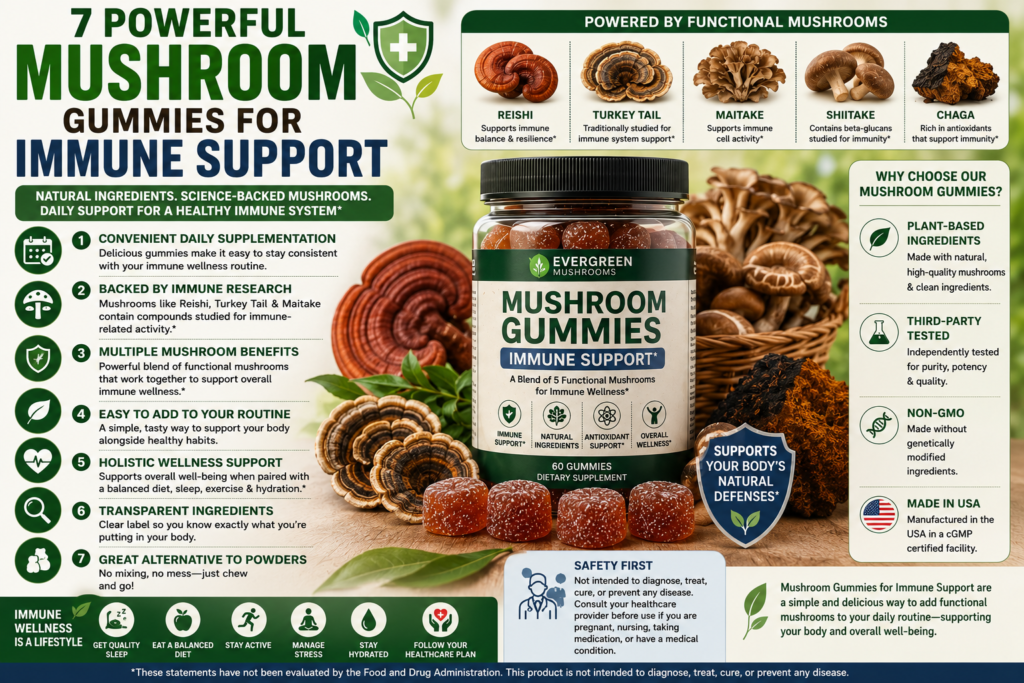
7 Powerful Mushroom Gummies for Immune Support: Complete Guide
Mushroom Gummies for Immune Support are a convenient way to include functional mushroom ingredients in a daily wellness routine. Mushrooms such as Reishi, Turkey Tail, Maitake, Shiitake, and Chaga have attracted scientific interest because they contain compounds that researchers have investigated for their interactions with immune-related biological processes.
However, it is important to understand the difference between supporting normal immune function and claiming that a supplement can prevent, treat, or cure an illness. Research on mushrooms is still developing, and evidence can vary considerably depending on the mushroom species, preparation, dosage, and population studied.
This guide explores seven reasons people consider Mushroom Gummies for Immune Support, the functional mushrooms commonly included in these formulas, how to evaluate supplement labels, and important safety considerations.
According to the National Center for Complementary and Integrative Health, the amount of scientific evidence supporting dietary supplements varies widely. Supplements sold commercially may also differ from products used in research.
This article is educational and does not diagnose, treat, prevent, or cure disease. Dietary supplements should not replace medical treatment, vaccination, a nutritious diet, adequate sleep, or other evidence-based healthcare.
For a broader overview of functional gummies, visit our Mushroom Gummies Benefits pillar guide.
Mushroom Gummies for Immune Support: What to Know
Mushroom Gummies for Immune Support are dietary supplements containing one or more mushroom-derived ingredients that are marketed around general immune wellness.
Functional mushrooms have received increasing scientific attention because they contain compounds such as polysaccharides, beta-glucans, triterpenes, and other bioactive substances.
Shop Magic Mushroom GummiesResearchers have investigated whether some of these compounds interact with immune-related pathways. However, laboratory findings and animal studies do not automatically demonstrate that a commercial mushroom gummy will provide the same effect in humans.
This distinction is particularly important for immune-related products because the immune system is complex. It is not simply a matter of making the immune system “stronger.”
A healthy immune system needs to respond appropriately to threats while also avoiding excessive or inappropriate activity.
For this reason, consumers should approach Mushroom Gummies for Immune Support as dietary supplements rather than replacements for medical care.
What Are Mushroom Gummies for Immune Support?
Mushroom Gummies for Immune Support are chewable supplements containing mushroom powders, extracts, or blends of functional mushrooms.
Depending on the manufacturer, a formula may contain one mushroom or several mushroom species.
Common ingredients include Reishi, Turkey Tail, Maitake, Shiitake, and Chaga.
Some formulas may also include vitamins, minerals, botanical ingredients, or other compounds associated with general wellness.
Why the Formula Matters
Two products can both be marketed for immune support while having completely different formulations.
One may contain a single mushroom extract, while another may contain several mushrooms plus vitamins and botanical ingredients.
The amount of each ingredient can also differ.
Therefore, the product name alone does not provide enough information to determine what you are actually consuming.
Always read the Supplement Facts panel and complete ingredient list.
Understanding the Immune System
The immune system is a complex network involving cells, tissues, organs, proteins, and signaling pathways.
Its role includes recognizing and responding to potentially harmful organisms and abnormal cells while maintaining appropriate regulation.
Immune function is influenced by numerous factors, including genetics, age, nutrition, sleep, physical activity, stress, medications, and existing health conditions.
This is why the concept of “boosting” immunity can be misleading.
A better way to think about Mushroom Gummies for Immune Support is as one possible component of a broader wellness routine.
Good nutrition, adequate sleep, regular physical activity, hygiene, vaccination when recommended, and appropriate medical care all have important roles in maintaining health.
The NCCIH guidance on dietary supplements also emphasizes that evidence for immune-related supplement claims varies and that more research is often needed.
Reishi and Immune Research
Reishi is one of the most recognized functional mushrooms used in wellness supplements.
It generally refers to mushrooms in the Ganoderma genus, with Ganoderma lucidum frequently discussed in scientific and supplement literature.
Reishi contains several compounds that researchers have investigated for biological activity, including polysaccharides and triterpenes.
Some research has examined Reishi in relation to immune-related pathways, inflammation, and other biological mechanisms.
However, laboratory and preclinical findings should not automatically be interpreted as proof that Mushroom Gummies for Immune Support containing Reishi will prevent illness or improve immunity in every person.
Commercial Reishi products can also differ in species, extraction method, concentration, and serving size.
For this reason, look at the specific product rather than assuming all Reishi supplements are equivalent.
Turkey Tail and Immune Research
Turkey Tail is another mushroom that has attracted substantial research interest.
Its scientific name is Trametes versicolor, and it contains compounds including polysaccharides that have been studied for their biological activity.
Turkey Tail is particularly interesting in immune-related research because certain compounds derived from the mushroom have been investigated in clinical and supportive-care contexts.
However, research on specific extracts or compounds should not be interpreted as evidence that every commercial gummy containing Turkey Tail provides the same effects.
This is an important distinction when evaluating Mushroom Gummies for Immune Support.
The exact species, preparation, concentration, and amount per serving all matter.
Maitake and Immune Research
Maitake, scientifically known as Grifola frondosa, is an edible mushroom that has also been investigated for immune-related biological activity.
Researchers have studied compounds found in Maitake, particularly polysaccharide fractions, in laboratory and preclinical settings.
Some human research has also explored Maitake preparations, although the overall evidence is not sufficient to treat the mushroom as a proven therapy for immune disorders.
Maitake may therefore appear in formulas marketed around general wellness, including some Mushroom Gummies for Immune Support.
Consumers should distinguish between scientific interest and established clinical benefits.
Shiitake and Immune Research
Shiitake, or Lentinula edodes, is a widely consumed edible mushroom.
In addition to its nutritional value as a food, researchers have investigated compounds from Shiitake for various biological activities.
Because Shiitake is an edible mushroom, it is also used in food-based nutrition as well as some functional mushroom products.
However, consuming a mushroom as part of a balanced diet is not necessarily equivalent to taking a concentrated mushroom extract in Mushroom Gummies for Immune Support.
The dose and preparation can be substantially different.
Chaga and Immune Research
Chaga is another mushroom frequently included in functional mushroom blends.
Scientific studies have investigated Chaga compounds for antioxidant and immune-related biological activity, although much of the evidence remains preclinical.
This means Chaga can be an interesting subject of scientific research without establishing that it can prevent infections or treat immune-related diseases.
Consumers should be particularly cautious about products that turn preliminary laboratory findings into guaranteed health claims.
When evaluating Mushroom Gummies for Immune Support, look for transparent labeling and realistic claims.
1. Convenient Daily Supplementation
One of the most practical advantages of Mushroom Gummies for Immune Support is convenience.
Gummies provide a pre-portioned format that does not require measuring powders or preparing drinks.
They can be easy to carry and may fit naturally into an existing supplement routine.
However, convenience does not determine effectiveness.
A convenient product should still have clear labeling and identifiable ingredients.
Consumers should follow the manufacturer’s serving instructions rather than assuming that taking additional gummies will provide greater benefits.
2. Interest in Immune-Related Mushroom Research
The scientific interest surrounding functional mushrooms is another reason people explore Mushroom Gummies for Immune Support.
Different mushrooms contain different compounds, and researchers have investigated their interactions with immune-related biological pathways.
Beta-glucans are among the compounds that have received attention in mushroom research.
However, the presence of a bioactive compound does not automatically prove that consuming a particular commercial gummy will produce a clinically meaningful result.
Evidence should therefore be evaluated according to the quality of human research available for the specific mushroom and preparation.
3. Multiple Mushroom Formulations
Some Mushroom Gummies for Immune Support contain blends of several mushrooms.
A formula might combine Reishi, Turkey Tail, Maitake, Shiitake, and Chaga.
The advantage of a blend is that it provides multiple mushroom ingredients in one product.
The disadvantage is that it can make it more difficult to determine how much of each mushroom is actually provided.
Consumers should check whether individual ingredient quantities are disclosed.
| Mushroom | Common Research Interest |
|---|---|
| Reishi | Immune-related and biological research |
| Turkey Tail | Immune-related polysaccharide research |
| Maitake | Immune-related biological research |
| Shiitake | Nutritional and biological research |
| Chaga | Antioxidant and preclinical research |
These categories describe areas of research interest and should not be interpreted as guaranteed health outcomes.
4. Easy Integration Into a Wellness Routine
Daily supplements can be easier to remember when they are incorporated into an established routine.
Mushroom Gummies for Immune Support can be taken according to the product’s directions as part of a broader approach to wellness.
For example, someone may take a supplement alongside breakfast or another consistent daily habit.
The goal should be consistency with the manufacturer’s directions rather than excessive supplementation.
A supplement should complement healthy habits instead of replacing them.
5. Flexible Supplement Formulations
There are many different formulations of Mushroom Gummies for Immune Support.
Some products focus on one mushroom, while others contain multiple mushrooms.
Some formulas may also include vitamins such as vitamin C or vitamin D, minerals such as zinc, or botanical ingredients.
This flexibility allows consumers to select products according to their preferences.
It also means that careful label reading is essential.
A product containing mushrooms plus several vitamins and botanicals should be evaluated as a complete formula rather than judged only by its mushroom content.
6. Simple Ingredient Comparison
Comparing labels can help consumers make more informed decisions about Mushroom Gummies for Immune Support.
Important information includes the mushroom species, amount per serving, serving size, preparation type, and additional ingredients.
Compare These Details
- Exact mushroom species.
- Scientific names when provided.
- Powder versus extract.
- Amount per serving.
- Number of gummies per serving.
- Additional vitamins and minerals.
- Botanical ingredients.
- Sweeteners and flavors.
- Directions and warnings.
The NIH Office of Dietary Supplements provides guidance on understanding dietary supplement labels and evaluating supplement information.
7. Convenient Alternative to Mushroom Powders
Mushroom powders can be added to drinks, smoothies, soups, or other foods.
However, some people prefer a pre-portioned chewable format.
Mushroom Gummies for Immune Support can provide that convenience without requiring the consumer to measure powder.
The trade-off is that gummies often contain additional ingredients for flavor, texture, stability, or sweetness.
Therefore, compare the entire ingredient list rather than focusing exclusively on the mushroom.
Mushroom Powders vs Extracts
The preparation of the mushroom can affect how a supplement should be interpreted.
Mushroom Powder
Mushroom powder generally consists of dried mushroom material that has been processed into a powder.
Mushroom Extract
An extract is produced through an extraction process designed to concentrate or separate certain mushroom components.
Why Preparation Matters
Scientific studies may use specific mushroom preparations that differ from commercial products.
Therefore, the fact that a gummy contains a mushroom studied in research does not necessarily mean the gummy is equivalent to the preparation used in that study.
| Feature | What to Check |
|---|---|
| Mushroom species | Identify the exact species. |
| Preparation | Determine whether it is powder or extract. |
| Amount | Check the amount per serving. |
| Serving size | Determine how many gummies make one serving. |
Common Ingredients in Mushroom Gummies for Immune Support
Formulations can vary substantially between products.
Common ingredients may include:
- Reishi.
- Turkey Tail.
- Maitake.
- Shiitake.
- Chaga.
- Lion’s Mane.
- Vitamin C.
- Vitamin D.
- Zinc.
- Botanical extracts.
- Natural flavors.
- Sweeteners.
- Pectin.
- Gelatin.
- Citric acid.
Not every product contains these ingredients.
Always check the specific product label before consuming a supplement.
It is also useful to distinguish between the active ingredients and the other ingredients used to create the gummy’s flavor and texture.
How to Read the Label
Understanding the label is one of the best ways to compare Mushroom Gummies for Immune Support.
1. Check the Serving Size
Determine how many gummies constitute one serving.
2. Identify the Mushrooms
Look for the specific mushroom names and scientific names where available.
3. Check the Amount
Review how much of each active ingredient is provided per serving.
4. Determine the Preparation
Look for information indicating whether the product contains mushroom powder, extract, fruiting body material, mycelium, or a combination.
5. Read the Other Ingredients
Check sweeteners, flavors, colors, binders, gelling agents, vitamins, minerals, and botanical ingredients.
6. Check Directions
Follow the manufacturer’s recommended serving instructions.
7. Read Warnings
Pay attention to allergy information, medication warnings, age recommendations, and other safety instructions.
The NIH Office of Dietary Supplements provides additional information about understanding supplement labels.
How to Evaluate Product Quality
Quality and transparency matter when choosing Mushroom Gummies for Immune Support.
Look for products that clearly identify:
- Mushroom species.
- Ingredient preparation.
- Amount per serving.
- Serving size.
- Complete ingredients.
- Manufacturer information.
- Directions.
- Warnings.
- Storage information.
- Expiration or best-by information.
- Testing information when available.
Third-party testing can provide additional information about product quality, although testing does not automatically prove that a supplement is effective.
Be cautious with products that promise to “supercharge” the immune system, prevent infections, cure illnesses, or guarantee medical outcomes.
The U.S. Food and Drug Administration provides consumer information about dietary supplements and their regulation.
The NCCIH also advises consumers to recognize that supplements available commercially may differ from products tested in scientific studies.
Building a Healthy Immune Wellness Routine
If you choose Mushroom Gummies for Immune Support, consider using them as only one part of a broader wellness routine.
Eat a Varied Diet
A balanced diet provides a broad range of nutrients needed for normal body function.
Prioritize Sleep
Consistent, adequate sleep is an important part of overall health.
Exercise Regularly
Regular physical activity supports general health and can be adapted to different ages and fitness levels.
Manage Stress
Healthy stress-management practices can contribute to overall wellbeing.
Practice Good Hygiene
Basic hygiene practices can help reduce exposure to some infectious organisms.
Follow Recommended Healthcare
Routine medical care, recommended vaccinations, and appropriate treatment for health conditions remain important parts of maintaining health.
A supplement should never be used as a substitute for appropriate healthcare.
Safety and Possible Side Effects
Safety should always be considered before using Mushroom Gummies for Immune Support.
Dietary supplements can contain active ingredients that cause side effects or interact with medications.
Potential concerns may include:
- Digestive discomfort.
- Allergic reactions.
- Sensitivity to mushroom ingredients.
- Reactions to sweeteners or other ingredients.
- Interactions with medications.
- Concerns associated with excessive intake.
The NCCIH safety guidance explains that safety depends on the specific supplement and that many supplements have not been adequately studied in certain populations.
If you experience concerning symptoms after taking a supplement, stop using it and seek appropriate medical advice.
Mushroom Gummies and Medications
People taking prescription or over-the-counter medication should consider potential interactions before using Mushroom Gummies for Immune Support.
Supplement interactions can depend on the mushroom, other ingredients, medication, dosage, and individual health circumstances.
Before Surgery
Tell your healthcare team about all supplements you use before a planned surgical procedure.
Pregnancy and Breastfeeding
Many dietary supplements have not been adequately studied during pregnancy or breastfeeding. Professional medical advice is appropriate before use.
Children
Adult mushroom gummies should not automatically be assumed to be appropriate for children.
Prescription Medication
If you take regular medication, discuss your complete supplement routine with your doctor or pharmacist.
The NCCIH information on supplement and medication interactions explains why these potential interactions should be considered.
How to Choose Mushroom Gummies for Immune Support
Use this checklist when comparing Mushroom Gummies for Immune Support.
| Factor | What to Check |
|---|---|
| Mushroom species | Look for the exact mushroom identity. |
| Preparation | Check whether it is powder, extract, fruiting body, mycelium, or a combination. |
| Amount | Review the amount provided per serving. |
| Serving size | Determine how many gummies make one serving. |
| Additional ingredients | Check vitamins, minerals, botanicals, sweeteners, flavors, and colors. |
| Testing | Look for credible testing information when available. |
| Manufacturer | Check for clear company and contact information. |
| Claims | Avoid guaranteed disease-treatment or prevention claims. |
A product with more mushrooms is not automatically better.
Likewise, a product with a long ingredient list is not necessarily superior to a simpler formula.
Transparency, appropriate labeling, and realistic claims are more useful indicators when comparing products.
For additional purchasing guidance, visit our Functional Mushroom Gummies Buying Guide.
Frequently Asked Questions
What are Mushroom Gummies for Immune Support?
Mushroom Gummies for Immune Support are chewable dietary supplements containing functional mushroom ingredients and marketed around general immune wellness.
Which mushrooms are commonly used for immune support?
Reishi, Turkey Tail, Maitake, Shiitake, and Chaga are among the mushrooms frequently discussed in immune-related mushroom research.
Do mushroom gummies boost the immune system?
The term “boost” can be misleading. Some mushrooms have been studied for their effects on immune-related biological pathways, but this does not establish that every mushroom gummy will strengthen immunity or prevent illness.
Are Mushroom Gummies for Immune Support scientifically proven?
The evidence varies by mushroom, preparation, dose, and intended use. Some research is conducted in laboratories or animals, while human evidence is available for certain mushroom preparations. More research is needed for many supplement claims.
Can I take mushroom gummies every day?
Follow the manufacturer’s labeled directions. If you take medication, have a medical condition, are pregnant or breastfeeding, or have another health concern, consult an appropriate healthcare professional before use.
Are mushroom gummies better than capsules?
Not necessarily. Gummies offer convenience and a chewable format, while capsules may contain fewer additional ingredients. The appropriate choice depends on the product and individual preference.
Do immune mushroom gummies contain vitamins?
Some products contain vitamins such as vitamin C or vitamin D, while others contain only mushroom ingredients. Always check the individual product label.
Can mushroom gummies replace vitamins?
Not automatically. Mushroom gummies and vitamin supplements can have different formulations. If you are concerned about a nutrient deficiency, discuss appropriate testing and supplementation with a healthcare professional.
Can mushroom gummies prevent infections?
They should not be treated as a guaranteed method of preventing infections. Avoid products that make unsupported promises about preventing or curing disease.
Can Mushroom Gummies for Immune Support interact with medication?
Yes. Dietary supplements can interact with medications. People taking prescription or over-the-counter medication should discuss supplement use with an appropriate healthcare professional.
Are mushroom gummies safe during pregnancy?
Many dietary supplements have not been adequately studied during pregnancy. Speak with a healthcare professional before using a mushroom supplement during pregnancy.
Where can I learn more about mushroom gummies?
Visit our Mushroom Gummies Benefits pillar guide for a broader overview.
Conclusion
Mushroom Gummies for Immune Support provide a convenient way to incorporate functional mushroom ingredients into a daily wellness routine.
Reishi, Turkey Tail, Maitake, Shiitake, and Chaga have all attracted scientific interest in different areas of immune-related and biological research. However, the strength of evidence varies between mushrooms and preparations.
Consumers should therefore avoid treating mushroom gummies as guaranteed immune boosters or replacements for medical treatment.
Instead, examine the actual formulation. Check the mushroom species, preparation, amount per serving, serving size, additional ingredients, manufacturer information, directions, warnings, and available quality-testing information.
A healthy immune system also depends on broader lifestyle and healthcare factors, including adequate sleep, balanced nutrition, physical activity, appropriate hygiene, recommended vaccination, and timely medical care.
The NCCIH recommends evaluating supplement evidence carefully and discussing supplement use with healthcare professionals when appropriate.
For the broader topic, continue to our Mushroom Gummies Benefits pillar guide.
You can also explore our Mushroom Gummies for Daily Wellness article for more information about everyday functional mushroom supplementation.
For a broader explanation of functional mushrooms, visit Functional Mushrooms Explained.
