
Uncategorized
Mushroom Chocolate Bar Dosage
Aug
Mushroom Chocolate Bar Dosage: 7 Powerful Tips for Serving Size
Mushroom Chocolate Bar Dosage can be confusing because different products use different serving sizes, mushroom preparations, and ingredient concentrations. A chocolate bar may contain whole mushroom powder, an extract, a blend of functional mushrooms, or other ingredients, meaning that the amount of chocolate alone does not tell you how much mushroom material is present.
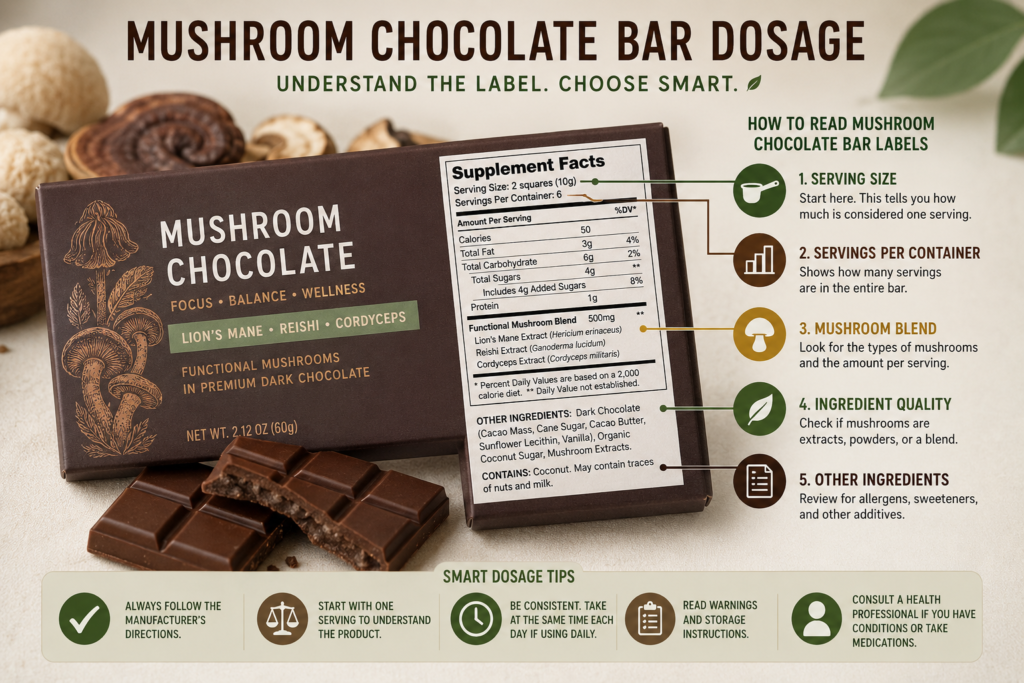
Understanding the label is therefore more useful than comparing products by package size. Consumers should look at the stated serving size, mushroom ingredients, preparation type, and complete ingredient list before deciding how a product fits into their routine.
This guide explains how to interpret serving information, why products differ, what dosage terminology means in different contexts, and which labeling details deserve attention.
For a broader introduction to mushroom chocolate products, visit our Mushroom Chocolate Bar Guide.
What Does Mushroom Chocolate Bar Dosage Mean?
The term Mushroom Chocolate Bar Dosage can mean different things depending on the product. For an ordinary functional mushroom food, the label may identify a serving size and the amount of mushroom ingredient contained in that serving.
For example, a manufacturer may define one portion as a particular number of chocolate squares. Another manufacturer may define an entire bar as several servings.
This makes it important to distinguish between:
- The total weight of the chocolate bar.
- The number of servings in the package.
- The weight of each serving.
- The amount of mushroom ingredient per serving.
- The form of the mushroom ingredient.
These details provide much more useful information than the package size alone.
Why Serving Sizes Differ Between Products
There is no universal serving size for every mushroom chocolate product. Formulations can differ substantially in their ingredients and intended use.
A bar containing a particular amount of mushroom powder may have a different serving structure from one containing an extract or a blend of several mushrooms.
Chocolate formulation also matters. A manufacturer may need to balance mushroom ingredients with cocoa, sugar, milk ingredients, flavorings, nuts, or other components.
Consequently, consumers should follow the serving information provided for the particular product rather than assuming that one chocolate bar can be compared directly with another.
1. Start With the Serving Size
The first step when evaluating Mushroom Chocolate Bar Dosage information is to find the serving-size statement on the package or product label.
Look for wording such as:
- Serving size.
- Servings per container.
- Amount per serving.
- Total amount per package.
A bar that appears to be one portion may actually contain multiple labeled servings. Conversely, a smaller product may contain a single serving.
Never assume that the entire package represents one serving simply because it is sold as a single chocolate bar.
2. Check the Mushroom Ingredient
The next step is identifying exactly which mushroom is included. The mushroom species is an important part of understanding the product because different mushrooms have different compositions and research histories.
Common functional mushroom ingredients include:
- Lion’s mane.
- Reishi.
- Cordyceps.
- Chaga.
- Turkey tail.
- Blends containing several mushroom species.
A serving of a lion’s mane product should not automatically be interpreted in the same way as a serving of a reishi or Cordyceps product.
The mushroom name should therefore be considered alongside the quantity and preparation listed on the label.
3. Understand Powder vs. Extract
The form of the mushroom ingredient can be particularly important when comparing products and interpreting Mushroom Chocolate Bar Dosage information.
| Mushroom Form | What It Means | What to Check |
|---|---|---|
| Whole Mushroom Powder | Dried mushroom material processed into powder | Species and amount per serving |
| Mushroom Extract | Processed mushroom material | Extract information and labeled amount |
| Mycelial Material | Material derived from fungal mycelium | Source and labeling information |
| Mushroom Blend | Several mushroom ingredients combined | Individual mushrooms and amounts where provided |
A larger number printed on one package does not necessarily mean that it contains a greater amount of the same type of mushroom material as another product.
This is why the preparation and serving information should be read together.
4. Do Not Compare Chocolate Weight Alone
Chocolate weight is not the same thing as mushroom quantity.
Two products may have similar total weights while containing different amounts and types of mushroom ingredients. The remainder of the weight may come from cocoa, sugar, fats, dairy ingredients, flavorings, nuts, or other components.
The total weight therefore tells you about the finished food, not necessarily the amount of mushroom material.
When considering Mushroom Chocolate Bar Dosage, focus on the information provided for the mushroom ingredient rather than judging the product by the size or weight of the chocolate bar.
5. Read the Complete Ingredient List
The mushroom ingredient is only one part of a chocolate formulation.
A complete ingredient list may include:
- Cocoa or chocolate.
- Sugar or other sweeteners.
- Cocoa butter.
- Milk ingredients.
- Nuts.
- Flavorings.
- Mushroom powders or extracts.
- Other functional ingredients.
Reading the entire ingredient list can help identify allergens and other ingredients that may be important for individual dietary requirements.
It also prevents consumers from assuming that every characteristic of a product comes from the mushroom ingredient.
6. Look at the Amount Per Serving
After identifying the serving size, check whether the label states the amount of mushroom ingredient associated with that serving.
This can make comparisons easier, particularly when two products use different package sizes.
A useful comparison should consider:
| Label Detail | Why It Matters |
|---|---|
| Serving size | Shows how the manufacturer defines one portion |
| Servings per package | Shows how many labeled portions are included |
| Mushroom species | Identifies the primary mushroom ingredient |
| Ingredient form | Distinguishes powder, extract, mycelium, or blend |
| Amount per serving | Helps evaluate the labeled quantity |
| Other ingredients | Identifies the rest of the formulation |
Functional Mushroom Chocolate and Serving Information
Functional mushroom chocolate products may contain mushrooms such as lion’s mane, reishi, or Cordyceps. These products are generally evaluated according to their food or supplement labeling and the specific ingredients used.
Scientific research involving a particular mushroom does not automatically establish a recommended serving for every commercial product containing that mushroom.
This distinction matters because research studies can use specific preparations, quantities, populations, and protocols that differ considerably from commercial foods.
For additional information about formulation, read our Mushroom Chocolate Bar Ingredients article.
What Does Scientific Research Say?
Research into medicinal and functional mushrooms covers a range of species and preparations. Published studies can provide useful information about particular mushrooms, but findings must be considered in the context of the preparation and research design.
Readers can explore published scientific studies through PubMed, a database of biomedical research literature.
The National Center for Complementary and Integrative Health also provides consumer information about herbs, supplements, and complementary health approaches.
These resources can help readers distinguish published research from generalized marketing statements.
What About Products Containing Psychoactive Ingredients?
Some products marketed as mushroom chocolate may contain ingredients intended to produce psychoactive effects. These products require a different level of caution and should not be treated as interchangeable with ordinary functional mushroom foods.
This article does not provide dosing instructions for psilocybin or other controlled or psychoactive substances. Laws, product composition, potency, and health risks can vary substantially.
Anyone encountering such a product should first determine exactly what it contains, verify applicable local laws, and consult an appropriately qualified professional when health or medication questions are involved.
The important labeling principle remains the same: do not assume that a chocolate bar’s total weight represents the quantity of its active or functional ingredients.
Why More Is Not Automatically Better
Consumers sometimes assume that a larger serving must provide a better result. That assumption is not supported simply by the size of a package or the amount of chocolate involved.
Increasing the amount consumed can also increase exposure to other ingredients in the product, including sugar, cocoa compounds, dairy, nuts, or other components.
For that reason, following the manufacturer’s labeled serving information is a more sensible approach than creating a serving size based solely on the size of the bar.
Serving Size vs. Daily Use
A serving size and a recommended frequency are not necessarily the same thing.
The serving size tells you how much the manufacturer considers one portion. A separate usage statement may explain how the product is intended to fit into a routine.
These concepts should not be confused.
For example, a package could contain several servings without suggesting that every serving should necessarily be consumed at the same time. Always read the complete directions and warnings supplied with the specific product.
How to Compare Two Mushroom Chocolate Bars
When comparing products, use the same information for both rather than focusing on marketing language.
- Identify the mushroom species.
- Check whether the ingredient is powder or extract.
- Find the labeled serving size.
- Check the number of servings in the package.
- Look for the amount of mushroom ingredient per serving.
- Review the remaining ingredients.
- Check allergen information.
- Read storage and usage instructions.
This approach makes product comparisons more meaningful and reduces the chance of confusing total chocolate weight with mushroom quantity.
Common Mistakes When Reading Mushroom Chocolate Labels
Confusing the Whole Bar With One Serving
Some bars contain multiple labeled servings. Always check the serving information before treating the entire product as one portion.
Comparing Only Package Weight
A heavier chocolate bar does not necessarily contain more mushroom material. Package weight includes all ingredients in the finished product.
Ignoring the Mushroom Preparation
Powder and extract are different forms of mushroom material and should not automatically be treated as equivalent.
Ignoring Other Ingredients
Chocolate products can contain common allergens and other ingredients that may matter to individual consumers.
Assuming Every Mushroom Has the Same Research
Different mushroom species have different research histories. Evidence involving one species should not automatically be transferred to another.
How Storage Relates to Product Quality
Storage does not change the labeled serving size, but it can influence the quality of chocolate over time.
Heat, moisture, light, and poor storage conditions can affect the texture and appearance of chocolate. Consumers should follow the manufacturer’s storage recommendations.
For additional information, read our Mushroom Chocolate Bar Storage Guide.
Related Mushroom Chocolate Resources
Continue exploring the Evergreen Mushrooms educational cluster:
- Mushroom Chocolate Bar Guide
- Mushroom Chocolate Bar Benefits
- Mushroom Chocolate Bar Effects
- How to Use Mushroom Chocolate Bars
- Mushroom Chocolate Bar Flavors
Explore Mushroom Chocolate Bars
Readers interested in exploring mushroom chocolate products can visit the Mushroom Chocolate Bars category.
For readers specifically interested in the Polkadot collection, visit the Polkadot Mushroom Chocolate Bars category.
Frequently Asked Questions About Mushroom Chocolate Bar Dosage
What does Mushroom Chocolate Bar Dosage mean?
Mushroom Chocolate Bar Dosage generally refers to the amount or serving information associated with a mushroom chocolate product. For functional products, the label may identify a serving size and the quantity of mushroom ingredient associated with that serving.
Is the entire chocolate bar one serving?
Not necessarily. Some bars contain multiple labeled servings. Always check the package information before assuming that the entire bar represents one serving.
Does a bigger chocolate bar contain more mushrooms?
Not necessarily. Total product weight includes chocolate and all other ingredients. The mushroom quantity should be evaluated using the ingredient and serving information provided by the manufacturer.
Why does mushroom preparation matter?
Mushrooms can appear as whole mushroom powder, extracts, mycelial material, or blends. These forms can have different compositions, so they should not automatically be treated as equivalent.
Should I compare products by price alone?
No. A meaningful comparison should consider mushroom species, preparation, serving size, ingredient quantity, chocolate formulation, allergens, and labeling transparency.
Can research studies determine a product’s serving size?
Research studies use specific preparations and protocols. Their quantities should not automatically be treated as instructions for commercial products. Product labeling and appropriate professional advice are more relevant when determining how a product should be used.
What should I check before consuming mushroom chocolate?
Check the mushroom species, preparation, serving size, complete ingredient list, allergens, manufacturer information, usage directions, warnings, and storage instructions.
Does Mushroom Chocolate Bar Dosage apply to psychoactive mushroom products?
The term can be used broadly, but psychoactive mushroom products require separate consideration. This article does not provide dosing instructions for psilocybin or other psychoactive substances. Such products may also be subject to specific laws and safety concerns.
Can serving sizes differ between brands?
Yes. Manufacturers can use different formulations and serving definitions. Always read the label for the specific product rather than applying a serving size from another brand.
Why should I follow the product label?
The product label provides information specific to that formulation, including its serving size, ingredients, warnings, and directions. This is more reliable than assuming that another mushroom chocolate product has the same composition.
Final Thoughts on Mushroom Chocolate Bar Dosage
Understanding Mushroom Chocolate Bar Dosage starts with reading the product label rather than judging a chocolate bar by its size or appearance.
Check the serving size, mushroom species, ingredient preparation, amount per serving, complete ingredient list, allergens, and manufacturer’s directions. These details provide the context needed to understand what a particular product contains.
It is also important to distinguish functional mushroom foods from products containing psychoactive ingredients. Research involving a mushroom or extract does not automatically establish a serving recommendation for every commercial chocolate product.
A careful approach is therefore simple: identify the ingredients, understand the serving information, follow the product’s labeled directions, and avoid making assumptions based on unrelated products or research.
For more information, continue through the Evergreen Mushrooms Mushroom Chocolate Bar Guide and the related educational resources throughout this cluster.
