
Uncategorized
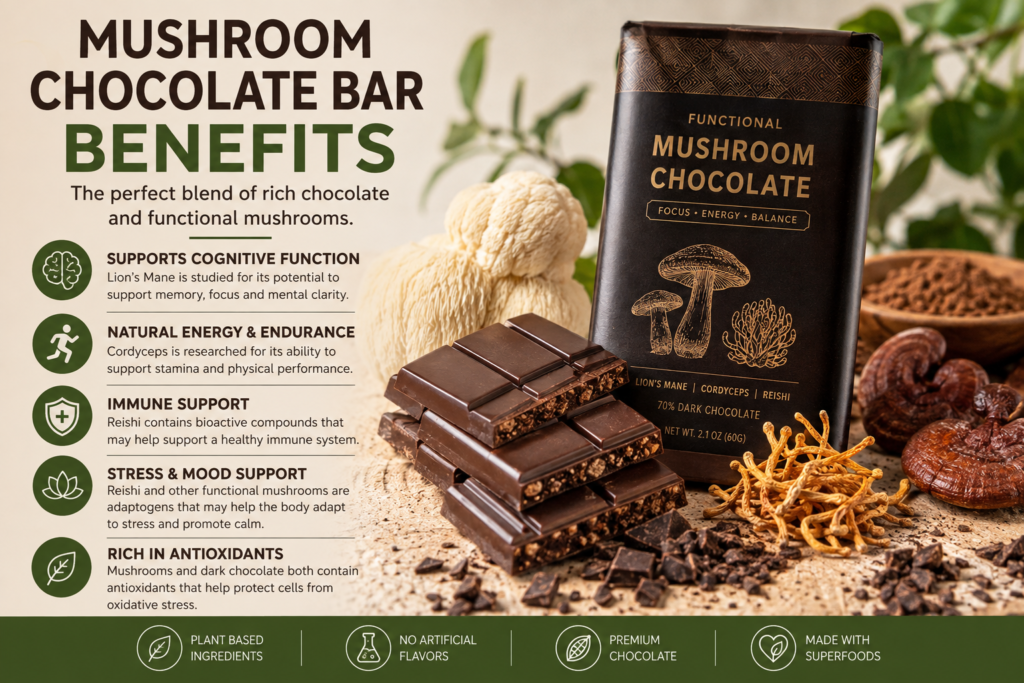
Mushroom Chocolate Bar Benefits
Aug
Mushroom Chocolate Bar Benefits: 7 Powerful Facts to Know
Mushroom Chocolate Bar Benefits have attracted increasing attention as functional mushrooms become more common in food products, beverages, supplements, and chocolate. But understanding the potential benefits requires looking beyond attractive packaging and broad wellness claims.
A mushroom chocolate product combines two very different components: chocolate and one or more mushroom-derived ingredients. The nutritional characteristics of the chocolate depend on its formulation, while the potential properties associated with the mushrooms depend on the species, preparation, extraction method, and amount used.
This guide takes an evidence-conscious look at Mushroom Chocolate Bar Benefits, including the potential nutritional contribution of mushrooms, commonly used functional mushroom varieties, what scientific research suggests, and why laboratory findings should not automatically be interpreted as proven health effects in humans.
For a broader introduction to the category, visit our Mushroom Chocolate Bars resource.
What Are Mushroom Chocolate Bar Benefits?
The phrase Mushroom Chocolate Bar Benefits can refer to several different things. Some people are interested in the nutritional qualities of edible mushrooms, while others are interested in specific compounds found in functional mushroom species.
It is important to separate these concepts.
A chocolate bar containing mushrooms is a food product. It should not automatically be considered a treatment or medicine simply because it contains a mushroom ingredient. The potential nutritional or functional characteristics depend on the actual formulation.
Research into mushrooms has identified numerous biologically active compounds, including polysaccharides, beta-glucans, triterpenes, phenolic compounds, and sterols. A scientific review published in PubMed describes these compounds and discusses the growing interest in mushrooms as functional foods. The same review also emphasizes the need for further clinical research to establish their effects and safety. :contentReference[oaicite:1]{index=1}
1. Mushrooms Can Add Functional Food Ingredients
One of the simplest potential advantages of mushroom chocolate is that mushrooms can introduce additional food-derived compounds into a familiar format.
Edible mushrooms contain a variety of nutrients and naturally occurring compounds. Depending on the species and preparation, mushrooms can contribute polysaccharides, dietary fiber, minerals, and other bioactive compounds.
However, the nutritional contribution of a chocolate product depends on the amount of mushroom ingredient actually present. A product containing a small amount of mushroom powder should not automatically be equated with eating a substantial serving of whole mushrooms.
This is an important distinction when discussing Mushroom Chocolate Bar Benefits. The presence of a mushroom ingredient tells you what is included, but it does not by itself establish a specific health outcome.
2. Lion’s Mane Is Being Studied for Cognitive Function
Lion’s mane, scientifically known as Hericium erinaceus, is one of the most recognizable functional mushrooms associated with cognitive-health discussions.
Research has investigated compounds found in lion’s mane and their possible relationship with neurological processes. Laboratory research has generated interest in compounds such as hericenones and erinacines, while human studies have explored cognitive outcomes.
A systematic review published in 2025 examined clinical and laboratory research involving lion’s mane. The review included randomized controlled trials, pilot clinical studies, laboratory investigations, and other research. It concluded that the evidence is promising but still limited, with differences between studies and a need for larger, better-controlled research. :contentReference[oaicite:2]{index=2}
Therefore, it is more accurate to say that lion’s mane is being investigated for potential cognitive effects than to claim that a mushroom chocolate bar will improve memory or prevent neurological disease.
Why the form of lion’s mane matters
Research on a mushroom species does not necessarily mean that every commercial product containing that mushroom has the same characteristics. Whole mushroom powder, fruiting-body preparations, mycelial material, and extracts can differ in their chemical composition.
Consumers should therefore look at the specific ingredient information rather than assuming that all lion’s mane products are equivalent.
3. Cordyceps Has Been Studied for Exercise-Related Outcomes
Cordyceps is another mushroom frequently used in functional-food products. Researchers have investigated different Cordyceps species and preparations for their possible relationship with exercise performance and endurance.
A recent systematic review and meta-analysis examined randomized controlled trials involving fungal supplementation in athletes. The analysis reported potential improvements in several endurance-related measures with Cordyceps sinensis supplementation, while also emphasizing the limitations of the available evidence. :contentReference[oaicite:3]{index=3}
This research is interesting, but it should not be translated into a blanket statement that every Cordyceps-containing chocolate bar improves athletic performance.
The species, preparation, amount consumed, duration of use, and formulation all matter.
4. Reishi Is Commonly Included in Functional Mushroom Products
Reishi, generally associated with Ganoderma species, has a long history of traditional use and has also been studied for its bioactive compounds.
Research has examined compounds in reishi and their possible biological activities, including antioxidant and immune-related mechanisms. Much of the evidence, however, comes from laboratory or preclinical research rather than large human clinical trials.
This distinction is essential when considering Mushroom Chocolate Bar Benefits. A biological effect observed in a laboratory experiment is not the same thing as a proven benefit from eating a commercial chocolate product.
A responsible article should therefore describe promising areas of research without presenting preliminary findings as established medical facts.
5. Mushroom Compounds Can Contribute to Functional Food Research
Mushrooms contain a diverse range of compounds that have attracted interest from food scientists and nutrition researchers.
A review of medicinal mushrooms and functional food production identified several classes of compounds, including beta-glucans, triterpenes, phenolic compounds, and sterols. Researchers are interested in how these compounds might be incorporated into functional foods while maintaining their properties. :contentReference[oaicite:4]{index=4}
This means mushroom chocolate is part of a much broader functional-food trend. Instead of viewing the chocolate bar solely as a delivery format for a particular claimed benefit, it can also be understood as one example of how mushroom-derived ingredients are incorporated into foods.
6. Chocolate Itself Has Its Own Nutritional Characteristics
The mushroom ingredient is only one part of the product. The chocolate base also contributes to the nutritional profile.
Dark chocolate, milk chocolate, and white chocolate differ considerably in their ingredients, cocoa content, sweetness, fat content, and overall nutritional composition.
| Chocolate Type | General Characteristics | What to Consider |
|---|---|---|
| Dark Chocolate | Higher cocoa character and often less sweetness | Check cocoa percentage, sugar, and serving size |
| Milk Chocolate | Creamier texture and generally sweeter | Check added sugar and dairy ingredients |
| White Chocolate | Sweet and creamy with no cocoa solids | Check sugar, dairy, and fat content |
Consequently, a discussion of Mushroom Chocolate Bar Benefits should not focus exclusively on mushrooms. The complete nutritional profile of the finished product matters too.
7. A Convenient Way to Include Mushroom Ingredients
Convenience is another practical consideration. Chocolate is a familiar food format, and combining a mushroom ingredient with chocolate may make the ingredient more appealing to people who do not enjoy the taste of plain mushroom powders.
However, convenience should not be confused with greater effectiveness.
A chocolate format may make an ingredient easier to incorporate into a food routine, but the potential properties of the mushroom still depend on the ingredient itself and the formulation used by the manufacturer.
What Does the Scientific Evidence Actually Show?
The evidence surrounding functional mushrooms is best described as an evolving research area rather than a collection of universally established health benefits.
A systematic review examining dietary mushroom supplementation found that studies involving lion’s mane, reishi, and cordyceps varied considerably in animal models, preparations, doses, durations, and outcomes. Only a small number of randomized controlled trials were included, and the authors called for additional clinical research. :contentReference[oaicite:5]{index=5}
This is why scientific wording matters.
| Evidence Type | What It Can Show | What It Cannot Automatically Prove |
|---|---|---|
| Laboratory study | Possible biological mechanisms | A benefit in humans consuming a food |
| Animal study | Potential biological effects | Identical effects in humans |
| Small human trial | Preliminary evidence | A universally effective treatment |
| Large controlled trial | Stronger evidence of an effect | That every product has the same result |
| Systematic review | Overall assessment of available research | That all evidence is equally strong |
This evidence hierarchy is particularly important in the functional mushroom market, where marketing language can sometimes move faster than scientific consensus.
Mushroom Chocolate Benefits Depend on the Mushroom
There is no single universal mushroom profile. Lion’s mane, reishi, cordyceps, chaga, shiitake, and turkey tail contain different compounds and have been investigated for different purposes.
A product containing one mushroom should therefore not automatically be assumed to provide the same potential properties as a product containing another.
The preparation also matters. Research conducted using a standardized extract cannot necessarily be applied directly to a chocolate bar containing a small amount of whole mushroom powder.
Why Product Formulation Matters
When discussing Mushroom Chocolate Bar Benefits, the finished formulation deserves attention.
Consider:
- Which mushroom species are included?
- Is the ingredient a powder or extract?
- Is the mushroom ingredient clearly identified?
- What other ingredients are included?
- What type of chocolate is used?
- What is the serving size?
- Are allergens disclosed?
- Does the manufacturer provide appropriate product information?
Our Mushroom Chocolate Bar Ingredients article explores formulation in greater detail.
Potential Nutritional Value vs Health Claims
It is useful to distinguish nutritional value from health claims.
For example, mushrooms can contain dietary fiber and bioactive compounds. That is a statement about their composition.
Claiming that a particular mushroom chocolate product prevents a disease or treats a medical condition is a substantially stronger statement that requires appropriate clinical evidence.
The distinction helps consumers interpret product information more critically and avoids turning preliminary research into exaggerated promises.
What Research Says About Lion’s Mane Specifically
Lion’s mane provides a useful example of why scientific nuance matters.
A 2025 systematic review evaluated a range of research involving Hericium erinaceus. The authors identified promising findings across several areas but also noted limitations in the existing clinical literature, including relatively limited human evidence. :contentReference[oaicite:6]{index=6}
Earlier systematic research also found that mushroom supplementation studies varied considerably in preparation, dose, duration, and outcome measures. The researchers concluded that further clinical research was necessary. :contentReference[oaicite:7]{index=7}
Thus, lion’s mane is scientifically interesting, but a consumer should not assume that a chocolate product containing lion’s mane has been clinically proven to produce every benefit associated with the mushroom in laboratory or supplement research.
Potential Benefits Should Not Be Confused With Treatment
Functional foods occupy an interesting position between ordinary foods and products marketed for specific wellness purposes. Consumers should be cautious when a food product is presented as though it were a medical treatment.
Scientific evidence may support investigation of a mushroom’s compounds without supporting the use of a chocolate product as a treatment for a disease.
This distinction is especially important for people managing medical conditions or taking medication.
Safety and Responsible Use
Natural origin does not automatically mean that a product is risk-free. People can have allergies or sensitivities to mushroom ingredients and other components of chocolate products.
Anyone with a known mushroom allergy or food allergy should carefully review the ingredient and allergen information.
People taking medication or managing a medical condition should discuss unfamiliar supplements or concentrated mushroom products with an appropriate healthcare professional.
It is also important to distinguish ordinary functional mushroom products from products marketed as containing psychoactive or controlled substances. These are different product categories and can involve different legal and safety considerations.
How to Choose a Mushroom Chocolate Product
Rather than choosing a product solely because it makes the strongest health claim, consider a more objective checklist.
- Read the complete ingredient list.
- Identify the mushroom species.
- Check whether the mushroom is listed as powder, extract, or another preparation.
- Review the chocolate formulation.
- Check allergen information.
- Review manufacturer information.
- Look for clear storage instructions.
- Consider the serving information.
- Research specific mushroom ingredients separately when necessary.
This approach makes the discussion of Mushroom Chocolate Bar Benefits much more useful because it connects potential benefits with the actual product being evaluated.
Related Mushroom Chocolate Resources
Our educational cluster covers several different aspects of mushroom chocolate. These resources can help you explore the subject from different perspectives:
- Mushroom Chocolate Bars
- Mushroom Chocolate Bar Guide
- Mushroom Chocolate Bar Effects
- Mushroom Chocolate Bar Ingredients
- Mushroom Chocolate Bar Flavors
- Mushroom Chocolate Bar Storage Guide
Products to Explore
For readers interested in exploring mushroom chocolate products, the Evergreen Mushrooms Polkadot Mushroom Chocolate Bars category provides a relevant product collection.
When evaluating any product, use the ingredient and labeling principles discussed in this article rather than assuming that every chocolate product has the same formulation or research background.
Frequently Asked Questions
What are the main Mushroom Chocolate Bar Benefits?
Potential benefits depend on the mushroom species, preparation, and overall formulation. Functional mushrooms contain compounds that are being studied for nutritional and biological properties, but evidence varies considerably between mushrooms and many proposed benefits require additional human research.
Are mushroom chocolate bars healthy?
There is no universal answer because products differ in chocolate type, sugar, mushroom ingredients, serving size, and other components. The complete nutritional and ingredient profile should be evaluated for each product.
Which mushrooms are commonly used in mushroom chocolate?
Functional mushroom products commonly feature mushrooms such as lion’s mane, reishi, cordyceps, and chaga. The exact ingredients vary by product.
Does lion’s mane chocolate improve memory?
Research into lion’s mane and cognitive function is ongoing. Some studies have reported promising findings, but current evidence is not sufficient to claim that every lion’s mane chocolate product improves memory.
Does Cordyceps chocolate improve exercise performance?
Cordyceps has been investigated in exercise and endurance research, including a recent systematic review. However, results from specific preparations or supplements should not automatically be applied to every Cordyceps-containing chocolate product.
Do mushroom chocolate bars contain the same mushroom compounds as supplements?
Not necessarily. The mushroom species, preparation method, extraction process, concentration, and finished formulation can all differ.
Are Mushroom Chocolate Bar Benefits scientifically proven?
Some mushroom compounds and species have promising research behind them, but the strength of evidence differs significantly. Reviews of the literature continue to identify gaps in human clinical research.
Can mushroom chocolate replace medication?
No. A mushroom chocolate product should not be treated as a replacement for prescribed medication or professional medical care.
What should I look for when buying mushroom chocolate?
Look for clear ingredient information, identifiable mushroom species, transparent product labeling, allergen information, manufacturer details, storage instructions, and a formulation that matches your dietary preferences.
Where can I learn more about mushroom research?
PubMed provides access to published biomedical research, while organizations such as the National Center for Complementary and Integrative Health provide educational information about complementary health approaches.
Final Thoughts on Mushroom Chocolate Bar Benefits
The most useful way to understand Mushroom Chocolate Bar Benefits is to separate established nutritional information from promising but still developing scientific research.
Functional mushrooms contain a variety of compounds that researchers continue to investigate. Lion’s mane has attracted interest in cognitive research, Cordyceps has been studied in exercise-related research, and reishi and other mushrooms have been investigated for numerous biological properties.
At the same time, evidence from laboratory studies, animal research, and individual clinical trials should not automatically be interpreted as proof that a particular chocolate product will produce a specific health outcome.
A thoughtful consumer should therefore evaluate the mushroom species, ingredient form, chocolate formulation, serving information, labeling, and available evidence together.
For the broader topic, continue to our Mushroom Chocolate Bars resource and explore the related educational articles in this cluster.
