
Uncategorized
Mushroom Chocolate Bar Guide
Aug
Mushroom Chocolate Bar Guide
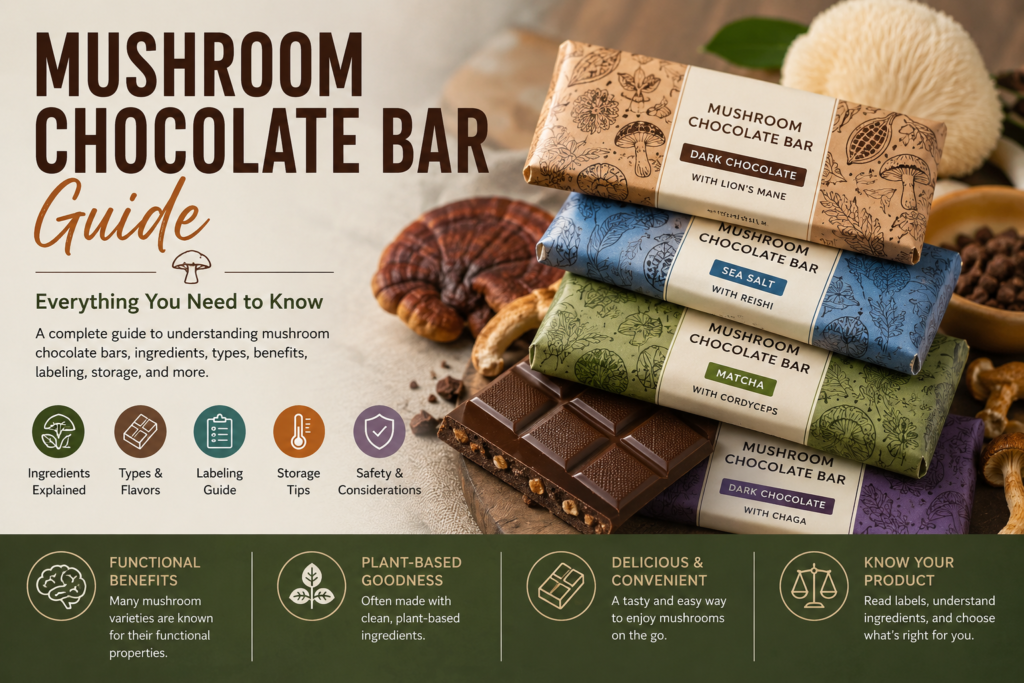
A Mushroom Chocolate Bar Guide should do more than explain what mushroom chocolate is. It should help readers understand the ingredients, mushroom components, chocolate formulations, flavors, labeling, storage requirements, and quality considerations that can differ from one product to another.
Mushroom chocolate has become a broad product category, but not every bar has the same formulation. Some products are made with functional mushroom ingredients such as lion’s mane, reishi, cordyceps, or chaga, while others may use different mushroom-derived ingredients. The chocolate itself can also vary considerably.
This Mushroom Chocolate Bar Guide provides an educational framework for understanding those differences. Rather than assuming that every mushroom chocolate product is identical, readers can use the information below to examine ingredients, labels, manufacturing information, flavors, storage recommendations, and other useful details.
For a broader introduction to the category, explore our Mushroom Chocolate Bars resource.
What Is a Mushroom Chocolate Bar?
A mushroom chocolate bar is a chocolate product that contains one or more mushroom-derived ingredients. Depending on the formulation, the mushroom component may be supplied as a mushroom powder, extract, blend, or another ingredient identified by the manufacturer.
The chocolate base can also vary. Some products use dark chocolate, while others use milk chocolate, white chocolate, or specialty chocolate formulations. Additional ingredients may include nuts, fruit, spices, sweeteners, flavorings, seeds, or other food ingredients.
Consequently, there is no single universal recipe for mushroom chocolate. The term describes a broad category rather than one standardized formula.
Understanding this distinction is one of the first principles in a Mushroom Chocolate Bar Guide. The name printed on the front of a package cannot tell you everything about the product. The ingredient list and manufacturer’s information provide considerably more detail.
Why Mushroom Chocolate Products Can Differ
Two mushroom chocolate bars can look similar while having substantially different formulations. Differences may occur in the type of mushroom used, the form of the mushroom ingredient, the chocolate base, additional ingredients, manufacturing methods, and storage requirements.
When comparing products, consider these factors:
- The mushroom species or mushroom ingredients.
- Whether the mushroom ingredient is a powder, extract, or blend.
- The type of chocolate used.
- Additional flavor ingredients.
- Sweeteners and other food ingredients.
- Allergen information.
- Manufacturer information.
- Storage recommendations.
- Available quality-control information.
This makes careful product comparison much more useful than comparing packaging alone. A good Mushroom Chocolate Bar Guide should encourage readers to examine the complete formulation rather than relying on a product name or marketing phrase.
How to Read a Mushroom Chocolate Label
Learning to read a product label is one of the simplest ways to make better comparisons. Start with the ingredient list rather than the promotional wording on the front of the package.
Look for the following information:
- Specific mushroom ingredients.
- The type of chocolate.
- Sweeteners.
- Flavoring ingredients.
- Milk or dairy ingredients.
- Nuts and other allergens.
- Serving information when provided.
- Storage instructions.
- Manufacturer information.
- Relevant product warnings.
A complete label can help you understand what the product actually contains. If a product description makes broad statements but provides little ingredient information, there is less information available for meaningful comparison.
For more detailed information about formulation, read our Mushroom Chocolate Bar Ingredients guide.
Functional Mushrooms Commonly Used in Chocolate
Functional mushroom products may contain several different mushroom varieties. Some of the most commonly discussed include lion’s mane, reishi, cordyceps, and chaga.
| Mushroom | Common Product Category | What to Check |
|---|---|---|
| Lion’s Mane | Functional mushroom | Whether the label identifies powder, extract, or another form |
| Reishi | Functional mushroom | The specific ingredient and formulation |
| Cordyceps | Functional mushroom | The ingredient form and product labeling |
| Chaga | Functional mushroom | The listed source and formulation |
The presence of one of these mushrooms does not automatically mean that two products are equivalent. The complete formulation, ingredient amounts where disclosed, processing method, and manufacturer’s information should all be considered.
A useful Mushroom Chocolate Bar Guide therefore focuses on the complete product rather than treating a mushroom name as sufficient information.
Mushroom Powder vs Mushroom Extract
Mushroom ingredients can appear in different forms. Some products use mushroom powder, while others use extracts or combinations of different mushroom ingredients.
These terms should not automatically be treated as interchangeable. Processing methods can produce ingredients with different characteristics, and the manufacturer should identify the ingredient clearly.
When comparing products, look for specific terminology on the label. If the formulation is described only as a general mushroom blend, there may be less information available about the individual ingredients.
Dark Chocolate, Milk Chocolate, and White Chocolate
Chocolate type can significantly influence the flavor, sweetness, texture, and overall experience of a mushroom chocolate product.
| Chocolate Type | Typical Characteristics | Potential Preference |
|---|---|---|
| Dark Chocolate | Stronger cocoa character and generally less sweetness | People who prefer intense cocoa flavors |
| Milk Chocolate | Creamier and generally sweeter | People who prefer a softer chocolate profile |
| White Chocolate | Sweet, creamy, and often vanilla-like | People who prefer sweeter chocolate |
There is no universally best chocolate type. Personal preference, dietary requirements, and the rest of the ingredient list should all be considered.
Exploring Mushroom Chocolate Bar Flavors
Flavor variety is another reason mushroom chocolate products can differ substantially. Manufacturers can combine chocolate with fruits, nuts, spices, cookies, extracts, and other ingredients to create distinctive profiles.
Common flavor concepts may include:
- Dark cocoa.
- Milk chocolate.
- Cookies and cream.
- Caramel-inspired combinations.
- Fruit combinations.
- Nut-based flavors.
- Vanilla-inspired combinations.
- Matcha-inspired combinations.
A flavor name should not be considered a substitute for an ingredient list. For example, a product described as having a fruit flavor may contain a specific fruit ingredient, flavoring, or another formulation.
Readers who want to explore this subject further can visit our Mushroom Chocolate Bar Flavors article.
How to Evaluate Mushroom Chocolate Quality
Quality is more difficult to determine from packaging alone. A more useful evaluation considers several aspects of the product at the same time.
Ingredient Transparency
A transparent product should clearly identify its ingredients and provide enough information for a consumer to understand the basic formulation.
Manufacturer Information
Look for identifiable business or manufacturer information, customer-service details, and consistent product documentation.
Packaging Quality
Packaging should protect chocolate from conditions that can negatively affect its quality. Damaged, opened, or compromised packaging deserves additional attention.
Storage Information
Clear storage instructions help consumers understand how to protect the product from excessive heat, humidity, sunlight, and other unfavorable conditions.
Quality-Control Information
Some manufacturers provide information about quality control or testing. When such information is provided, it should clearly relate to the actual product rather than being presented as a vague marketing statement.
These factors form a useful foundation for the evaluation process described throughout this Mushroom Chocolate Bar Guide.
Why Ingredient Transparency Matters
Ingredient transparency is especially important when comparing mushroom chocolate products because formulations can vary so widely.
A detailed ingredient list can help answer questions such as:
- Which mushrooms are included?
- What form are the mushroom ingredients in?
- What type of chocolate is used?
- Are dairy ingredients present?
- Are nuts included?
- Which sweeteners are used?
- What ingredients create the stated flavor?
- Are there ingredients that conflict with a particular dietary preference?
Consumers should therefore compare the actual information supplied for each product rather than assuming that all mushroom chocolate bars have the same composition.
Allergens and Dietary Preferences
Chocolate products can contain common allergens depending on their ingredients and manufacturing environment.
Potential considerations include:
- Milk.
- Tree nuts.
- Peanuts.
- Soy.
- Wheat or gluten-containing ingredients.
- Other ingredients used in specialty flavors.
Anyone with a known food allergy should review the complete allergen statement before consuming a product.
People following plant-based diets should also verify whether a product is specifically formulated and labeled to meet their requirements. Our Vegan Mushroom Chocolate Bars article provides additional educational information about this topic.
How to Store Mushroom Chocolate Bars
Proper storage can help preserve the flavor, texture, and appearance of chocolate. Excessive heat, humidity, direct sunlight, and repeated temperature fluctuations can negatively affect the product.
- Store chocolate in a cool, dry environment.
- Protect it from direct sunlight.
- Avoid excessive heat.
- Protect opened packaging from moisture.
- Follow the manufacturer’s storage recommendations.
Chocolate can also develop a pale coating when exposed to unfavorable temperature or moisture conditions. This phenomenon is commonly associated with chocolate bloom and can affect appearance and texture.
For a more detailed discussion, read our Mushroom Chocolate Bar Storage Guide.
How Long Does Mushroom Chocolate Last?
Shelf life depends on the product formulation, packaging, storage conditions, and manufacturer’s recommendations. There is no single shelf-life period that applies to every mushroom chocolate bar.
Consumers should check the package for applicable date information and follow the manufacturer’s storage instructions.
Exposure to excessive heat or moisture may affect the quality of chocolate even before the stated date. Proper storage is therefore important throughout the product’s usable period.
Our article on How Long Do Mushroom Chocolate Bars Last provides additional information about shelf life and storage.
Comparing Mushroom Chocolate With Other Formats
Mushroom-derived ingredients are available in several different formats, including chocolate bars, gummies, capsules, powders, and other preparations. Each format can have different ingredients, textures, serving formats, and storage considerations.
| Format | Main Characteristic | What to Review |
|---|---|---|
| Chocolate Bar | Food-based chocolate format | Chocolate and mushroom ingredients |
| Gummy | Chewable format | Sweeteners and other ingredients |
| Capsule | Compact supplement format | Specific mushroom formulation |
| Powder | Flexible ingredient format | Ingredient information and serving guidance |
For dedicated comparisons, see Mushroom Chocolate Bar vs Gummies and Mushroom Chocolate Bar vs Capsules.
What Makes a Good Product Description?
A useful product description should provide practical information rather than relying entirely on promotional wording.
Readers should ideally be able to identify:
- The chocolate type.
- The mushroom ingredients.
- The form of those ingredients when disclosed.
- The major additional ingredients.
- Potential allergens.
- Available flavors.
- Storage requirements.
- Relevant manufacturer information.
Detailed descriptions make product comparisons easier because they give readers information they can evaluate. This is particularly important in a category where product formulations can vary considerably.
How to Compare Two Mushroom Chocolate Bars
When comparing two products, use the same criteria for each one. A consistent checklist reduces the influence of branding and packaging.
| Comparison Factor | Question to Ask |
|---|---|
| Mushroom ingredients | Which mushrooms are actually listed? |
| Ingredient form | Is the ingredient identified as powder, extract, or another form? |
| Chocolate | Is it dark, milk, white, or another formulation? |
| Allergens | Does the product contain or potentially contain common allergens? |
| Flavor | Which ingredients create the stated flavor? |
| Storage | What conditions does the manufacturer recommend? |
| Manufacturer | Is clear business information provided? |
This simple comparison method is one of the most practical elements of a Mushroom Chocolate Bar Guide. It turns a general product search into a structured evaluation.
Common Mistakes When Choosing Mushroom Chocolate
Several common mistakes can make it harder to evaluate mushroom chocolate products accurately.
Judging Only by Packaging
Attractive packaging can make a product memorable, but appearance does not explain its formulation. Always check the ingredient information as well.
Assuming Every Product Is Identical
Different mushrooms, chocolate bases, extracts, powders, sweeteners, flavorings, and other ingredients can produce very different products.
Ignoring Allergen Information
People with food allergies should always review the relevant allergen statement and manufacturing information.
Ignoring Storage Instructions
Heat, moisture, sunlight, and temperature fluctuations can affect chocolate quality. Follow the manufacturer’s recommendations.
Relying Entirely on Marketing Claims
Marketing language should not replace concrete product information. Ingredient lists, manufacturer details, and clear labeling provide a stronger basis for comparison.
Scientific and Educational Considerations
Scientific research involving mushrooms covers many areas, including mushroom biology, food science, nutritional composition, mushroom-derived compounds, and ingredient analysis.
However, research on a particular mushroom species should not automatically be interpreted as research on every finished commercial chocolate product containing that mushroom.
It is useful to distinguish between research involving a mushroom species, research involving a mushroom-derived ingredient, and research involving a particular finished formulation.
Readers interested in published scientific literature can use PubMed to search for peer-reviewed biomedical and scientific publications.
The National Center for Complementary and Integrative Health also provides educational resources concerning complementary health approaches and natural products.
Safety and Responsible Product Evaluation
Consumers should read the complete product label and follow the manufacturer’s instructions. Individual circumstances, dietary restrictions, food allergies, medications, and other considerations can influence whether a particular product is appropriate.
Anyone who is uncertain about an ingredient, particularly when taking medication or managing a health condition, should discuss the product’s ingredient list with an appropriately qualified healthcare professional.
It is also important to distinguish functional mushroom products from products containing controlled or psychoactive substances. Different categories may have substantially different legal requirements and safety considerations.
Related Evergreen Mushrooms Resources
This Mushroom Chocolate Bar Guide is part of a broader educational cluster covering different aspects of mushroom chocolate.
- Mushroom Chocolate Bars
- Mushroom Chocolate Bar Benefits
- Mushroom Chocolate Bar Ingredients
- Mushroom Chocolate Bar Flavors
- Mushroom Chocolate Bar Storage Guide
Key Takeaways From This Mushroom Chocolate Bar Guide
- Mushroom chocolate products can have very different formulations.
- The ingredient list is more useful than the product name alone.
- Mushroom powders and extracts should not automatically be considered identical.
- Chocolate type affects flavor, sweetness, and texture.
- Allergen information should be reviewed carefully.
- Storage conditions can influence chocolate quality.
- Manufacturer information can help consumers evaluate transparency.
- Research on a mushroom ingredient does not necessarily establish evidence about every finished commercial product.
Frequently Asked Questions
What is a Mushroom Chocolate Bar Guide?
A Mushroom Chocolate Bar Guide is an educational resource explaining how mushroom chocolate products can differ in ingredients, mushroom formulations, chocolate types, flavors, labeling, storage, and quality considerations.
What mushrooms are commonly used in functional mushroom chocolate?
Functional mushroom chocolate products may contain ingredients such as lion’s mane, reishi, cordyceps, or chaga. The exact formulation varies by manufacturer, so the ingredient list should always be checked.
Are mushroom powder and mushroom extract the same?
No. Powder and extract describe different forms of mushroom-derived ingredients. Consumers should examine the specific terminology and formulation supplied by the manufacturer.
How should mushroom chocolate bars be stored?
Chocolate is generally best protected from excessive heat, humidity, and direct sunlight. Always follow the specific storage instructions supplied with the product.
Does dark chocolate contain more mushroom ingredients?
Not necessarily. The chocolate type does not by itself determine the amount or form of mushroom ingredient. The ingredient list should be used for comparison.
Can mushroom chocolate contain allergens?
Yes. Depending on the recipe and manufacturing environment, mushroom chocolate products may contain or be exposed to ingredients such as milk, nuts, soy, or other common allergens.
How can I compare mushroom chocolate products?
Compare the mushroom ingredients, ingredient form, chocolate type, additional ingredients, allergens, manufacturer information, storage instructions, and available quality information.
Does every mushroom chocolate bar contain the same ingredients?
No. Formulations can vary significantly between manufacturers. Different products may use different mushrooms, chocolate types, sweeteners, flavorings, and other ingredients.
Is mushroom chocolate the same as a mushroom supplement?
Not necessarily. Mushroom chocolate is generally a food-based format, while supplements can include capsules, powders, gummies, and other preparations. The actual formulation should be evaluated individually.
Where can I find scientific information about mushrooms?
Scientific databases such as PubMed can be used to locate published research. When evaluating evidence, distinguish research involving a mushroom species or compound from research involving a specific finished commercial product.
Conclusion
A useful Mushroom Chocolate Bar Guide should help readers evaluate products using concrete information rather than assumptions. Mushroom species, ingredient form, chocolate type, flavor, allergens, labeling, storage, manufacturer information, and available quality documentation can all contribute to a more informed evaluation.
The most reliable approach is to read the complete product information, compare formulations using consistent criteria, follow storage recommendations, and consult authoritative educational resources when researching individual ingredients.
Continue exploring the Evergreen Mushrooms Mushroom Chocolate Bars resource for additional educational information and related articles.
