
Uncategorized
Mushroom Chocolate Bar Flavors
Aug
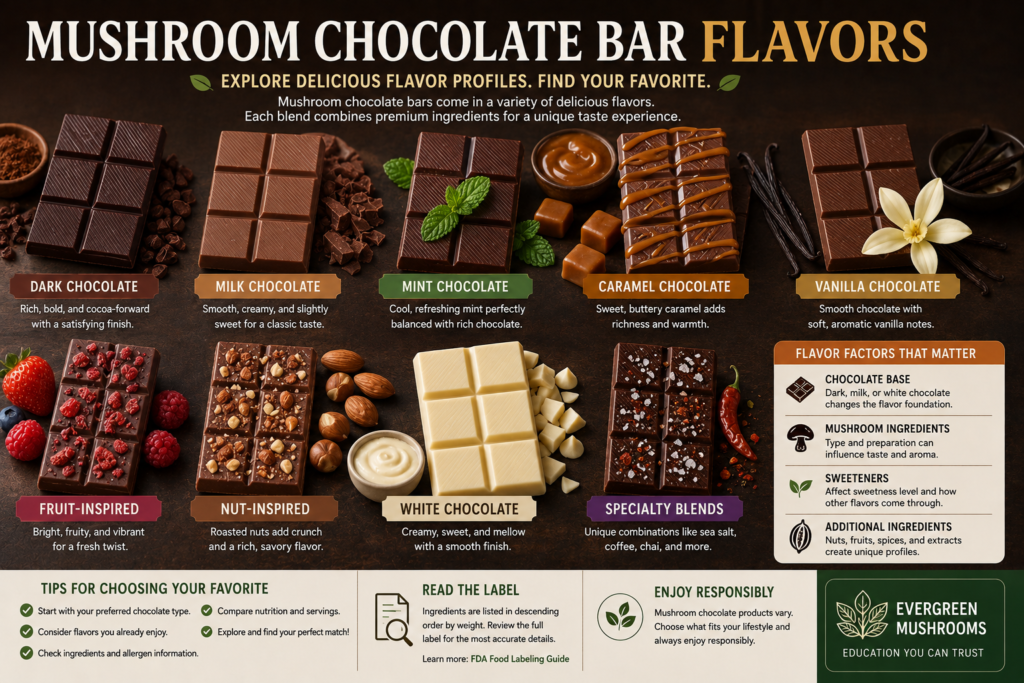
Mushroom Chocolate Bar Flavors: 9 Amazing Choices to Explore
Mushroom Chocolate Bar Flavors can make a major difference in how a mushroom chocolate product tastes and how appealing it is to different consumers. While the mushroom component is an important part of the formulation, chocolate, sweeteners, flavorings, nuts, fruit, spices, and other ingredients can all influence the final taste.
Some people prefer the rich character of dark chocolate, while others may enjoy sweeter combinations such as caramel, vanilla, mint, coconut, or fruit-inspired flavors. The right choice often depends on personal preference as well as the ingredients used in the particular product.
This guide explores common flavor profiles, explains what can influence the taste of mushroom chocolate, and shows how to compare products without relying only on the name printed on the package.
If you are new to mushroom chocolate, begin with our Mushroom Chocolate Bar Guide for a broader introduction to the category.
What Are Mushroom Chocolate Bar Flavors?
Mushroom Chocolate Bar Flavors describe the different taste profiles created by combining chocolate with mushroom ingredients and other flavor components.
A mushroom chocolate bar does not necessarily taste strongly like mushrooms. The final flavor can depend on the type of chocolate, the mushroom preparation, sweeteners, flavorings, and additional ingredients.
Common flavor profiles can include:
- Dark chocolate.
- Milk chocolate.
- White chocolate.
- Mint chocolate.
- Caramel chocolate.
- Vanilla chocolate.
- Fruit-inspired chocolate.
- Nut-inspired chocolate.
- Coconut and other specialty combinations.
Not every manufacturer offers all of these options, and individual products can use very different recipes.
Why Flavor Matters in Mushroom Chocolate
Flavor is more than a marketing detail. It can influence the overall eating experience of a chocolate product.
Mushroom ingredients can sometimes contribute earthy, woody, bitter, or savory notes. Chocolate and additional flavor ingredients may be used to create a more balanced taste.
For example, a darker chocolate may emphasize cocoa bitterness, while caramel or vanilla can create a sweeter profile.
This means that two products containing similar mushroom ingredients may still taste completely different because their chocolate bases and flavoring systems are different.
1. Dark Chocolate Mushroom Bars
Dark chocolate is one of the most recognizable flavor profiles in chocolate products.
It generally has a deeper cocoa character than sweeter milk chocolate formulations. Depending on the cocoa content and recipe, dark chocolate can have notes ranging from mildly sweet to distinctly bitter.
For consumers who enjoy strong cocoa flavors, a dark chocolate formulation may be appealing.
When comparing dark chocolate products, look beyond the word “dark” and review the ingredient list and nutrition information.
The exact recipe determines how sweet, bitter, creamy, or intense the final product tastes.
2. Milk Chocolate Mushroom Bars
Milk chocolate is generally associated with a smoother, creamier, and sweeter flavor profile.
Milk ingredients can soften the stronger cocoa characteristics found in some darker formulations.
This can make milk chocolate attractive to consumers who prefer a familiar candy-bar style flavor.
However, people with milk allergies or dietary restrictions should carefully review the ingredient and allergen information before selecting a product.
When comparing Mushroom Chocolate Bar Flavors, the difference between dark and milk chocolate is often one of the easiest starting points for narrowing down personal preferences.
3. Mint Chocolate
Mint and chocolate are a classic flavor combination.
Mint can provide a cool, refreshing note that contrasts with the richness of cocoa.
Depending on the formulation, mint chocolate can range from subtle and creamy to strongly mint-forward.
Consumers who enjoy peppermint or mint desserts may find this profile particularly appealing.
Check the ingredient list to determine whether the mint flavor comes from a specific mint ingredient or is declared more generally as a flavor.
4. Caramel Chocolate
Caramel is another popular chocolate flavor profile.
It can add sweetness and a rich toasted character to chocolate.
Caramel-inspired mushroom chocolate products may use caramel flavoring, caramel ingredients, or a combination of components to create the desired taste.
Because recipes differ, it is worth checking the label rather than assuming that every caramel chocolate product contains the same ingredients.
People monitoring sugar intake should also review the nutrition information rather than judging sweetness from the product name alone.
5. Vanilla Chocolate
Vanilla can provide a softer and more familiar flavor profile.
It is often used to complement chocolate rather than overpower it.
A vanilla chocolate formulation may taste creamy, sweet, or mildly aromatic depending on the other ingredients in the recipe.
Vanilla can also be combined with other flavors such as caramel, coconut, nuts, or fruit.
This makes vanilla one of the more versatile flavor components used in chocolate products.
6. Fruit-Inspired Chocolate Flavors
Fruit and chocolate can create a wide variety of flavor combinations.
Possible profiles include:
- Strawberry.
- Raspberry.
- Cherry.
- Orange.
- Blueberry.
- Banana.
- Coconut.
Fruit-inspired products can introduce sweetness, acidity, or a brighter flavor that contrasts with the richness of chocolate.
The actual ingredients can vary significantly. Some products may use fruit pieces, fruit powders, concentrates, or flavoring ingredients.
Always check the ingredient list if a specific fruit or dietary concern matters to you.
7. Nut-Inspired Chocolate Flavors
Nuts can contribute both flavor and texture to chocolate.
Popular combinations can include:
- Almond chocolate.
- Hazelnut chocolate.
- Peanut chocolate.
- Pistachio chocolate.
- Coconut and nut combinations.
Nut-based flavors can add roasted, creamy, or earthy characteristics that complement cocoa.
However, nuts are also important allergens. Anyone with a known food allergy should review the ingredient list and allergen statement carefully.
8. White Chocolate-Inspired Flavors
White chocolate has a different flavor profile from dark and milk chocolate because its formulation does not contain the same cocoa solids found in conventional dark chocolate.
It is commonly associated with creamy, sweet, and vanilla-like characteristics.
White chocolate can also be paired with fruit, caramel, nuts, or other flavor ingredients.
Consumers comparing Mushroom Chocolate Bar Flavors may therefore want to consider the chocolate base before focusing on secondary flavor additions.
9. Specialty Flavor Combinations
Some manufacturers create more unusual combinations rather than relying on traditional chocolate flavors.
Specialty combinations may include:
- Sea salt and chocolate.
- Espresso and chocolate.
- Spiced chocolate.
- Coconut chocolate.
- Chili chocolate.
- Cookies and cream.
- Peanut butter chocolate.
These combinations can produce more distinctive flavor experiences.
However, the more ingredients a product contains, the more important it becomes to read the complete label.
Mushroom Chocolate Bar Flavors Comparison
| Flavor Profile | Typical Taste Character | Potential Consideration |
|---|---|---|
| Dark chocolate | Rich and cocoa-forward | Can have more bitterness |
| Milk chocolate | Creamy and sweet | May contain dairy |
| Mint chocolate | Cool and refreshing | Check flavor ingredients |
| Caramel | Sweet and rich | Check sugar content |
| Vanilla | Soft and aromatic | May be combined with other flavors |
| Fruit | Bright and sweet or tangy | Check fruit and flavor ingredients |
| Nut | Roasted and creamy | Important allergen consideration |
| White chocolate | Creamy and sweet | Different cocoa composition |
| Specialty blends | Distinctive and complex | Review the complete ingredient list |
What Makes Mushroom Chocolate Taste Earthy?
The earthy character sometimes associated with mushroom chocolate can come from the mushroom ingredient itself.
Mushrooms naturally have different aromas and flavors depending on the species and preparation.
Powders and extracts can also contribute different characteristics to a finished formulation.
Chocolate manufacturers may balance these notes using cocoa, sweeteners, vanilla, mint, caramel, fruit, or other flavor ingredients.
This is one reason that Mushroom Chocolate Bar Flavors can vary so widely even when two products contain mushrooms from the same general category.
How the Chocolate Base Changes the Flavor
The chocolate base is one of the biggest factors affecting flavor.
| Chocolate Base | General Character |
|---|---|
| Dark chocolate | Strong cocoa character with varying bitterness |
| Milk chocolate | Creamier and generally sweeter |
| White chocolate | Sweet and creamy with vanilla-like notes |
| Specialty chocolate | Can have distinctive cocoa or added flavor characteristics |
The chocolate base should therefore be considered alongside the mushroom ingredient and additional flavor components.
How Sweeteners Affect Mushroom Chocolate Flavor
Sweeteners can change the balance between cocoa, mushroom, and other flavors.
A sweeter recipe can reduce the perception of bitterness, while a less sweet formulation may allow cocoa and mushroom notes to become more noticeable.
Consumers should check the ingredient list and nutrition information when comparing sweetness between products.
FDA explains that food ingredients are generally listed in descending order of predominance by weight, which makes the ingredient list a useful tool for understanding the overall formulation. FDA food ingredient guidance provides additional information.
Natural and Artificial Flavors
Some packaged foods use terms such as natural flavor or artificial flavor on their ingredient lists.
These terms can describe flavor ingredients without necessarily identifying every individual flavor compound on the front of the package.
FDA explains that certain flavors can be declared collectively using terms such as “natural flavor” or “artificial flavor” under applicable labeling rules.
Therefore, if a particular flavor ingredient matters to you, review the full label and manufacturer information rather than relying only on the flavor name displayed on the front.
How to Choose a Mushroom Chocolate Flavor
Choosing between Mushroom Chocolate Bar Flavors can be easier when you begin with familiar preferences.
Consider the following:
- Choose your preferred chocolate base.
- Decide whether you prefer sweeter or stronger cocoa flavors.
- Consider whether you enjoy mint, caramel, vanilla, fruit, or nuts.
- Check the complete ingredient list.
- Review allergen information.
- Compare nutrition information.
- Check the manufacturer’s product description.
Someone who enjoys dark chocolate may prefer a cocoa-forward product, while someone who prefers sweeter desserts may gravitate toward caramel or vanilla combinations.
Flavor Does Not Determine Product Quality
A particular flavor should not automatically be considered better than another.
Flavor is largely a matter of preference.
Product quality should instead be considered using broader criteria such as ingredient transparency, accurate labeling, manufacturing information, product suitability, and consistency.
A complicated flavor name does not necessarily mean that a product is better than a simple dark chocolate formulation.
Similarly, a product with fewer flavor ingredients is not automatically superior.
How to Read a Flavor Label
A product’s flavor name should be treated as the starting point rather than the complete description.
Check:
- The chocolate type.
- The mushroom ingredient.
- The flavoring ingredients.
- The sweetener.
- Dairy ingredients.
- Nuts and other allergens.
- Additional inclusions.
This approach makes it easier to understand what creates the actual flavor profile.
Mushroom Chocolate Flavors and Dietary Preferences
Flavor selection can also intersect with dietary preferences.
For example, someone following a vegan diet may need to avoid milk ingredients. Someone with a nut allergy may need to avoid certain nut-based flavors.
People monitoring sugar intake may also want to compare nutrition information between different flavor options.
Do not assume that a flavor automatically tells you whether a product is vegan, dairy-free, gluten-free, or suitable for a particular diet.
The complete ingredient list is the more useful reference.
Allergens to Watch For
Some Mushroom Chocolate Bar Flavors may contain common allergens because of their added ingredients.
Potential examples include:
- Milk.
- Peanuts.
- Tree nuts.
- Soy.
- Other ingredients relevant to specific dietary restrictions.
Packaged-food allergen information should be reviewed carefully by anyone with a known food allergy.
If a product is manufactured in a facility that handles allergens, the manufacturer’s cross-contact information may also be relevant.
What About Mushroom Chocolate Products With Psychoactive Ingredients?
The term mushroom chocolate can be used for products with substantially different formulations.
Some products are made with functional mushrooms, while others may be marketed using terminology associated with psychoactive mushrooms.
These products should not automatically be treated as equivalent.
This article focuses on flavor profiles and food-label considerations. It does not provide instructions for consuming or dosing psilocybin or other controlled psychoactive substances.
Anyone researching an unfamiliar mushroom chocolate product should determine exactly what ingredients it contains and consider applicable laws and safety information.
Safety and Ingredient Awareness
Flavor should never be the only consideration when evaluating a mushroom-containing product.
NCCIH explains that the safety of complementary health products depends on the specific product and that some products may interact with medications or pose risks for people with certain medical conditions. NCCIH safety information provides additional educational guidance.
NCCIH also advises consumers to tell healthcare providers about supplements and complementary products they use because this can help identify potential interactions. NCCIH information about medication and supplement interactions provides further context.
This is especially relevant when a mushroom chocolate product contains ingredients beyond ordinary food components.
Related Mushroom Chocolate Guides
Continue exploring the Evergreen Mushrooms educational cluster:
- Mushroom Chocolate Bar Guide
- Mushroom Chocolate Bar Benefits
- Mushroom Chocolate Bar Effects
- Mushroom Chocolate Bar Dosage
- How to Use Mushroom Chocolate Bars
- Mushroom Chocolate Bar Ingredients
Explore Mushroom Chocolate Bars
Explore the wider Mushroom Chocolate Bars category for additional products and educational resources.
Readers interested specifically in Polkadot products can also visit the Polkadot Mushroom Chocolate Bars collection.
Frequently Asked Questions About Mushroom Chocolate Bar Flavors
What are the most common Mushroom Chocolate Bar Flavors?
Common flavor profiles include dark chocolate, milk chocolate, mint, caramel, vanilla, fruit, nuts, white chocolate, and specialty combinations.
Do mushroom chocolate bars taste like mushrooms?
They can have earthy or savory notes depending on the mushroom ingredient, but the final taste is influenced by the chocolate, sweeteners, extracts, powders, and additional flavor ingredients.
Which mushroom chocolate flavor is sweetest?
There is no universal answer because sweetness depends on the individual recipe. Caramel, milk chocolate, vanilla, and some fruit-inspired products may be formulated with sweeter profiles, but the label and nutrition information provide a better indication.
Is dark chocolate mushroom chocolate bitter?
It can have a stronger cocoa character and may taste more bitter than sweeter chocolate formulations. The exact flavor depends on the cocoa content and recipe.
Are mint mushroom chocolate bars sweet?
They can be, but sweetness varies by product. Mint primarily contributes a cooling flavor, while the chocolate and sweeteners determine much of the overall sweetness.
Are nut-flavored mushroom chocolates safe for people with nut allergies?
People with nut allergies should not assume that a nut-flavored or non-nut-flavored product is safe without checking the ingredient and allergen information. Manufacturing cross-contact may also be relevant.
Can mushroom chocolate be vegan?
Yes, some formulations may be made without animal-derived ingredients. However, consumers should check the complete ingredient list and product labeling rather than assuming that every mushroom chocolate bar is vegan.
How do I choose between different flavors?
Start with your preferred chocolate type, then consider whether you prefer mint, caramel, vanilla, fruit, nuts, or specialty combinations. After that, compare the ingredient and nutrition labels.
Does flavor tell me what is in the chocolate?
Not completely. The flavor name describes the intended taste profile, but the complete ingredient list provides much more information about the actual formulation.
Where can I explore different mushroom chocolate products?
You can browse the Evergreen Mushrooms Mushroom Chocolate Bars category or explore the Polkadot Mushroom Chocolate Bars collection.
Final Thoughts on Mushroom Chocolate Bar Flavors
Mushroom Chocolate Bar Flavors range from familiar choices such as dark and milk chocolate to combinations featuring mint, caramel, vanilla, fruit, nuts, and other specialty ingredients.
The mushroom itself is only one part of the overall flavor experience. The chocolate base, sweeteners, flavorings, and additional ingredients can all influence the final taste.
The best way to compare products is to start with your own flavor preferences and then check the complete ingredient list, allergen information, and nutrition label.
Flavor should also be considered separately from product quality. A particular flavor name does not automatically indicate that a product is better or more suitable than another.
For more information, continue exploring the Evergreen Mushrooms Mushroom Chocolate Bar Guide, review our Mushroom Chocolate Bar Ingredients article, or explore the Mushroom Chocolate Bars category.
