
Uncategorized
Mushroom Chocolate Bar Ingredients
Aug
Mushroom Chocolate Bar Ingredients: 9 Essential Tips for Better Choices
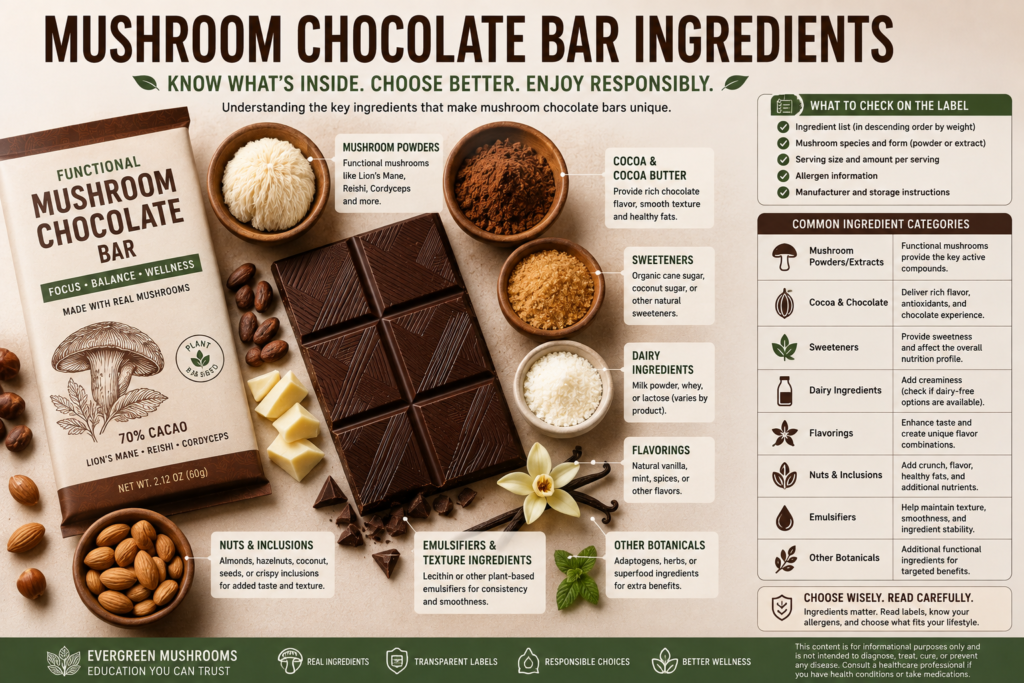
Mushroom Chocolate Bar Ingredients can vary considerably from one product to another. Although the name may make the mushroom component seem like the most important part of the product, a chocolate bar can contain many other ingredients, including cocoa, cocoa butter, sweeteners, milk ingredients, nuts, flavorings, emulsifiers, and mushroom powders or extracts.
Understanding the complete ingredient list is one of the easiest ways to compare mushroom chocolate products. It can help you identify the mushroom used, understand the form of the mushroom ingredient, recognize potential allergens, and determine what else is included in the chocolate.
This guide explains the major ingredient categories found in mushroom chocolate products and shows how to read the label without relying solely on marketing claims.
If you are new to the category, start with our Mushroom Chocolate Bar Guide for a broader introduction.
What Are Mushroom Chocolate Bar Ingredients?
Mushroom Chocolate Bar Ingredients are the individual components used to produce a finished chocolate product containing mushroom material.
These ingredients can be divided into several broad categories:
- Mushroom powders or extracts.
- Cocoa or chocolate.
- Cocoa butter or other fats.
- Sugar and other sweeteners.
- Milk ingredients.
- Flavorings.
- Nuts and other inclusions.
- Emulsifiers and texture-related ingredients.
- Other functional or botanical ingredients.
Not every product contains all of these components. The formulation depends on the manufacturer, the type of chocolate, the mushroom preparation, the desired flavor, and the characteristics of the finished product.
1. Mushroom Powder
One of the most obvious Mushroom Chocolate Bar Ingredients is mushroom powder.
Mushroom powder is generally produced by processing dried mushroom material into a powder that can be incorporated into another food product. The label may identify the mushroom by its common name, scientific name, or both.
Common functional mushroom varieties used in food and supplement products can include:
- Lion’s mane.
- Reishi.
- Cordyceps.
- Chaga.
- Turkey tail.
A product may contain one mushroom or a blend of several mushrooms.
When reading the label, look for the exact mushroom listed rather than relying on a general phrase such as “mushroom blend.”
If several mushrooms are present, check whether the manufacturer identifies each one and provides information about their amounts.
2. Mushroom Extracts
Another possible ingredient is mushroom extract.
An extract is different from simply using whole mushroom powder. The term indicates that the mushroom material has undergone a processing step intended to produce an extract.
Product labels can vary in how much information they provide about an extract. Some may identify the mushroom species and amount, while others may provide additional information about the extraction process.
When comparing two products, do not automatically assume that the same weight of a powder and an extract represents identical material.
The form of the mushroom ingredient is therefore an important part of evaluating Mushroom Chocolate Bar Ingredients.
3. Cocoa and Chocolate
The mushroom component is only one part of a mushroom chocolate bar. Cocoa and chocolate ingredients generally provide the main chocolate character of the product.
Depending on the formulation, a product may contain:
- Cocoa solids.
- Cocoa powder.
- Cocoa butter.
- Chocolate liquor.
- Milk chocolate ingredients.
- Dark chocolate ingredients.
The type of chocolate can influence the flavor, sweetness, texture, and nutritional profile of the finished product.
This is why two products containing similar mushroom ingredients can still taste and feel very different.
4. Cocoa Butter and Other Fats
Cocoa butter is a naturally occurring fat obtained from cocoa beans and is commonly used in chocolate manufacturing.
Fats help contribute to the smooth texture and melting characteristics consumers associate with chocolate.
Some products may also contain other fats or oils depending on their formulation.
When comparing Mushroom Chocolate Bar Ingredients, the presence and type of fats can therefore be useful information, especially for consumers following particular dietary preferences.
5. Sugar and Sweeteners
Sweeteners are another important category to check.
Chocolate products can contain different types of sweeteners depending on their formulation. These may include conventional sugar or alternative sweetening ingredients.
Consumers who monitor their sugar intake should review the nutrition information and ingredient list rather than assuming that a product is low in sugar simply because it contains mushrooms.
The U.S. Food and Drug Administration explains that food ingredients are generally listed in descending order of predominance by weight.
You can review the FDA’s information about types of food ingredients for additional background.
6. Milk and Dairy Ingredients
Some mushroom chocolate products are made with milk chocolate or contain dairy-derived ingredients.
Possible dairy-related ingredients can include:
- Milk.
- Milk powder.
- Milk fat.
- Whey.
- Lactose.
People with milk allergies or certain dietary restrictions should pay particular attention to the ingredient and allergen information.
It is also important to distinguish between a product that contains milk ingredients and one that is specifically formulated as dairy-free or vegan.
7. Flavorings
Flavorings can be used to create a particular taste profile or complement the natural flavor of mushroom ingredients.
Depending on the product, flavor components may include:
- Vanilla.
- Mint.
- Caramel.
- Fruit flavors.
- Nut flavors.
- Spices.
Flavorings can make mushroom chocolate more approachable for people who do not enjoy the earthy character that some mushroom ingredients may contribute.
For more information about different taste profiles, see our Mushroom Chocolate Bar Flavors article.
8. Nuts and Other Inclusions
Some chocolate bars contain additional ingredients that provide texture and flavor.
Examples include:
- Almonds.
- Hazelnuts.
- Peanuts.
- Coconut.
- Seeds.
- Dried fruit.
- Crispy ingredients.
These additions can change both the nutritional profile and allergen considerations of the product.
Always check the allergen statement and manufacturing information if you have a known food allergy.
9. Emulsifiers and Texture Ingredients
Some chocolate formulations contain ingredients that help maintain texture, consistency, or stability.
For example, lecithin may be used as an emulsifier in chocolate products.
The FDA describes emulsifiers as ingredients that can help ingredients mix smoothly, prevent separation, maintain stability, and control characteristics such as crystallization.
These ingredients do not necessarily indicate that a product is inferior. Their function should be considered in the context of the complete formulation.
Mushroom Chocolate Bar Ingredients at a Glance
| Ingredient Category | Typical Purpose | What to Check |
|---|---|---|
| Mushroom powder | Provides mushroom material | Mushroom species and amount |
| Mushroom extract | Provides processed mushroom material | Species, amount, and extract information |
| Cocoa | Provides chocolate flavor and character | Cocoa type and position on ingredient list |
| Cocoa butter | Contributes texture and melting characteristics | Fat content and formulation |
| Sweeteners | Provide sweetness | Type and quantity |
| Milk ingredients | Used in some chocolate formulations | Milk and allergen information |
| Flavorings | Enhance or modify taste | Flavor profile |
| Nuts and inclusions | Add flavor and texture | Allergen information |
| Emulsifiers | Support texture and consistency | Specific ingredient used |
How to Read a Mushroom Chocolate Ingredient List
Reading the label is easier when you approach it systematically.
Start by looking at the first several ingredients. Since food ingredients are generally listed in descending order by weight, the beginning of the list can help show which components make up the largest portions of the product.
Then look for the mushroom ingredient.
Ask the following questions:
- Which mushroom species are listed?
- Is the mushroom a powder or extract?
- Is the amount provided?
- Does the product contain a mushroom blend?
- What type of chocolate is used?
- What sweetener is included?
- Are dairy ingredients present?
- Are nuts or other allergens present?
- Are additional botanical or functional ingredients included?
This approach provides a much clearer picture than relying on the product name alone.
Mushroom Powder vs. Mushroom Extract
One of the most useful distinctions to understand is the difference between mushroom powder and mushroom extract.
| Feature | Mushroom Powder | Mushroom Extract |
|---|---|---|
| Basic form | Processed dried mushroom material | Processed extract derived from mushroom material |
| Label information | May identify species and amount | May identify species, amount, and extract details |
| Comparison | Best compared with similar powders | Best compared with similar extracts |
| Consumer consideration | Check exact mushroom and quantity | Check exact mushroom and available extract information |
Neither term by itself tells you everything about a finished product. The rest of the label remains important.
Why the Ingredient List Matters More Than Marketing Claims
Front-of-package language can be useful for identifying a product, but it should not replace reading the ingredient list.
A product may emphasize a particular mushroom on the front while containing many other ingredients that contribute to the final product.
Consumers should therefore compare the actual ingredient list with the product’s marketing description.
This is particularly important when evaluating products that make broad claims about wellness or performance.
NCCIH provides consumer information about complementary health approaches and encourages consumers to consider available evidence and safety when evaluating these products.
You can review the NCCIH consumer information for additional educational context.
Allergens in Mushroom Chocolate Bars
Allergen awareness is an important part of understanding Mushroom Chocolate Bar Ingredients.
Depending on the formulation, chocolate products can contain or come into contact with common allergens.
Potential concerns can include:
- Milk.
- Peanuts.
- Tree nuts.
- Soy.
- Wheat or other grain ingredients in certain formulations.
Always check the product’s allergen statement and manufacturing information if you have an allergy.
Do not rely solely on the absence of an allergen from the front of the package.
What Makes a Mushroom Chocolate Bar Vegan?
Vegan mushroom chocolate products generally avoid animal-derived ingredients such as milk and certain dairy-based components.
However, consumers should check the complete ingredient list rather than assuming that a chocolate product is vegan because it contains mushrooms.
The chocolate base, sweeteners, flavorings, and other components all need to be considered.
Our Vegan Mushroom Chocolate Bars article can provide a more focused look at this topic.
Ingredients and Product Quality
The presence of a particular ingredient does not automatically determine whether a product is good or bad.
Quality is better evaluated by considering the complete formulation, ingredient transparency, manufacturing information, labeling, and suitability for the individual consumer.
NCCIH notes that complementary products can vary and that consumers should consider possible safety concerns and interactions when evaluating products.
Read the NCCIH safety information when researching general safety considerations.
This is a useful reminder not to assume that research involving one mushroom preparation automatically describes every commercial product containing that mushroom.
How to Compare Two Mushroom Chocolate Bars
If you are comparing two products, create a simple ingredient checklist.
- Identify the mushroom species.
- Determine whether the mushroom is powder or extract.
- Check the amount listed per serving.
- Review the chocolate ingredients.
- Compare sweeteners.
- Check dairy ingredients.
- Look for nuts and allergens.
- Review flavorings and other additions.
- Check serving information.
- Read the manufacturer’s directions and warnings.
This gives you a more useful comparison than looking only at package size or price.
When comparing Mushroom Chocolate Bar Ingredients, use the same checklist for each product so that differences in formulation are easier to identify.
What to Look for in a Transparent Label
A transparent product label should make it reasonably easy to identify the major components of the product.
Useful information can include:
- A clearly identified mushroom species.
- The form of the mushroom ingredient.
- Serving information.
- A complete ingredient list.
- Allergen information.
- Manufacturer information.
- Storage instructions.
- Relevant warnings.
The more clearly a product communicates these details, the easier it is for consumers to make an informed comparison.
Safety Considerations for Mushroom Chocolate Ingredients
Understanding the ingredients is also important from a safety perspective.
NCCIH emphasizes that natural products are not automatically safe and that safety depends on the specific product and individual circumstances.
Consumers should consider factors such as allergies, existing health conditions, medications, pregnancy, dietary restrictions, and other individual circumstances when evaluating mushroom-containing products.
If there is uncertainty about whether a particular mushroom ingredient is appropriate for you, speaking with a qualified healthcare professional is a sensible step.
These considerations are another reason why carefully reviewing Mushroom Chocolate Bar Ingredients is preferable to relying only on advertising language.
What About Mushroom Chocolate Containing Psychoactive Ingredients?
The term mushroom chocolate can describe products with very different formulations.
Some products may contain functional mushrooms, while others may be marketed using terms associated with psychoactive mushrooms.
These products should not automatically be considered equivalent.
This article focuses on understanding food and functional mushroom product labels and does not provide instructions for consuming or dosing psilocybin or other controlled psychoactive substances.
Consumers should determine what a product actually contains and consider applicable laws and safety information before making decisions about unfamiliar products.
Related Mushroom Chocolate Resources
Continue through the Evergreen Mushrooms educational cluster for additional information:
- Mushroom Chocolate Bar Guide
- Mushroom Chocolate Bar Benefits
- Mushroom Chocolate Bar Effects
- Mushroom Chocolate Bar Dosage
- How to Use Mushroom Chocolate Bars
Explore Mushroom Chocolate Bars
Readers who want to explore the broader product category can visit the Mushroom Chocolate Bars category.
For readers specifically interested in the Polkadot collection, visit the Polkadot Mushroom Chocolate Bars category.
Frequently Asked Questions About Mushroom Chocolate Bar Ingredients
What are the main Mushroom Chocolate Bar Ingredients?
The main ingredients can include mushroom powder or extract, cocoa or chocolate, cocoa butter, sweeteners, milk ingredients, flavorings, nuts, emulsifiers, and other components depending on the product.
What mushroom is usually found in mushroom chocolate?
There is no single mushroom used in every product. Functional mushroom chocolates can contain lion’s mane, reishi, Cordyceps, chaga, turkey tail, or blends of several mushrooms.
Is mushroom powder the same as mushroom extract?
No. Mushroom powder and mushroom extract describe different forms of mushroom material. Consumers should check the specific preparation and information provided by the manufacturer.
Why should I read the complete ingredient list?
The complete ingredient list shows what else is included in the chocolate besides the mushroom component. It can help identify sweeteners, dairy ingredients, nuts, flavorings, and other components.
Are mushroom chocolate bars dairy-free?
Not necessarily. Some products contain milk or other dairy ingredients, while others may be formulated without them. Check the ingredient and allergen information for the specific product.
Are mushroom chocolate bars vegan?
Some can be, but not all. A vegan product needs to avoid animal-derived ingredients throughout its formulation. Always check the complete ingredient list and product labeling.
Why are emulsifiers used in chocolate?
Emulsifiers can help ingredients mix smoothly and support the texture and stability of a chocolate formulation. The FDA identifies emulsifiers as one category of food ingredients used for functions such as maintaining stable mixtures and controlling crystallization.
How can I compare mushroom chocolate ingredients?
Compare the mushroom species, ingredient form, amount per serving, chocolate base, sweeteners, dairy, allergens, flavorings, and other ingredients rather than relying only on package size or marketing claims.
Does the ingredient list show which ingredients are used most?
For foods covered by standard ingredient-labeling requirements, ingredients are generally listed in descending order by weight, with ingredients used in greater amounts appearing earlier in the list.
Are mushroom chocolate ingredients automatically safe because they are natural?
No. Natural does not automatically mean safe. Safety depends on the specific ingredients, product, individual circumstances, and potential interactions. Consumers should consider appropriate professional advice when they have health or medication concerns.
Final Thoughts on Mushroom Chocolate Bar Ingredients
Understanding Mushroom Chocolate Bar Ingredients gives consumers a clearer picture of what they are actually buying.
The mushroom itself is only one part of the formulation. Cocoa, cocoa butter, sweeteners, dairy, flavorings, nuts, emulsifiers, and other ingredients can all contribute to the finished product.
The best approach is to read the complete ingredient list, identify the mushroom species and preparation, check the serving information, review allergens, and consider any additional ingredients that may be relevant to your dietary or health circumstances.
Rather than judging a product solely by its front label, use the complete ingredient information to make comparisons.
When researching Mushroom Chocolate Bar Ingredients, authoritative food-label information can provide useful context alongside the manufacturer’s own product information.
For more educational information, continue to the Evergreen Mushrooms Mushroom Chocolate Bar Guide, explore the Mushroom Chocolate Bars category, or browse the Polkadot Mushroom Chocolate Bars collection.
