
Uncategorized
Mushroom Chocolate Bar Effects
Aug
Mushroom Chocolate Bar Effects: 7 Important Facts to Know
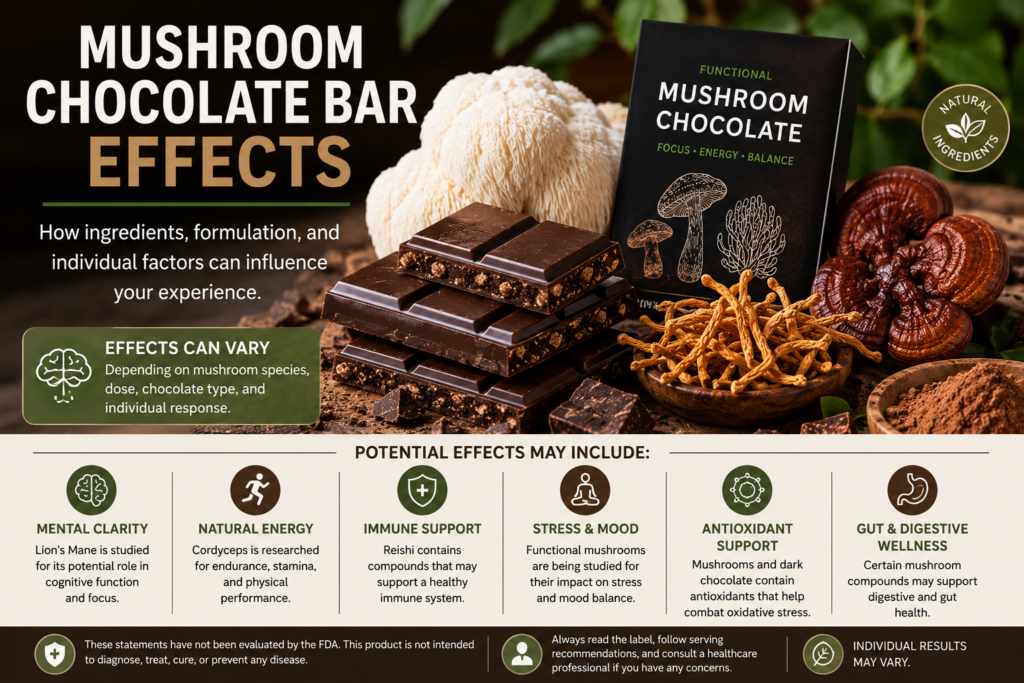
Mushroom Chocolate Bar Effects can mean different things depending on the ingredients, mushroom species, chocolate formulation, serving size, and individual consumer. A chocolate bar containing lion’s mane, reishi, cordyceps, or another mushroom ingredient should not automatically be expected to produce the same experience as a different formulation.
Mushroom chocolate has become increasingly popular as manufacturers combine familiar chocolate formats with functional mushroom ingredients. However, understanding the potential effects requires looking at the complete product rather than focusing only on the word “mushroom” on the package.
This guide examines Mushroom Chocolate Bar Effects from an educational perspective. It explains how the chocolate itself, functional mushroom ingredients, serving size, formulation, individual differences, and available scientific evidence can influence what consumers may notice.
For broader information about this category, visit our Mushroom Chocolate Bars resource.
What Are Mushroom Chocolate Bar Effects?
The phrase Mushroom Chocolate Bar Effects does not describe one standardized experience. Different mushroom chocolate products can contain completely different ingredients and formulations.
For example, one product may contain lion’s mane, while another may contain reishi or cordyceps. Some products may contain a blend of several mushroom ingredients. The chocolate base can also differ, with products using dark chocolate, milk chocolate, white chocolate, or other formulations.
Because of these differences, it is not scientifically accurate to assume that every mushroom chocolate bar will produce the same effects.
A useful way to understand the category is to separate three components:
- The effects and characteristics associated with the chocolate or cocoa component.
- The properties being investigated in the mushroom ingredient.
- The characteristics of the complete finished product.
These components can overlap, but they should not be treated as identical.
1. The Mushroom Ingredient Can Influence the Product
One of the most important factors affecting potential Mushroom Chocolate Bar Effects is the specific mushroom ingredient used.
Functional mushroom products commonly feature species such as lion’s mane, reishi, cordyceps, chaga, and turkey tail. These mushrooms contain different naturally occurring compounds and have been investigated for different biological properties.
A review published in PubMed describes medicinal mushrooms as sources of compounds including beta-glucans, triterpenes, phenolic compounds, and sterols. The review also discusses their growing use in functional foods. :contentReference[oaicite:0]{index=0}
This means that the mushroom species should always be identified before trying to understand a product’s potential characteristics.
2. Lion’s Mane May Have Different Research Than Reishi
Lion’s mane and reishi are both popular functional mushrooms, but they have been investigated in different ways.
Lion’s mane, or Hericium erinaceus, has attracted scientific interest because of compounds found in its fruiting bodies and mycelium. Research has investigated possible relationships with cognitive function, mood, neurological processes, and other biological pathways.
A 2025 systematic review examined human and laboratory research involving lion’s mane. It included randomized controlled trials and smaller clinical studies, but the researchers also highlighted the limitations of the existing evidence. :contentReference[oaicite:1]{index=1}
Another review examining mushrooms and mood and neurocognitive health found mixed results among human intervention studies and concluded that additional research is needed. :contentReference[oaicite:2]{index=2}
Therefore, consumers should distinguish between a mushroom being scientifically investigated and a specific chocolate product being clinically demonstrated to produce a particular result.
3. Reishi Has Its Own Research Profile
Reishi, commonly associated with Ganoderma species, has a long history of traditional use and extensive laboratory research.
Scientific reviews have investigated reishi compounds including polysaccharides and triterpenes. Researchers have explored several possible biological activities, but much of the evidence remains preclinical or otherwise insufficient to establish specific effects for every commercial product.
A critical review published in PubMed noted that reishi research covers numerous biological areas but also emphasized the need for stronger clinical evidence regarding efficacy and safety in humans. :contentReference[oaicite:3]{index=3}
Consequently, the possible Mushroom Chocolate Bar Effects of a reishi-containing product should not be described as guaranteed medical outcomes.
4. Cordyceps Is Being Studied for Exercise-Related Effects
Cordyceps has become particularly popular in functional-food and sports-nutrition discussions.
Researchers have investigated Cordyceps species for possible relationships with endurance, exercise performance, and recovery. Recent human research continues to examine these questions.
A 2026 narrative review assessed human evidence involving Cordyceps militaris and reported that only a limited number of intervention studies were available. The authors emphasized the need for additional research to clarify the evidence. :contentReference[oaicite:4]{index=4}
A separate systematic review and meta-analysis examined fungal supplementation and endurance-related outcomes in athletes. Although some positive findings were reported, these results involved specific supplementation protocols and should not automatically be applied to every chocolate product containing Cordyceps. :contentReference[oaicite:5]{index=5}
5. Chocolate Itself Can Influence the Experience
When discussing Mushroom Chocolate Bar Effects, it is easy to overlook the chocolate component.
Chocolate contains cocoa compounds, sugars, fats, and other ingredients depending on the formulation. Dark chocolate, milk chocolate, and white chocolate can therefore differ substantially in composition.
Chocolate and cocoa have themselves been studied for possible effects on areas such as cardiovascular markers and cognitive function. However, systematic reviews have found that the evidence is mixed and often limited by study duration, dosage differences, and other methodological factors. :contentReference[oaicite:6]{index=6}
This is another reason why a mushroom chocolate product should be evaluated as a complete food rather than attributing every perceived characteristic exclusively to the mushroom ingredient.
6. The Form of the Mushroom Ingredient Matters
The same mushroom species can appear in different forms.
| Ingredient Form | General Description | Why It Matters |
|---|---|---|
| Whole Mushroom Powder | Dried mushroom that has been processed into powder | Contains a broad mixture of mushroom components |
| Extract | Mushroom material processed to concentrate or isolate certain components | Composition may differ from whole mushroom powder |
| Mycelial Material | Material derived from the fungal mycelium | May have a different chemical profile from fruiting bodies |
| Mushroom Blend | Combination of multiple mushroom ingredients | Potential characteristics depend on the complete blend |
These differences are important because research conducted on one preparation cannot automatically be applied to every other preparation.
Consumers should therefore examine the ingredient list and manufacturer information before drawing conclusions about potential Mushroom Chocolate Bar Effects.
7. Individual Responses Can Differ
Even when two people consume the same food product, their experiences may differ.
Individual factors can include:
- Dietary habits.
- Individual sensitivity to caffeine or cocoa.
- Food allergies or intolerances.
- Existing health conditions.
- Medications or supplements.
- Previous exposure to particular ingredients.
- Overall diet and lifestyle.
This variability makes broad claims about how every person will respond to a mushroom chocolate bar inappropriate.
The National Center for Complementary and Integrative Health also emphasizes that natural products can have safety considerations and that evidence should be evaluated carefully rather than assuming that natural ingredients are automatically risk-free.
Mushroom Chocolate Bar Effects vs Mushroom Research
One of the most important distinctions in this subject is the difference between research on mushrooms and research on finished chocolate products.
Suppose researchers study a concentrated mushroom extract in a controlled experiment. That does not necessarily mean that a chocolate bar containing a smaller amount of a mushroom powder will produce the same result.
| Research Subject | What It Tells Us | What It Does Not Automatically Establish |
|---|---|---|
| Whole mushroom | Potential properties of the mushroom | Effects of every finished food containing it |
| Extract | Properties of a particular preparation | Effects of other preparations |
| Animal study | Potential biological mechanisms | Identical effects in humans |
| Human trial | Evidence from a specific population and protocol | Results for every commercial formulation |
| Finished chocolate product | Information about that specific formulation | Effects of unrelated mushroom products |
This distinction helps prevent exaggerated interpretations of scientific findings.
How Long Can Mushroom Chocolate Effects Last?
There is no single duration that applies to every mushroom chocolate product.
Duration can depend on the ingredients, amount consumed, formulation, individual characteristics, and whether the product contains ingredients capable of producing noticeable acute effects.
For ordinary functional mushroom chocolate, it is particularly important not to assume that research involving concentrated extracts or other preparations predicts a specific timeline for a commercial food product.
Storage can also influence product quality over time, although storage is different from the duration of any biological effect. For information about preserving chocolate quality, see our Mushroom Chocolate Bar Storage Guide.
Can Mushroom Chocolate Make You Feel More Energetic?
Some products are marketed around energy or performance, particularly those containing ingredients such as Cordyceps.
However, the term “energy” can mean several different things. It might refer to subjective alertness, physical endurance, reduced perceived fatigue, or simply the enjoyment of eating a sweet food.
Research into Cordyceps and exercise performance is ongoing, but results from specific studies should not be treated as proof that every Cordyceps chocolate product produces the same effect.
The complete formulation and the specific mushroom preparation matter.
Can Mushroom Chocolate Affect Focus or Cognitive Function?
Cognitive effects are another common subject in discussions about functional mushroom products, particularly those containing lion’s mane.
Human research into lion’s mane has produced some promising findings, but the evidence remains limited and mixed. A 2025 systematic review found several clinical studies while also noting the need for stronger research. :contentReference[oaicite:7]{index=7}
A broader review of mushrooms and neurocognitive health similarly found that intervention studies were mixed and called for additional human trials. :contentReference[oaicite:8]{index=8}
Therefore, it is more accurate to say that lion’s mane is being studied for cognitive outcomes than to guarantee that a lion’s mane chocolate bar will improve focus or memory.
Can Mushroom Chocolate Affect Mood?
Mushrooms have also been investigated in relation to mood and psychological well-being.
Some preliminary human studies have examined lion’s mane and other mushrooms, but the available evidence is not strong enough to treat functional mushroom chocolate as a treatment for depression, anxiety, or other mental-health conditions.
A review of edible mushrooms and major depressive disorder described preliminary findings for lion’s mane while noting equivocal evidence for reishi and the need for additional clinical research. :contentReference[oaicite:9]{index=9}
People experiencing persistent mood symptoms should seek appropriate professional care rather than relying on a food product.
Potential Digestive Effects
Individual mushroom and chocolate ingredients can affect digestion differently.
Some people may tolerate mushroom ingredients well, while others may experience digestive discomfort or sensitivity. Chocolate products can also contain ingredients such as dairy, nuts, sweeteners, or other components that may be relevant to individual dietary tolerance.
This is why checking the complete ingredient list is an important part of understanding potential Mushroom Chocolate Bar Effects.
Why Serving Size Matters
Two chocolate bars can contain the same mushroom species but provide very different amounts of that ingredient.
Serving size also matters because a product may be designed to be consumed as a small portion rather than as an entire bar at once.
Consumers should follow the manufacturer’s serving information and avoid assuming that a larger quantity automatically produces a better result.
For a dedicated educational discussion of serving information, see our upcoming Mushroom Chocolate Bar Dosage resource.
Functional Mushroom Chocolate vs Psychoactive Mushroom Products
The term “mushroom chocolate” can refer to very different product categories.
Functional mushroom chocolate generally refers to food products containing mushrooms such as lion’s mane, reishi, cordyceps, or similar ingredients.
Products marketed as containing psychoactive or controlled substances are a separate category and can involve substantially different legal and safety considerations.
Consumers should read labels carefully and determine exactly what ingredients are present rather than relying solely on the word “mushroom” in a product name.
Safety Considerations
Mushroom chocolate should not automatically be considered risk-free simply because it is sold as a food or contains naturally occurring ingredients.
Potential considerations include:
- Mushroom allergies.
- Food allergies to chocolate ingredients.
- Dairy or nut ingredients.
- Individual sensitivities.
- Interactions involving supplements or medications.
- Unclear or incomplete labeling.
People who take medications, have chronic health conditions, are pregnant or breastfeeding, or have known allergies should seek individualized advice from an appropriately qualified healthcare professional before using unfamiliar functional products.
Product transparency is particularly important. In 2024, the U.S. National Center for Complementary and Integrative Health reported on illnesses associated with Diamond Shruumz products marketed as containing a proprietary mushroom blend. The incident illustrates why consumers should carefully evaluate labels and distinguish between different mushroom-product categories. :contentReference[oaicite:10]{index=10}
How to Evaluate a Mushroom Chocolate Product
Rather than choosing a product based entirely on marketing language, use a structured checklist.
- Identify every mushroom ingredient.
- Check whether each ingredient is a powder, extract, or another preparation.
- Review the chocolate formulation.
- Check serving information.
- Review allergen information.
- Look for clear manufacturer information.
- Review storage instructions.
- Research individual mushroom ingredients separately.
- Be cautious with unusually broad health claims.
This approach gives consumers a better foundation for understanding potential Mushroom Chocolate Bar Effects without assuming that every product will behave identically.
Mushroom Chocolate Bar Effects Compared With Other Formats
| Format | Key Difference | What to Evaluate |
|---|---|---|
| Chocolate Bar | Food-based chocolate format | Mushroom ingredients, chocolate, serving size |
| Gummy | Chewable food format | Mushroom ingredients, sweeteners, serving information |
| Capsule | Supplement format | Specific mushroom preparation and labeled amount |
| Powder | Flexible ingredient format | Ingredient identity and formulation |
For more information about format differences, read Mushroom Chocolate Bar vs Gummies and Mushroom Chocolate Bar vs Capsules.
Related Evergreen Mushrooms Resources
Continue exploring the mushroom chocolate cluster through these related educational resources:
- Mushroom Chocolate Bars
- Mushroom Chocolate Bar Guide
- Mushroom Chocolate Bar Benefits
- Mushroom Chocolate Bar Ingredients
- Mushroom Chocolate Bar Flavors
- How Long Do Mushroom Chocolate Bars Last
Explore Polkadot Mushroom Chocolate Bars
Readers interested in exploring a specific mushroom chocolate collection can visit the Polkadot Mushroom Chocolate Bars category.
When evaluating individual products, use the principles in this article to examine their ingredients, formulation, labeling, serving information, and storage instructions rather than assuming that all mushroom chocolate products produce the same experience.
Frequently Asked Questions
What are Mushroom Chocolate Bar Effects?
Mushroom Chocolate Bar Effects describe the characteristics or experiences a person may associate with a mushroom chocolate product. These can vary according to the mushroom ingredient, chocolate formulation, serving size, and individual factors.
Do all mushroom chocolate bars have the same effects?
No. Mushroom chocolate products can contain different mushroom species, preparations, chocolate types, and serving sizes. These differences mean that products should not be assumed to produce identical effects.
Can lion’s mane chocolate affect focus?
Lion’s mane is being investigated for cognitive outcomes, and some human studies have reported promising findings. However, current evidence remains limited and does not establish that every lion’s mane chocolate product improves focus.
Can Cordyceps chocolate affect energy?
Cordyceps has been studied in relation to endurance and exercise performance. However, evidence from specific supplementation studies cannot automatically be applied to every Cordyceps-containing chocolate product.
Can reishi chocolate make you sleepy?
Individual responses to reishi can vary, and research has explored several biological properties of reishi. There is not enough evidence to claim that every reishi chocolate product causes sleepiness.
How long do mushroom chocolate effects last?
There is no universal duration. It depends on the ingredients, preparation, serving size, individual characteristics, and whether the product contains ingredients associated with noticeable acute effects.
Does chocolate affect how mushroom products feel?
The chocolate component contributes its own ingredients and nutritional characteristics. Cocoa and chocolate have been studied independently, so the finished product should be considered as a whole rather than attributing every characteristic to the mushroom ingredient.
Are mushroom chocolate effects scientifically proven?
Evidence varies by mushroom and preparation. Some mushrooms have promising laboratory and human research, but many proposed effects require additional clinical investigation. Research on a mushroom species also does not automatically establish the effects of every commercial chocolate containing that species.
Can mushroom chocolate cause side effects?
Individual sensitivity, allergies, the mushroom ingredient, and other components of the product can influence tolerance. Anyone experiencing concerning symptoms should stop using the product and seek appropriate medical advice.
What should I check before trying mushroom chocolate?
Check the mushroom species, ingredient form, complete ingredient list, serving information, allergens, manufacturer details, storage instructions, and any relevant warnings.
Final Thoughts on Mushroom Chocolate Bar Effects
The most important point about Mushroom Chocolate Bar Effects is that there is no single effect that applies to every product.
Different mushroom species have different research profiles. Lion’s mane has attracted interest in cognitive and neurological research, Cordyceps has been investigated for exercise-related outcomes, and reishi has been studied for numerous biological properties. Chocolate and cocoa also have their own nutritional and research profiles.
However, research involving a mushroom species, extract, or supplement should not automatically be interpreted as proof that a particular chocolate product will produce the same result.
The most responsible approach is to evaluate the actual formulation, identify the mushroom preparation, review serving information, check allergens, and distinguish established evidence from preliminary findings.
Continue exploring the Evergreen Mushrooms Mushroom Chocolate Bars resource for the next articles in this educational cluster.
