
Uncategorized
Microdose Safety Guide
Aug
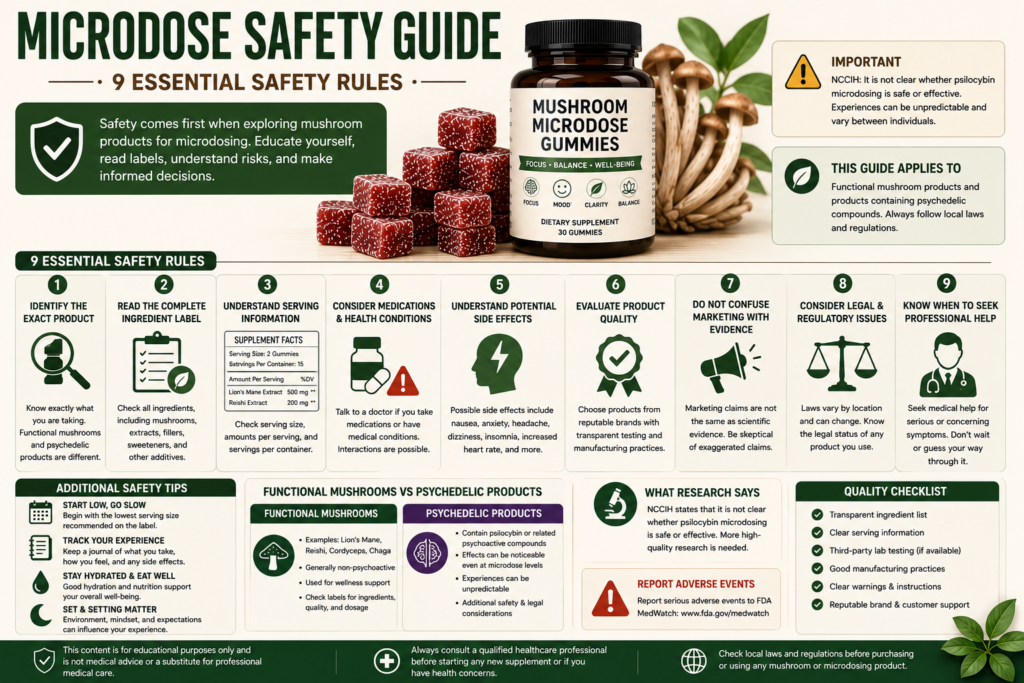
Microdose Safety Guide: 9 Essential Safety Rules
The Microdose Safety Guide is designed to help readers understand the most important safety considerations surrounding products marketed for microdosing. Mushroom products can vary significantly in their ingredients, formulation, labeling, intended use, and legal status, so the term “microdose” should never be treated as a guarantee of safety.
Some mushroom products contain functional mushrooms such as Lion’s Mane, Reishi, Cordyceps, Chaga, or Turkey Tail. Other products may be marketed around psychedelic mushrooms or psychoactive compounds. These categories can have very different safety considerations.
This Microdose Safety Guide focuses on product identification, ingredient labels, potential interactions, adverse effects, product quality, research limitations, legal considerations, and when professional medical advice may be appropriate.
The National Center for Complementary and Integrative Health (NCCIH) states that it is not clear whether psilocybin microdosing is safe or effective. NCCIH also explains that psychedelic experiences can be unpredictable and can vary according to factors including mood, expectations, surroundings, health, mushroom type, previous experience, and other substances being used.
Because of these uncertainties, this article is educational and does not provide a psychedelic dosing schedule or instructions for using controlled substances.
For the main topic, visit our Mushroom Microdose Gummies pillar page.
Microdose Safety Guide: Why Safety Matters
A good Microdose Safety Guide begins with an important distinction: not every mushroom product is the same.
Shop Magic Mushroom GummiesSome products are conventional dietary supplements containing functional mushroom ingredients. Others may contain substances associated with psychedelic effects.
The packaging, marketing terminology, and appearance of a product may not provide enough information to determine which category it belongs to.
Consumers should therefore identify the actual ingredients before making assumptions about safety.
The FDA advises consumers to be informed about dietary supplements and to discuss potential benefits and risks with a doctor, pharmacist, or other healthcare professional when appropriate. FDA Information for Consumers on Dietary Supplements
Safety also means recognizing that “natural” does not automatically mean harmless.
Some supplement ingredients can have strong biological effects, interact with medications, interfere with laboratory tests, or create risks in certain health circumstances.
This is why a responsible Microdose Safety Guide should focus on evidence, labeling, individual circumstances, and product quality rather than simply repeating marketing claims.
Rule 1: Identify the Exact Product
The first step in this Microdose Safety Guide is identifying exactly what product you are considering.
The word “mushroom” can describe many different products.
Functional mushroom products may contain:
- Lion’s Mane
- Reishi
- Cordyceps
- Chaga
- Turkey Tail
- Maitake
Other products may contain mushroom extracts, blends, botanical ingredients, vitamins, minerals, or other compounds.
Products marketed around psychedelic mushrooms represent another category.
Psilocybin is a psychedelic compound found in certain mushrooms. NCCIH explains that psilocybin is converted by the body into psilocin, which has psychoactive properties.
Consumers should therefore avoid assuming that every mushroom gummy, capsule, chocolate, or powder has the same effects or risks.
Product identification should always come before evaluating timing, benefits, or safety.
Rule 2: Read the Complete Ingredient Label
Reading the complete ingredient label is one of the most important principles in this Microdose Safety Guide.
The front of a package may contain attractive marketing language, but the detailed ingredient information provides more useful information about what is actually inside.
Look for:
- Specific mushroom species
- Mushroom powders
- Mushroom extracts
- Botanical ingredients
- Vitamins
- Minerals
- Sweeteners
- Flavoring ingredients
- Colors
- Other formulation ingredients
The FDA Dietary Supplement Labeling Guide provides information about ingredient labeling.
Consumers should also be cautious when a product does not clearly identify its ingredients.
Knowing what is actually in a product is fundamental to evaluating its potential risks.
A vague product description should not be treated as a substitute for a complete ingredient list.
Rule 3: Understand Serving Information
Serving information is another essential part of a Microdose Safety Guide.
Consumers should not assume that the number of gummies or capsules in a container represents the serving size.
The FDA explains that dietary supplement labels include serving size, servings per container, dietary ingredients, and applicable amounts per serving. FDA Dietary Supplement Labeling Guide
When reviewing a product, check:
- Serving size
- Servings per container
- Amount per serving
- Individual dietary ingredients
- Other ingredients
- Warnings
This information can prevent consumers from confusing the number of units with the amount of an ingredient.
Different products can also have different serving sizes even when they contain similar ingredients.
Careful label reading is therefore an important safety practice.
Rule 4: Consider Medications and Health Conditions
Health circumstances and medication use deserve particular attention in any Microdose Safety Guide.
FDA advises consumers to talk with healthcare professionals before using dietary supplements because supplements can interact with medications, interfere with laboratory tests, or create risks around certain medical conditions and procedures. FDA 101: Dietary Supplements
People taking prescription medications should therefore discuss potentially interactive supplements or mushroom products with a doctor or pharmacist.
Additional caution is appropriate for people who:
- Take prescription medications
- Have significant medical conditions
- Have psychiatric conditions
- Have cardiovascular concerns
- Are pregnant
- Are breastfeeding
- Take several supplements
- Have upcoming surgery or medical procedures
Do not stop, skip, or change prescribed medication because of information found online.
A healthcare professional can evaluate the actual ingredients and the individual’s circumstances.
Individual health information should always take priority over generic online recommendations.
Rule 5: Understand Potential Side Effects
Another essential part of this Microdose Safety Guide is understanding that microdosing does not automatically mean that unwanted effects are impossible.
NCCIH states that psilocybin experiences can be unpredictable and may vary according to factors such as mood, expectations, surroundings, health, mushroom type, previous experience, and other substances being used.
NCCIH lists potential adverse effects of psilocybin including:
- Increased blood pressure
- Increased heart rate
- Headache
- Nausea
- Dizziness
- Fatigue
- Poor sleep
- Anxiety
- Paranoia
- Hallucinations
- Persistent psychosis
NCCIH also reports potential problems associated with psilocybin microdosing, including insomnia, increased anxiety or depression, poor mood, low energy, gastrointestinal symptoms, disrupted senses, poor focus, impaired cognitive functioning, and impaired social skills. NCCIH Psilocybin Safety Information
These risks do not mean that every mushroom product will produce these effects.
They do demonstrate why the word “microdose” should not be treated as a synonym for “risk-free.”
Rule 6: Evaluate Product Quality
Product quality is another major consideration in a Microdose Safety Guide.
Consumers should look for transparent information about:
- Ingredients
- Serving size
- Manufacturer identity
- Warnings
- Storage requirements
- Manufacturing information
- Testing information where available
FDA explains that it does not approve dietary supplements for safety and effectiveness before they are marketed in the same way that drugs are approved. FDA: Is It Really FDA Approved?
This makes careful product evaluation especially important.
Consumers should be cautious about products that:
- Hide or obscure ingredients
- Make dramatic unsupported claims
- Provide little manufacturer information
- Use vague proprietary descriptions
- Do not provide clear serving information
- Make claims that sound too good to be true
Testing information, when available, can provide additional information about product composition, but consumers should understand exactly what a test covers.
A test result does not automatically establish that a product is medically effective.
Rule 7: Do Not Confuse Marketing With Evidence
A strong Microdose Safety Guide should distinguish marketing claims from scientific evidence.
Products may be promoted using claims involving:
- Focus
- Creativity
- Productivity
- Mood
- Stress
- Energy
- General wellness
However, a marketing statement is not automatically proof that a product produces a particular outcome.
NCCIH states that it is not clear whether psilocybin microdosing is safe or effective.
Consumers should therefore distinguish between:
- Personal testimonials
- Marketing statements
- Preliminary research
- Systematic reviews
- Clinical trials
- Established medical evidence
These categories provide different levels of evidence.
One personal experience cannot establish that the same result will occur in another person.
Similarly, one preliminary study should not automatically be interpreted as proof of a medical benefit.
Separating evidence from advertising is an important safety habit.
Rule 8: Consider Legal and Regulatory Issues
Legal status is another essential part of the Microdose Safety Guide.
Psilocybin is federally controlled in the United States, although some jurisdictions have adopted different policies. NCCIH notes that the legal status of psychedelic drugs continues to evolve. NCCIH Legal Information
Laws outside the United States can differ substantially.
Consumers should not assume that a product advertised online is legal to purchase, possess, sell, or consume everywhere.
Legal status may also depend on the specific ingredient.
This is especially important because products marketed using broad terms such as “mushroom” or “microdose” may contain different substances.
Always verify the current laws that apply to the exact product and jurisdiction.
Rule 9: Know When to Seek Professional Help
Knowing when to seek professional help is one of the most important principles in this Microdose Safety Guide.
Consumers should seek appropriate medical attention if they experience serious or concerning symptoms after using a supplement or mushroom product.
The FDA lists serious adverse reactions that can include:
- Difficulty breathing
- Swelling of the lips, tongue, or throat
- Chest pain
- Fainting
- Irregular heartbeat
- Severe or persistent vomiting
- Severe abdominal pain
- Severe allergic reactions
- Other serious or unusual symptoms
The FDA advises consumers to stop using a dietary supplement and seek medical care or advice when an adverse event occurs. FDA: How to Report a Problem With Dietary Supplements
For emergencies involving severe symptoms, seek emergency medical care immediately.
Do not attempt to manage a serious reaction by simply changing the timing or amount of a product.
Functional Mushroom Products vs Psychedelic Products
A useful part of this Microdose Safety Guide is understanding the difference between functional mushroom products and products associated with psychedelic compounds.
| Category | Examples | Main Consideration |
|---|---|---|
| Functional mushrooms | Lion’s Mane, Reishi, Cordyceps | Review supplement ingredients and labeling |
| Mushroom blends | Multiple mushroom species or extracts | Check every listed ingredient |
| Psychedelic mushroom products | Products associated with psychedelic compounds | Additional safety and legal considerations |
| Other mushroom products | Various mushroom-derived ingredients | Identify the exact ingredients |
A functional mushroom gummy should not automatically be treated as equivalent to a psychedelic mushroom product.
Likewise, two products that use the same marketing terminology may contain different ingredients.
Always identify the actual product before making assumptions about safety.
What Research Says About Microdosing
Research into psychedelic microdosing remains an evolving area.
Researchers have investigated potential relationships between microdosing and areas such as mood, cognition, creativity, productivity, and other outcomes.
However, NCCIH states that it is not clear whether psilocybin microdosing is safe or effective.
This uncertainty should be clearly communicated whenever microdosing is discussed.
Research involving supervised psychedelic-assisted therapy should also not automatically be applied to commercial mushroom gummies, capsules, or other consumer products.
Clinical studies can involve controlled environments, professional supervision, carefully selected participants, specific substances, and structured protocols.
Those circumstances can be substantially different from unsupervised consumer use.
A responsible Microdose Safety Guide therefore acknowledges both what research has investigated and what remains uncertain.
What to Do After an Adverse Reaction
If a person experiences an unexpected or concerning reaction after using a dietary supplement, safety should become the immediate priority.
The FDA advises consumers who experience an adverse event from a dietary supplement to stop using the supplement and seek medical care or advice. FDA Adverse Event Reporting Information
Depending on the severity of symptoms, appropriate action may include contacting a healthcare professional, poison control, or emergency medical services.
Serious symptoms should not be ignored simply because a product is marketed as natural, herbal, functional, or a microdose.
Consumers should also keep the product packaging and ingredient information available if medical professionals need to identify what was consumed.
When appropriate, reporting an adverse event can help regulators identify potentially unsafe products.
Microdose Safety Checklist
Use this checklist when evaluating a mushroom product.
- Identify the exact product.
- Read the complete ingredient list.
- Check the serving size.
- Check amounts per serving.
- Review warnings and directions.
- Check manufacturer information.
- Review available testing information.
- Consider medication interactions.
- Consider existing health conditions.
- Do not assume “natural” means safe.
- Do not assume “microdose” means risk-free.
- Separate marketing claims from scientific evidence.
- Check applicable laws.
- Do not drive or perform hazardous activities if a product causes unexpected impairment.
- Seek professional medical advice when appropriate.
This checklist summarizes the central principles of a responsible Microdose Safety Guide.
Frequently Asked Questions About Microdose Safety Guide
What is a Microdose Safety Guide?
A Microdose Safety Guide provides educational information about product identification, ingredients, labeling, potential risks, medication considerations, product quality, research limitations, and legal considerations.
Does microdosing mean something is completely safe?
No. The term “microdose” does not guarantee safety. NCCIH states that it is not clear whether psilocybin microdosing is safe or effective.
Are all mushroom gummies the same?
No. Mushroom gummies can contain different species, extracts, blends, botanicals, vitamins, minerals, or other ingredients.
Why should I read the ingredient label?
The ingredient label provides important information about what a product actually contains. Marketing terminology alone may not provide enough information to evaluate a product.
Can mushroom supplements interact with medications?
Yes, some supplement ingredients can interact with medications. FDA recommends discussing supplement use with a healthcare professional when appropriate.
Can functional mushroom supplements be compared directly with psychedelic products?
No. Functional mushroom supplements and products containing psychedelic compounds can have substantially different ingredients, effects, risks, evidence, and legal considerations.
Are dietary supplements approved by the FDA before they are sold?
FDA does not approve dietary supplements for safety and effectiveness before they are marketed in the same way that drugs are approved. Consumers should therefore evaluate products carefully.
What should I do if I experience a serious reaction?
Stop using the product and seek appropriate medical care or advice. For severe or emergency symptoms, seek emergency medical attention immediately.
Does product testing prove a supplement is effective?
No. Testing may provide information about product composition or contaminants, but it does not automatically establish clinical effectiveness.
Are psychedelic mushroom products legal everywhere?
No. Laws vary between jurisdictions and can change over time. Consumers should verify the current laws that apply to the exact substance and location.
Conclusion
A responsible Microdose Safety Guide starts with recognizing that the word “microdose” does not automatically establish a product’s ingredients, safety, effectiveness, or legality.
Consumers should identify the exact product, read the complete ingredient label, understand serving information, consider medications and health conditions, evaluate product quality, distinguish marketing from scientific evidence, and verify applicable laws.
For psychedelic microdosing, NCCIH states that it is not clear whether psilocybin microdosing is safe or effective and notes that psychedelic experiences can be unpredictable.
For dietary supplements, FDA advises consumers to be informed and to discuss potential benefits and risks with an appropriate healthcare professional.
Consumers should also know how to respond to adverse reactions and when professional medical attention is necessary.
The goal of this Microdose Safety Guide is not to encourage a particular product or routine. It is to provide a framework for evaluating mushroom products carefully and recognizing situations where additional professional guidance is appropriate.
Return to the main Mushroom Microdose Gummies pillar page to explore the complete cluster.
