
Uncategorized
What Are Mushroom Microdose Gummies
Aug
What Are Mushroom Microdose Gummies? 7 Powerful Essential Facts
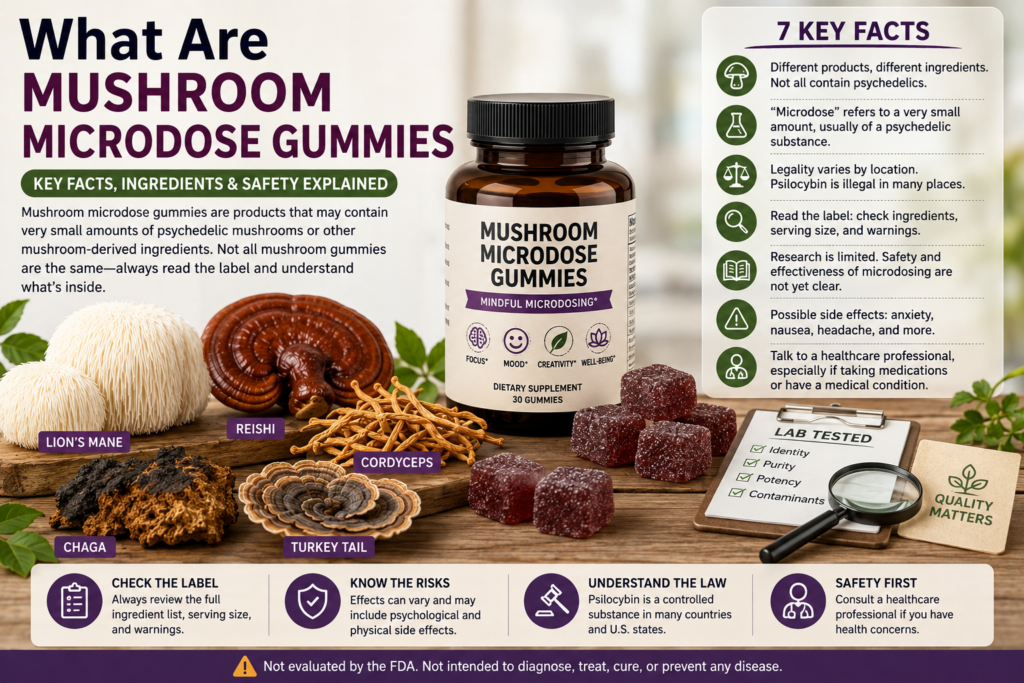
What Are Mushroom Microdose Gummies is a question that has become increasingly common as mushroom gummies and microdosing terminology have gained attention online. However, the term can describe different types of products, so understanding the ingredients and labeling is important before making assumptions about what a particular gummy contains.
Some mushroom gummies contain non-psychoactive functional mushrooms such as Lion’s Mane, Reishi, Cordyceps, Chaga, or Turkey Tail. Other products may use terms such as “microdose,” “psychedelic mushroom,” “magic mushroom,” or “mushroom blend” in their marketing.
These categories should not automatically be treated as interchangeable.
Understanding What Are Mushroom Microdose Gummies requires looking beyond the name printed on a package. The actual ingredients, serving information, manufacturer details, product claims, applicable regulations, and available research can all be important.
This guide explains What Are Mushroom Microdose Gummies, what the term may mean, how different mushroom gummy categories compare, what ingredients to examine, why labeling matters, what research says about psychedelic microdosing, and important safety considerations.
For products associated with psilocybin, the topic is substantially different from ordinary functional mushroom supplementation. The National Center for Complementary and Integrative Health (NCCIH) explains that research into psilocybin and microdosing is still developing and that the safety and effectiveness of psilocybin microdosing are not yet clear.
For the broader topic of functional mushroom gummies, visit our Mushroom Gummies Benefits guide.
What Are Mushroom Microdose Gummies?
What Are Mushroom Microdose Gummies can have different answers depending on the ingredients and the way a product is marketed.
Shop Magic Mushroom GummiesGenerally, the phrase refers to chewable products marketed around the concept of consuming a very small amount of a mushroom-derived substance. However, the word “microdose” does not by itself identify which mushroom, compound, or active ingredient is contained in a product.
A gummy marketed using microdosing terminology could contain a functional mushroom, a combination of mushroom ingredients, botanical compounds, or substances associated with psychedelic effects.
That distinction is important because different ingredients can have substantially different properties, research histories, safety considerations, and legal statuses.
A gummy containing Lion’s Mane should not automatically be considered equivalent to a product containing psilocybin. These are different categories of ingredients.
When researching What Are Mushroom Microdose Gummies, consumers should therefore begin with the actual ingredient list instead of relying exclusively on the product name.
What Does Microdose Mean?
The term “microdose” generally describes the use of a very small amount of a substance. It is especially common in discussions involving psychedelic substances.
In discussions about psilocybin, some people describe microdosing as taking amounts intended to produce less noticeable effects than a conventional psychedelic experience.
However, a product being described as a microdose does not automatically establish that it is safe, effective, accurately labeled, or appropriate for a particular person.
The National Center for Complementary and Integrative Health explains that it is not clear whether psilocybin microdosing is safe or effective.
This uncertainty is important when considering claims made by commercial products.
Understanding What Are Mushroom Microdose Gummies therefore involves distinguishing between the general concept of microdosing and the specific ingredients contained in a commercial gummy.
Consumers should also distinguish between scientific research and anecdotal reports. Personal experiences shared online may be interesting, but they do not establish that a product will produce the same outcome for everyone.
Different Types of Mushroom Gummies
There are several categories of mushroom gummies, and they should not all be grouped together.
| Category | Examples | Important Consideration |
|---|---|---|
| Functional mushroom gummies | Lion’s Mane, Reishi, Cordyceps | Generally marketed for general wellness purposes |
| Mushroom blends | Multiple functional mushrooms | Check the amount of each ingredient |
| Psychedelic mushroom products | Products associated with psychedelic compounds | Different safety and legal considerations apply |
| Other mushroom-derived products | Products containing unusual mushroom ingredients | Review the complete ingredient list carefully |
The name printed on the front of a package does not necessarily provide enough information to determine which category a product belongs to.
This is why What Are Mushroom Microdose Gummies should always be answered by examining the product’s actual ingredients and supporting information.
Functional Mushroom Gummies
Functional mushroom gummies commonly contain mushrooms such as Lion’s Mane, Reishi, Cordyceps, Chaga, Turkey Tail, or Maitake.
These mushrooms are generally discussed in the context of nutrition, traditional use, wellness, and scientific research rather than psychedelic experiences.
Lion’s Mane, for example, is frequently included in products marketed around cognitive wellness. Cordyceps is often associated with products marketed around energy and physical wellness, while Reishi is commonly included in general wellness formulas.
The presence of one of these mushrooms does not mean that a product is a psychedelic microdose product.
If you are researching functional mushroom supplements, read our Functional Mushrooms Explained guide for additional information.
Understanding the difference between functional mushroom products and psychedelic products is one of the most important parts of understanding What Are Mushroom Microdose Gummies.
Psychedelic Mushroom Products
Psychedelic mushroom products are a separate category from conventional functional mushroom supplements.
Psilocybin is a psychedelic compound found in certain mushroom species. The body converts psilocybin into psilocin, which has psychoactive properties.
People sometimes use microdosing terminology when discussing very small amounts of psychedelic substances.
However, research into psychedelic microdosing remains an evolving area, and evidence does not establish that microdosing is universally safe or effective.
The NCCIH states that the safety and effectiveness of psilocybin microdosing are not clear.
This is particularly important when researching What Are Mushroom Microdose Gummies because products containing psychoactive substances should not be treated as equivalent to ordinary functional mushroom gummies.
Consumers should also be aware that products marketed online can differ substantially in their ingredients, manufacturing practices, labeling, and regulatory status.
Common Mushroom Gummy Ingredients
The ingredient list is one of the most useful places to start when researching What Are Mushroom Microdose Gummies.
Depending on the product, mushroom gummies may contain:
- Lion’s Mane
- Reishi
- Cordyceps
- Chaga
- Turkey Tail
- Maitake
- Other mushroom powders
- Mushroom extracts
- Botanical ingredients
- Vitamins
- Minerals
- Natural flavors
- Sweeteners
- Pectin
- Gelatin
Some products may also contain ingredients that are not mushrooms at all.
For this reason, the product name alone should not be used to determine what a gummy contains.
Check the complete ingredient list, Supplement Facts panel where applicable, serving information, warnings, and manufacturer details.
Why Product Labels Matter
Reading the label carefully is one of the most important steps in understanding What Are Mushroom Microdose Gummies.
A transparent product label can provide information about:
- Ingredient names
- Serving size
- Amount per serving
- Other ingredients
- Manufacturer information
- Directions
- Warnings
- Storage instructions
Look for specific ingredient names rather than vague descriptions whenever possible.
For example, a label that simply says “mushroom blend” may provide less information than a label that identifies each mushroom ingredient and its amount.
Consumers should also be cautious about dramatic claims promising guaranteed improvements in mood, cognition, physical performance, or medical conditions.
The U.S. Food and Drug Administration provides consumer information about fraudulent health products and encourages consumers to be cautious about products making unproven health claims.
What Research Says About Microdosing
Research into psychedelic microdosing is still developing.
Researchers have investigated questions involving mood, cognition, creativity, productivity, and other potential outcomes.
However, research findings are not sufficient to establish that microdosing is safe or effective for everyone.
The NCCIH states that it is currently unclear whether psilocybin microdosing is safe or effective.
This means that commercial claims should be evaluated carefully.
Anecdotal testimonials and social-media reports are not equivalent to controlled scientific studies.
Similarly, a laboratory study involving a particular mushroom compound does not necessarily demonstrate that a commercially available gummy will produce the same outcome.
When evaluating What Are Mushroom Microdose Gummies, it is therefore useful to separate established evidence from preliminary research and personal reports.
Consumers should be especially cautious when marketing language presents preliminary research as if it were established medical evidence.
Potential Effects and Uncertainty
People discussing psychedelic microdosing may describe intended outcomes involving mood, attention, creativity, productivity, or general well-being.
However, intended outcomes are not the same as proven effects.
According to NCCIH, psychedelic experiences can vary between individuals and can be influenced by factors including health, mood, expectations, surroundings, the substance involved, and the use of other substances.
Possible adverse effects associated with psilocybin can include anxiety, nausea, dizziness, headache, increased heart rate or blood pressure, poor sleep, paranoia, and other psychological or physical effects.
These considerations are important because the term “microdose” should not be interpreted as a guarantee of a mild, predictable, or beneficial experience.
Understanding What Are Mushroom Microdose Gummies therefore requires acknowledging both the potential uncertainty surrounding effects and the limitations of current evidence.
Mushroom Microdose Gummies Safety
Safety is a central part of understanding What Are Mushroom Microdose Gummies.
Products can differ in ingredients, manufacturing quality, labeling accuracy, concentration, and regulatory status.
Potential concerns may include:
- Unexpected psychoactive effects
- Allergic reactions
- Digestive symptoms
- Anxiety or panic
- Interactions with medications
- Contamination
- Adulteration
- Mislabeling
- Unknown ingredients
NCCIH notes that psilocybin experiences can be unpredictable and that microdosing may itself involve adverse effects.
People with certain psychiatric conditions may face additional risks. NCCIH specifically identifies psychotic conditions such as schizophrenia and schizoaffective disorder, as well as severe forms of bipolar disorder, as situations in which psilocybin is not considered safe.
Anyone who experiences concerning symptoms after consuming a mushroom product should seek appropriate medical attention.
A responsible discussion of What Are Mushroom Microdose Gummies should therefore include safety rather than focusing only on potential benefits.
Mushroom Gummies and Medications
People who take prescription or over-the-counter medications should consider possible interactions before using mushroom-derived products.
The potential interaction depends on the specific mushroom or other active ingredient, the medication, the person’s health circumstances, and the formulation of the product.
Research into interactions between psilocybin and conventional medicines is still developing.
Do not stop, reduce, or change a prescribed medication because of information found online.
Instead, discuss supplement or psychedelic-product use with a doctor or pharmacist.
This is especially important for people taking psychiatric medications, medications affecting blood pressure or heart rate, or multiple medicines at the same time.
Medication considerations are therefore another important part of understanding What Are Mushroom Microdose Gummies.
Legal and Regulatory Considerations
Another important part of understanding What Are Mushroom Microdose Gummies is recognizing that legality depends on the ingredients and location.
Psilocybin is subject to strict legal controls in many jurisdictions.
In the United States, psilocybin is federally classified as a Schedule I controlled substance, although certain states and local jurisdictions have adopted different policies.
Laws can change, and regulations vary between countries, states, and local areas.
Consumers should check the laws applicable to their own location instead of assuming that a product sold online is legal everywhere.
Other mushroom-derived ingredients can have different regulatory classifications.
For example, the FDA has issued information concerning the use of Amanita muscaria and its constituents in conventional food.
FDA information about Amanita muscaria in food
Always verify current rules in your jurisdiction because regulatory requirements can change.
How to Evaluate Mushroom Microdose Gummies
When researching What Are Mushroom Microdose Gummies, it is useful to evaluate the actual product instead of relying only on marketing language.
1. Identify the Ingredients
Determine exactly which mushrooms and other substances are listed.
2. Read the Complete Label
Review the serving size, ingredient amounts, directions, warnings, and other ingredients.
3. Look for Transparent Manufacturer Information
A responsible manufacturer should provide identifiable company information and a way for consumers to obtain product information.
4. Examine Product Claims
Be cautious about claims promising guaranteed medical, psychological, or performance outcomes.
5. Consider Available Testing Information
Where applicable, independent laboratory testing may provide additional information about product identity, purity, or contaminants.
6. Consider the Regulatory Context
Determine whether the ingredients and product category are permitted in your location.
These steps can help consumers make more informed decisions when researching What Are Mushroom Microdose Gummies.
Common Mistakes to Avoid
There are several common mistakes people can make when researching mushroom microdose products.
Assuming Every Mushroom Gummy Is the Same
Different products can contain completely different ingredients.
Assuming “Microdose” Means Safe
The marketing term does not establish safety, effectiveness, or consistent product composition.
Ignoring the Full Ingredient List
A mushroom may be only one component of a gummy formula.
Relying Entirely on Testimonials
Personal experiences cannot establish that a product is safe or effective for everyone.
Ignoring Local Laws
Legal requirements can differ significantly depending on the ingredient and jurisdiction.
Assuming Natural Means Safe
Natural products can still have side effects, interactions, contraindications, or contamination concerns.
The NCCIH provides additional information about evaluating complementary health products and emphasizes that natural does not automatically mean safe.
Frequently Asked Questions
What Are Mushroom Microdose Gummies?
What Are Mushroom Microdose Gummies are chewable products marketed around the concept of consuming a very small amount of a mushroom-derived substance. The actual ingredients can vary significantly between products.
Are all mushroom microdose gummies psychedelic?
No. Some products marketed with microdosing terminology may contain functional mushrooms or other non-psychoactive ingredients, while other products may be associated with psychedelic compounds. The ingredient list is more informative than the product name.
Do mushroom gummies contain psilocybin?
Not necessarily. Some mushroom gummies contain functional mushrooms such as Lion’s Mane or Reishi, while other products may be marketed around psychedelic mushrooms. Consumers should examine the actual ingredients.
Is mushroom microdosing proven to work?
Research is still developing. NCCIH states that it is not clear whether psilocybin microdosing is safe or effective.
Are mushroom microdose gummies safe?
Safety depends on the ingredients, product quality, individual circumstances, and applicable regulations. Products associated with psychedelic compounds can involve unpredictable effects and additional risks.
Can mushroom gummies interact with medications?
Potential interactions depend on the specific ingredients and medications involved. Anyone taking medication should discuss supplement or psychedelic-product use with an appropriate healthcare professional.
Are mushroom microdose gummies legal?
Legality depends on the ingredients and location. Psilocybin is subject to strict controls in many jurisdictions, while other mushroom-derived ingredients may have different legal or regulatory statuses.
How can I tell what is in a mushroom gummy?
Read the complete ingredient list, Supplement Facts panel where applicable, manufacturer information, directions, and warnings. Do not rely solely on the product’s front-label marketing.
Are functional mushroom gummies the same as psychedelic mushroom gummies?
No. Functional mushroom gummies commonly contain mushrooms such as Lion’s Mane, Reishi, or Cordyceps, while psychedelic products may contain substances such as psilocybin. These categories have different properties and regulatory considerations.
Why is labeling important?
Labeling helps consumers identify ingredients, serving information, warnings, and other product details. Clear labeling is particularly important when product names use broad terms such as “mushroom,” “microdose,” or “blend.”
Where can I learn more about mushroom microdosing?
Continue with our Microdosing Guide and Microdose Safety Guide for additional educational information.
Conclusion
Understanding What Are Mushroom Microdose Gummies requires looking beyond the product name.
Mushroom gummies can contain functional mushrooms, mushroom blends, botanical ingredients, or substances associated with psychedelic effects. These categories should not automatically be treated as interchangeable.
When evaluating a product, examine the complete ingredient list, serving information, manufacturer details, warnings, available testing information, and applicable regulations.
Research into psychedelic microdosing is still developing, and current evidence does not establish that psilocybin microdosing is safe or effective for everyone.
Consumers should also consider potential medication interactions and individual health circumstances.
Ultimately, What Are Mushroom Microdose Gummies is best answered by examining what a particular product actually contains rather than relying on broad marketing terminology.
For the main topic, continue to our Mushroom Microdose Gummies pillar page.
You can also explore our Microdose Safety Guide for additional safety-focused information.
