
Uncategorized
Microdosing Guide
Aug
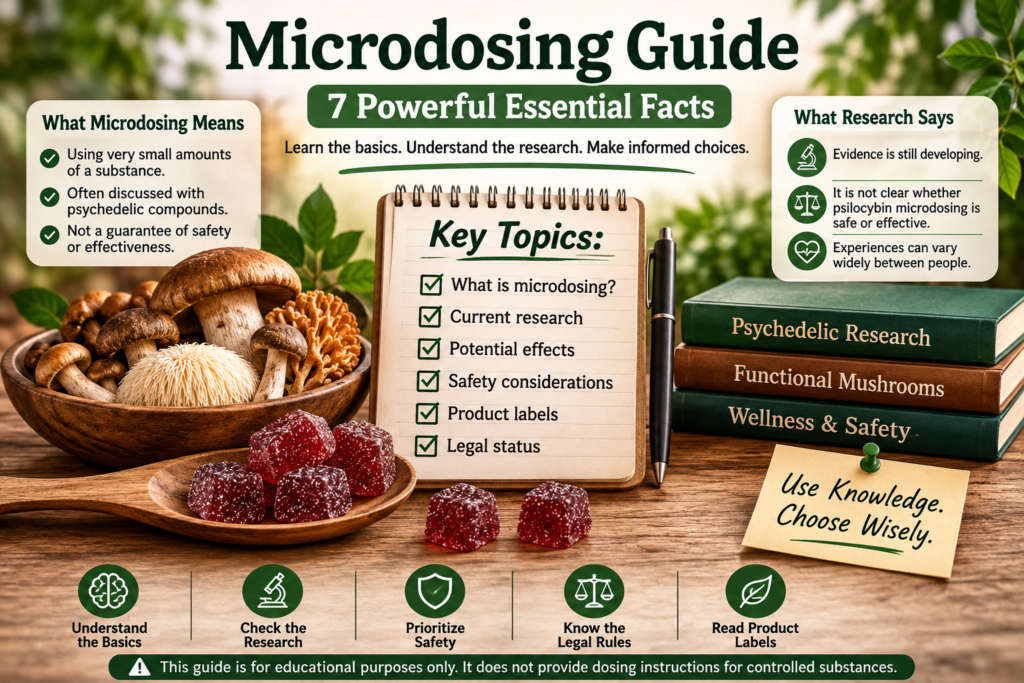
Microdosing Guide: 7 Powerful Essential Facts About Microdosing
The Microdosing Guide is designed to provide a clear, educational overview of microdosing, the terminology surrounding it, current research, potential risks, and important safety considerations. The term is frequently used online in discussions about psychedelic substances, particularly psilocybin, but it can also appear in broader conversations about supplements and wellness products.
Understanding the terminology is important because not every product described as a mushroom gummy, microdose gummy, or mushroom supplement contains the same ingredients.
Some mushroom products contain functional mushrooms such as Lion’s Mane, Reishi, Cordyceps, Chaga, or Turkey Tail. Others may be marketed around psychedelic compounds. These categories have different properties, research histories, safety considerations, and legal statuses.
This Microdosing Guide explains what microdosing means, why people discuss it, what current research suggests, what remains uncertain, how mushroom products can differ, and what safety considerations should be understood before evaluating related products.
The National Center for Complementary and Integrative Health (NCCIH) explains that some people use very small amounts of psilocybin because they believe it may improve mental health symptoms, productivity, or other outcomes. However, NCCIH states that it is not clear whether psilocybin microdosing is safe or effective.
This article is educational and does not provide a psychedelic dosing protocol or instructions for using controlled substances.
For the broader topic, visit our Mushroom Microdose Gummies pillar page.
Microdosing Guide: What Does Microdosing Mean?
The term microdosing generally refers to using a very small amount of a substance. It is most commonly discussed in connection with psychedelic substances such as psilocybin or LSD.
Shop Magic Mushroom GummiesThe concept has attracted attention because some people believe that taking very small amounts may produce subtle effects without producing the more obvious perceptual changes associated with larger psychedelic experiences.
However, the term itself does not establish that a particular product is safe, effective, accurately labeled, or appropriate for everyone.
A major purpose of this Microdosing Guide is therefore to distinguish between what people claim about microdosing and what scientific research has actually established.
NCCIH states that some people take psilocybin in very small amounts because they believe it may improve symptoms such as depression or stress, increase productivity, or reduce pain. However, it also states that it is not clear whether microdosing is safe or effective.
This uncertainty should be considered whenever microdosing is discussed online.
What Is Psychedelic Microdosing?
Psychedelic microdosing generally refers to the use of very small amounts of a psychedelic substance.
Psilocybin is one of the substances most frequently associated with the modern microdosing discussion.
According to NCCIH, psilocybin comes from certain mushrooms and is converted by the body into psilocin, a psychoactive compound that can affect mood, thoughts, and perception.
At larger amounts, psychedelic experiences can involve substantial changes in perception and consciousness. Microdosing discussions generally concern much smaller amounts intended to produce less noticeable effects.
However, the absence of an intended psychedelic experience does not mean that risks disappear.
According to NCCIH, experiences involving psilocybin can vary considerably based on factors such as a person’s health, mood, expectations, surroundings, the mushroom involved, previous experience, and use of other substances. :contentReference[oaicite:1]{index=1}
This is an important distinction for anyone using this Microdosing Guide to research psychedelic products.
Microdosing and Functional Mushroom Supplements
Functional mushroom supplements should not automatically be classified as psychedelic microdosing products.
Functional mushroom products commonly contain mushrooms such as:
- Lion’s Mane
- Reishi
- Cordyceps
- Chaga
- Turkey Tail
- Maitake
These mushrooms are commonly discussed in nutrition, wellness, traditional use, and scientific research.
A gummy containing Lion’s Mane, for example, is not automatically equivalent to a product containing psilocybin.
This distinction matters because the ingredients, expected effects, research evidence, and regulatory considerations can be very different.
For additional information, read our Functional Mushrooms Explained guide.
The difference between functional mushroom supplements and psychedelic products is one of the most important concepts covered in this Microdosing Guide.
Why Has Microdosing Become Popular?
Microdosing has received significant attention through social media, podcasts, books, online communities, and discussions surrounding psychedelic research.
People discussing the subject may describe goals involving mood, creativity, focus, productivity, stress, or general well-being.
However, popularity does not establish effectiveness.
Anecdotal reports can be useful for understanding why people are interested in a subject, but personal experiences cannot determine whether a substance is safe or effective for the broader population.
Marketing can also make scientific evidence appear stronger than it actually is.
For example, preliminary research may be presented online as if it were established clinical evidence.
A responsible Microdosing Guide should therefore distinguish between personal reports, laboratory research, observational research, clinical trials, and established medical evidence.
What Does Current Research Say?
Research into psychedelic microdosing is still developing.
Researchers have investigated whether very small amounts of psychedelic substances may influence areas such as mood, cognition, attention, creativity, or subjective well-being.
However, the available evidence does not establish that microdosing is universally effective or safe.
NCCIH specifically states that it is not clear whether psilocybin microdosing is safe or effective.
This is an important point because scientific interest in psychedelic-assisted therapy does not automatically prove that unsupervised microdosing produces the same outcomes.
Some clinical research involving psilocybin has investigated mental-health conditions in controlled settings, often with psychological support. These studies should not automatically be interpreted as evidence for commercial microdosing products.
NCCIH notes that research into psilocybin-assisted approaches for conditions such as depression and anxiety is growing, while also emphasizing limitations in the evidence.
For anyone following this Microdosing Guide, the distinction between clinical research and consumer use is essential.
Potential Effects and Uncertainty
People who discuss microdosing may report intended effects involving:
- Mood
- Focus
- Creativity
- Productivity
- Energy
- Stress
- General well-being
However, these reported goals should not be interpreted as established medical benefits.
Individual responses can differ significantly.
NCCIH reports that psilocybin experiences can vary according to factors including mood, expectations, surroundings, health, mushroom type, previous experience, and other substances being used.
This means that even when people report positive experiences, those experiences cannot guarantee similar outcomes for another person.
Likewise, an absence of obvious effects does not prove that a substance has no biological effects.
The uncertainty surrounding individual responses is one reason that a responsible Microdosing Guide should avoid presenting microdosing as a guaranteed solution for mental health, productivity, or wellness.
What the Evidence Does Not Prove
Understanding what research does not establish is just as important as understanding what it investigates.
Microdosing Is Not Proven to Work for Everyone
Current evidence does not establish that psychedelic microdosing produces predictable benefits for everyone.
Microdosing Is Not Automatically Safe
The word “microdose” describes an amount or concept, not a safety guarantee.
Personal Testimonials Are Not Clinical Evidence
Online experiences can be influenced by expectations, individual differences, placebo effects, and many other factors.
Research on Psilocybin Therapy Is Not the Same as Microdosing
Studies of supervised psychedelic-assisted therapy use specific research protocols and controlled environments. They should not automatically be applied to commercial products or unsupervised use.
One Mushroom Product Does Not Represent Every Mushroom Product
Different products may contain completely different ingredients and preparations.
These distinctions help prevent exaggerated conclusions when researching the subject.
Mushroom Products and Microdosing Terminology
The term “microdose” can appear on commercial mushroom products, but consumers should not assume that all such products contain the same type of substance.
Some products may contain functional mushroom powders or extracts.
Others may contain blends of mushrooms and botanical ingredients.
Some products may use terminology associated with psychedelic mushrooms.
For that reason, product names are not enough to establish what a gummy or supplement actually contains.
When evaluating a product, examine:
- The complete ingredient list
- The Supplement Facts panel where applicable
- Serving information
- Manufacturer information
- Warnings
- Storage instructions
- Testing information when available
This approach is particularly important when researching the relationship between Microdosing Guide information and commercial mushroom products.
How to Read Mushroom Product Labels
A product label can provide useful information about what is actually contained in a mushroom gummy or supplement.
Look for Specific Ingredients
Specific mushroom names are generally more informative than vague terms such as “mushroom blend.”
Check the Serving Information
Review the serving size and the amounts listed for ingredients.
Review Other Ingredients
Gummies may contain sweeteners, flavors, pectin, gelatin, vitamins, minerals, or botanical ingredients.
Look for Manufacturer Information
A transparent product should provide identifiable manufacturer or distributor information.
Read the Warnings
Warnings can provide important information about intended use, allergies, storage, or circumstances in which the product should not be used.
Consumers should also be cautious about products making dramatic or guaranteed health claims.
The FDA provides information about fraudulent health products and encourages consumers to be cautious about unproven claims.
Microdosing Safety
Safety should be one of the first considerations in any Microdosing Guide.
For psychedelic substances such as psilocybin, effects can be unpredictable and may vary between individuals.
NCCIH lists possible adverse effects associated with psilocybin including increased blood pressure and heart rate, headache, nausea, dizziness, fatigue, poor sleep, anxiety, paranoia, persistent psychosis, and hallucinations.
NCCIH also reports that microdosing may be associated with insomnia, increased anxiety or depression, poor mood, low energy, gastrointestinal symptoms, headache, disrupted senses, poor focus, impaired cognitive functioning, and impaired social skills.
These potential risks demonstrate why the term “microdose” should not be interpreted as meaning risk-free.
People with certain psychiatric conditions may face particular risks. NCCIH states that psilocybin is not considered safe for people with psychotic conditions such as schizophrenia or schizoaffective disorder, severe forms of bipolar disorder, and borderline personality disorder.
If someone experiences a serious or concerning reaction after consuming a substance, appropriate medical attention should be sought.
Possible Side Effects and Risks
Potential adverse effects depend on the substance and individual circumstances.
For psilocybin, reported concerns can include:
- Anxiety
- Panic
- Paranoia
- Nausea
- Dizziness
- Headache
- Changes in heart rate
- Changes in blood pressure
- Poor sleep
- Confusion
- Perceptual changes
Some effects may be psychological while others may be physical.
The experience can also be affected by the surrounding environment, expectations, mood, health, and use of other substances.
NIDA similarly notes that hallucinogenic experiences can be unpredictable and can vary according to the amount taken, personality, mood, expectations, and surroundings.
These risks should be considered before drawing conclusions from positive testimonials or marketing claims.
Medications and Health Considerations
People taking medications should discuss psychedelic or supplement use with an appropriate healthcare professional.
Potential interactions can depend on the specific substance, medication, medical condition, and other factors.
NCCIH notes that research is ongoing into potential interactions between psilocybin and conventional medicines, including psychiatric medications.
Do not stop or change a prescribed medication because of information found online.
Instead, speak with a doctor or pharmacist about potential interactions.
Additional caution may be appropriate for people who:
- Take prescription medications
- Have a psychiatric condition
- Have cardiovascular concerns
- Are pregnant
- Are breastfeeding
- Are preparing for surgery
- Take multiple supplements
Individual medical circumstances should always be considered separately from general information found in a Microdosing Guide.
Legal and Regulatory Considerations
Legal status is another important part of understanding microdosing.
Psilocybin is federally controlled in the United States, although certain states and local jurisdictions have adopted different policies.
NCCIH states that the legal status of psychedelic drugs in the United States continues to evolve.
Outside the United States, laws can vary considerably between countries.
A product being advertised online does not automatically mean that possession, sale, purchase, or use is legal in every jurisdiction.
Regulations can also differ depending on the exact substance contained in a product.
Consumers should verify current laws and regulations applicable to their own location before considering any product associated with controlled substances.
Legal information can change, so an older online article should not be treated as definitive legal advice.
Common Microdosing Misconceptions
Microdosing Means No Effects
Microdosing is generally discussed as using a smaller amount, but that does not guarantee the absence of noticeable or unwanted effects.
Microdosing Is Always Safe
There are potential risks, and current evidence does not establish universal safety.
Natural Means Harmless
Natural substances can still have biological effects, side effects, interactions, and risks.
Every Mushroom Gummy Contains the Same Ingredients
Commercial mushroom products can differ substantially in their ingredients and formulations.
Testimonials Prove Effectiveness
Personal experiences are not a substitute for controlled scientific evidence.
Research on Psychedelic Therapy Proves Microdosing Works
Research into supervised psychedelic-assisted therapy is not equivalent to evidence supporting unsupervised microdosing or commercial mushroom gummies.
These distinctions are essential for anyone using this Microdosing Guide to evaluate claims found online.
Frequently Asked Questions About the Microdosing Guide
What is microdosing?
Microdosing generally refers to using a very small amount of a substance, particularly in discussions about psychedelics. The term does not itself establish safety or effectiveness.
What substances are commonly associated with microdosing?
Psilocybin and LSD are commonly discussed in relation to psychedelic microdosing. The exact substance and its legal status depend on the product and location.
Is microdosing proven to improve mental health?
Current evidence does not establish that psychedelic microdosing is universally safe or effective. NCCIH specifically states that the safety and effectiveness of psilocybin microdosing remain unclear.
Are functional mushroom gummies the same as psychedelic microdosing?
No. Functional mushroom gummies may contain mushrooms such as Lion’s Mane or Reishi, while psychedelic products may contain substances such as psilocybin. These are different categories.
Can microdosing cause side effects?
Yes. NCCIH reports several possible adverse effects associated with psilocybin and notes that microdosing can involve unwanted physical and psychological effects.
Can microdosing interact with medication?
Potential interactions are possible, and research is ongoing. Anyone taking medication should speak with an appropriate healthcare professional.
Is microdosing legal?
Legal status depends on the substance and jurisdiction. Psilocybin is federally controlled in the United States, while laws and policies can vary by location.
Does a mushroom gummy labeled “microdose” necessarily contain psilocybin?
No. Product terminology alone does not establish the ingredients. Always examine the complete product label and manufacturer information.
How should I evaluate microdosing claims online?
Look for credible scientific sources, distinguish controlled research from personal testimonials, examine the actual ingredients, and be cautious about guaranteed health claims.
Where can I learn more about mushroom microdose gummies?
Visit our Mushroom Microdose Gummies pillar page for a broader overview of the topic.
Conclusion
The Microdosing Guide shows why it is important to look beyond the terminology used to describe mushroom and psychedelic products.
Microdosing generally refers to using a very small amount of a substance, but the term itself does not guarantee safety, effectiveness, or predictable results.
Functional mushroom supplements and psychedelic mushroom products are also different categories and should not automatically be treated as equivalent.
Current research into psychedelic microdosing remains limited, and NCCIH states that it is not clear whether psilocybin microdosing is safe or effective.
Anyone researching the topic should examine credible scientific evidence, product labeling, potential risks, medication considerations, and applicable laws.
A responsible approach to the subject means separating established evidence from preliminary research, personal testimonials, and marketing claims.
For the next article in this cluster, continue with our Beginner’s Guide to Mushroom Microdosing.
You can also return to the main Mushroom Microdose Gummies pillar page.
