
Uncategorized
Daily Mushroom Gummies Guide
Aug
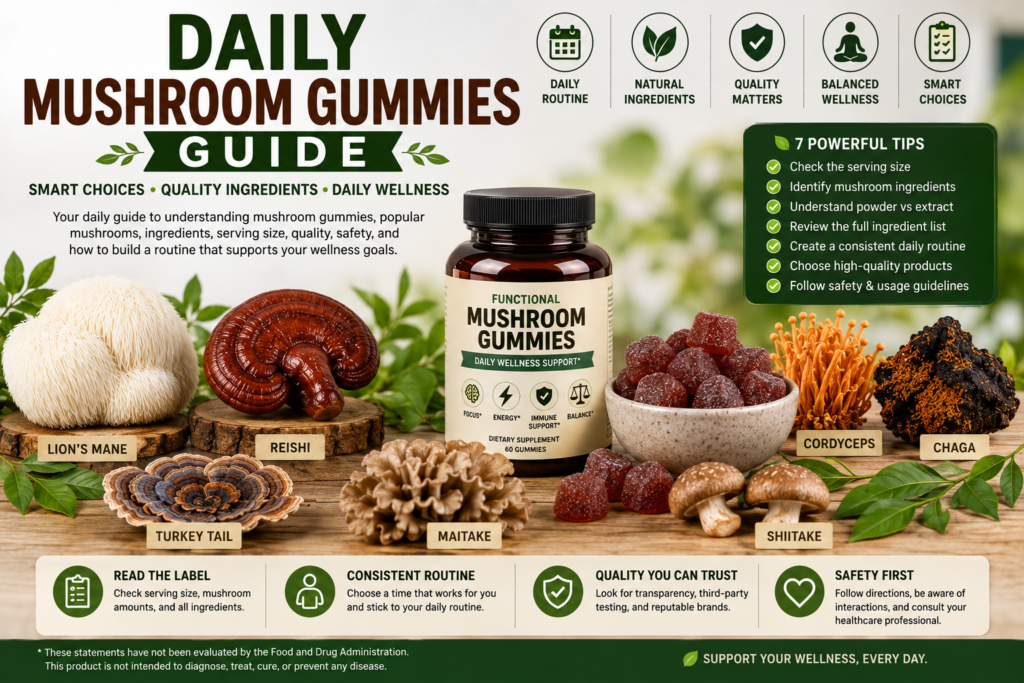
7 Powerful Tips: Daily Mushroom Gummies Guide for Beginners
The Daily Mushroom Gummies Guide is designed to help beginners understand how mushroom gummies can fit into an everyday wellness routine. These chewable supplements are convenient, portable, and available in many different formulations containing functional mushrooms and other ingredients.
Mushroom gummies may contain ingredients such as Lion’s Mane, Reishi, Cordyceps, Chaga, Turkey Tail, Maitake, or blends of several mushrooms. Some formulas may also contain vitamins, minerals, botanical ingredients, natural flavors, sweeteners, pectin, gelatin, or other components.
Because products can differ substantially, choosing a mushroom gummy should involve more than looking at the name on the front of the package. Serving size, mushroom species, preparation, ingredient amounts, additional ingredients, manufacturer information, and safety instructions are all worth reviewing.
This Daily Mushroom Gummies Guide explains what mushroom gummies are, how to read their labels, how to build a consistent routine, what to consider when comparing products, and important safety information.
Dietary supplements are not regulated in exactly the same way as medicines. The NIH Office of Dietary Supplements provides consumer information about dietary supplements, including their ingredients, labeling, and safety considerations.
For a broader overview of mushroom gummies, visit our Mushroom Gummies Benefits guide.
Daily Mushroom Gummies Guide: What Are Mushroom Gummies?
A Daily Mushroom Gummies Guide begins with understanding exactly what these products are and how they differ from other mushroom supplements.
Mushroom gummies are chewable dietary supplements containing one or more mushroom-derived ingredients. They are designed to provide a convenient alternative to capsules, powders, teas, or liquid mushroom extracts.
Shop Magic Mushroom GummiesSome products contain a single mushroom, while others combine several functional mushrooms in one formula.
A gummy may contain mushroom powder, mushroom extract, fruiting-body material, mycelium, or a combination of mushroom ingredients.
The product may also contain ingredients that provide flavor, sweetness, texture, color, or stability.
Because formulas vary considerably, consumers should examine the actual product label rather than assuming that all mushroom gummies are formulated in the same way.
The serving size can also vary. One product might recommend two gummies per serving while another might use three or four. Comparing the number of gummies alone therefore does not provide enough information.
Why Include Mushroom Gummies in a Daily Routine?
One of the biggest reasons people choose mushroom gummies is convenience.
Unlike powders, gummies generally do not require measuring or mixing into another food or beverage. They are also portable, making them convenient for people who prefer a simple supplement format.
A Daily Mushroom Gummies Guide should focus on responsible and consistent use rather than simply consuming more gummies.
A dietary supplement should complement healthy lifestyle habits rather than replace them.
A balanced diet, adequate sleep, physical activity, stress management, and appropriate healthcare remain important parts of overall wellness.
The NIH Office of Dietary Supplements provides additional consumer information about dietary supplements and their appropriate use.
For people interested specifically in wellness applications, our Mushroom Gummies for Daily Wellness article provides additional information.
Popular Mushrooms Found in Gummies
Different daily mushroom gummies contain different functional mushrooms.
Common ingredients include:
- Lion’s Mane
- Reishi
- Cordyceps
- Chaga
- Turkey Tail
- Maitake
- Shiitake
These mushrooms have different characteristics and research histories.
A product containing several mushroom species should not automatically be considered better than one containing a single mushroom.
The amount of each mushroom, the preparation used, the serving size, and the other ingredients all matter when comparing products.
Lion’s Mane
Lion’s Mane, scientifically known as Hericium erinaceus, is one of the most commonly discussed functional mushrooms.
It is frequently included in products marketed around cognitive and neurological wellness.
Researchers have investigated Lion’s Mane and its naturally occurring compounds in relation to nervous-system pathways and cognition.
However, research involving a particular preparation does not necessarily establish that every commercial gummy containing Lion’s Mane will produce the same outcome.
For more information, read our Benefits of Lion’s Mane Gummies guide.
Reishi
Reishi is another popular functional mushroom used in wellness supplements.
The name commonly refers to mushrooms in the Ganoderma genus.
Reishi contains naturally occurring compounds including polysaccharides and triterpenes that have attracted scientific interest.
It is frequently included in products marketed for general wellness.
Consumers should distinguish between traditional use, preliminary research, and established clinical evidence when evaluating claims about Reishi.
Cordyceps
Cordyceps is commonly found in mushroom products marketed around energy and physical wellness.
Researchers have investigated Cordyceps preparations in areas including energy metabolism and exercise performance.
The exact species and preparation can differ between commercial products, so checking the label remains important.
For more information, visit our Mushroom Gummies for Energy guide.
Chaga
Chaga, commonly identified as Inonotus obliquus, is another mushroom found in functional mushroom products.
Chaga has attracted scientific interest because of compounds associated with antioxidant activity.
Some proposed effects have primarily been investigated through laboratory and preclinical research.
Consumers should therefore avoid interpreting laboratory findings as proof that every Chaga gummy will provide a specific health outcome.
Turkey Tail
Turkey Tail, scientifically known as Trametes versicolor, is recognized for its fan-shaped appearance and distinctive bands of color.
It has received scientific attention because of polysaccharides and other compounds associated with immune-related research.
Research involving a particular Turkey Tail preparation should not automatically be applied to every commercial supplement containing the mushroom.
Maitake
Maitake, or Grifola frondosa, is both an edible mushroom and a functional mushroom ingredient.
Researchers have investigated compounds in Maitake in relation to immune and metabolic pathways.
Maitake can appear in powders, capsules, extracts, beverages, and gummies.
1. Check the Serving Size
The first practical step in a Daily Mushroom Gummies Guide is understanding the serving size.
The serving size tells you how many gummies the manufacturer considers one serving.
For example, one product may define a serving as two gummies while another may define a serving as three gummies.
This means consumers should compare the amount of mushroom ingredients per serving rather than comparing the number of gummies alone.
The NIH explains that the Supplement Facts panel includes information about serving size and the amount of dietary ingredients provided per serving.
Do not automatically assume that consuming additional gummies will provide additional benefits.
Follow the manufacturer’s recommended serving unless a qualified healthcare professional gives you different instructions.
2. Identify the Mushroom Ingredients
A good Daily Mushroom Gummies Guide should always emphasize identifying the actual mushrooms contained in a product.
A label might list Lion’s Mane, Reishi, Cordyceps, or a blend containing several mushroom species.
Look for the specific mushroom name and, where available, the scientific name.
It can also be useful to determine whether the ingredient is a powder, extract, fruiting-body material, mycelium, or another preparation.
The more transparent the label is about its ingredients, the easier it becomes to compare products accurately.
The word “mushroom” by itself does not tell you which mushroom species is present or how much of it is included.
3. Understand Powder vs Extract
Mushroom powder and mushroom extract are not necessarily interchangeable.
Mushroom Powder
Mushroom powder is generally made from dried mushroom material that has been processed into a powder.
Powder can be included directly in a gummy formula or used in other foods and beverages.
Mushroom Extract
An extract is produced through an extraction process intended to separate or concentrate certain mushroom compounds.
The extraction method can influence the resulting composition.
Because research studies can use specific mushroom preparations, consumers should not assume that a study involving one extract proves that every powder or gummy containing the same mushroom produces the same result.
This distinction is an important part of understanding a Daily Mushroom Gummies Guide because the mushroom name alone does not describe the complete ingredient.
4. Review the Complete Ingredient List
Mushroom gummies may contain more than mushroom ingredients.
Depending on the product, the formula may include:
- Natural flavors
- Artificial flavors
- Sweeteners
- Pectin
- Gelatin
- Citric acid
- Vitamins
- Minerals
- Botanical ingredients
- Coloring ingredients
- Other formulation ingredients
Review the complete ingredient list before purchasing or using a product.
This can be particularly important for people with allergies, dietary restrictions, or sensitivities to specific ingredients.
The NIH provides consumer information explaining that supplement labels can identify other ingredients such as fillers, binders, flavorings, and sweeteners.
5. Create a Consistent Routine
One practical advantage of daily mushroom gummies is that they can be easy to incorporate into an established routine.
You might choose a consistent point in your day, such as alongside breakfast or another regular activity, provided that this fits the product’s directions.
The goal is to create a routine that is simple and sustainable.
There is no universal requirement that every mushroom gummy must be taken at exactly the same time.
Instead, follow the manufacturer’s instructions and choose a schedule that makes responsible use easier to remember.
A Daily Mushroom Gummies Guide should emphasize consistency without encouraging unnecessary increases in serving size.
6. Evaluate Product Quality
Product quality is another major part of choosing daily mushroom gummies.
Look for clear information about:
- Mushroom species
- Scientific names where available
- Ingredient preparation
- Amount per serving
- Serving size
- Complete ingredient list
- Manufacturer information
- Directions
- Warnings
- Storage requirements
- Expiration or best-by information
- Testing information when available
Third-party testing may provide additional information about product quality and ingredient identity.
However, a quality seal does not automatically prove that a supplement is effective for a particular health goal.
Transparent labeling and realistic claims are more useful indicators when comparing products.
This is why product evaluation is an important part of the Daily Mushroom Gummies Guide.
7. Understand Safety Considerations
Safety should always be considered before starting daily mushroom gummies.
Dietary supplements can have biological effects and may interact with medications or create concerns for people with certain health conditions.
Potential concerns can include:
- Digestive discomfort
- Allergic reactions
- Ingredient sensitivities
- Medication interactions
- Excessive intake
- Interactions with other supplements
Do not assume that a product is automatically safe simply because its ingredients are described as natural.
The FDA provides consumer information about dietary supplements and encourages consumers to understand potential benefits and risks before using them.
When Should You Take Mushroom Gummies?
There is no single universal time that applies to every mushroom gummy product.
The appropriate timing depends partly on the product’s directions and the other ingredients included in the formula.
Some people may prefer taking their gummies with breakfast because it makes the routine easier to remember.
Others may choose another consistent time that fits their schedule.
The important point is to follow the manufacturer’s instructions rather than creating an unnecessarily complicated routine.
If a product causes digestive discomfort or another concerning reaction, stop using it and seek appropriate professional advice.
For people specifically interested in cognitive-focused formulas, our Mushroom Gummies for Cognitive Support guide provides additional information.
How to Build a Daily Mushroom Gummy Routine
A simple routine can make supplement use easier to manage.
Step 1: Choose the Product
Review the mushroom species, serving size, ingredient amounts, preparation, and additional ingredients.
Step 2: Read the Directions
Follow the serving instructions provided by the manufacturer.
Step 3: Pick a Consistent Time
Choose a practical time that fits your normal schedule.
Step 4: Store the Product Correctly
Follow the manufacturer’s instructions regarding temperature, humidity, sunlight, and container closure.
Step 5: Keep Track of Other Supplements
If you use multiple supplements, keep a record of the products and ingredients so you can discuss them with your healthcare professional if necessary.
Keeping an organized supplement routine can also make it easier to identify which products you are using if you experience an unexpected reaction.
Common Mistakes to Avoid
Following a Daily Mushroom Gummies Guide also means knowing what to avoid.
Taking More Than Recommended
More gummies do not automatically mean better results.
Ignoring the Ingredient List
Do not focus only on the mushroom name. Review all ingredients.
Assuming Every Mushroom Is the Same
Lion’s Mane, Reishi, Cordyceps, Chaga, Turkey Tail, and Maitake have different characteristics.
Relying Entirely on Marketing Claims
Look for realistic claims supported by appropriate evidence rather than promises of guaranteed results.
Ignoring Medication Interactions
Tell your doctor or pharmacist about supplements you use, particularly if you take prescription medications.
Using Supplements Instead of Medical Treatment
Do not replace prescribed medicines or appropriate medical care with mushroom gummies.
How to Compare Mushroom Gummy Products
When comparing daily mushroom gummies, consider the following factors:
| Factor | What to Look For |
|---|---|
| Mushroom species | Exact mushroom names and scientific names where provided |
| Preparation | Powder, extract, fruiting body, mycelium, or another preparation |
| Serving size | Number of gummies per serving |
| Amount | Amount of each dietary ingredient per serving |
| Other ingredients | Sweeteners, flavors, vitamins, minerals, and other ingredients |
| Testing | Available third-party testing or quality information |
| Manufacturer | Clear company information and contact details |
| Directions | Clear instructions for use |
| Warnings | Relevant safety and storage information |
The Supplement Facts panel can help consumers compare serving sizes and ingredient amounts across different products.
Do not compare products based solely on the number of gummies in a bottle. Instead, examine what each serving actually contains.
Mushroom Gummy Safety
Safety deserves particular attention when using daily mushroom gummies.
Supplements can interact with medications and may present additional risks for people with certain medical conditions.
Extra caution is appropriate if you:
- Take prescription medication
- Take multiple supplements
- Have a chronic medical condition
- Are preparing for surgery
- Are pregnant
- Are breastfeeding
- Are considering supplements for a child
- Have known allergies
Many dietary supplements have not been adequately studied during pregnancy, breastfeeding, or childhood.
If you experience an adverse reaction after taking a dietary supplement, stop using the product and seek appropriate medical advice.
For additional information, review the NCCIH guidance on dietary and herbal supplements.
Mushroom Gummies and Medications
People taking medications should discuss supplement use with an appropriate healthcare professional.
Some dietary supplements can affect how medications work, while others may increase risks associated with certain medical conditions.
Before starting daily mushroom gummies, provide your doctor or pharmacist with a complete list of supplements and medicines you take.
This is especially important before surgery.
The FDA explains that some dietary supplements can interact with medications, interfere with laboratory tests, or create risks during surgery.
This is another reason why a responsible Daily Mushroom Gummies Guide should include safety rather than focusing exclusively on potential benefits.
Frequently Asked Questions About the Daily Mushroom Gummies Guide
What are daily mushroom gummies?
Daily mushroom gummies are chewable dietary supplements containing one or more mushroom-derived ingredients. They provide a convenient supplement format that can be incorporated into an everyday routine.
How many mushroom gummies should I take each day?
Follow the serving instructions on the specific product label. Serving sizes vary between products, so there is no universal number that applies to every mushroom gummy.
When is the best time to take mushroom gummies?
There is no universal best time. Follow the manufacturer’s directions and choose a consistent time that fits your routine.
Can I take mushroom gummies every day?
Follow the product’s directions. If you take medications, have a medical condition, are pregnant or breastfeeding, or have another health concern, consult an appropriate healthcare professional before use.
What mushrooms are commonly found in mushroom gummies?
Common ingredients include Lion’s Mane, Reishi, Cordyceps, Chaga, Turkey Tail, Maitake, and Shiitake. Formulas vary considerably between products.
Are mushroom gummies better than capsules?
Not necessarily. Gummies offer a convenient chewable format, while capsules may contain fewer flavoring or texturing ingredients. The better option depends on the individual product and personal preference.
Are mushroom gummies better than mushroom powder?
Neither format is automatically better. Gummies are convenient and portable, while powders can be mixed into foods and beverages. Compare the actual mushroom preparation and serving information.
Should I take more mushroom gummies if I do not notice an effect?
No. Do not exceed the manufacturer’s recommended serving simply because you do not notice an immediate effect. More is not necessarily better.
Can mushroom gummies interact with medications?
Yes. Some dietary supplements can interact with medications. Discuss your supplement use with a doctor or pharmacist, particularly when taking prescription medicines.
Are mushroom gummies safe during pregnancy?
Many dietary supplements have not been adequately studied during pregnancy. Consult a qualified healthcare professional before using mushroom supplements while pregnant.
Can children take mushroom gummies?
Do not assume that adult mushroom gummies are appropriate for children. Speak with a pediatric healthcare professional before giving a dietary supplement to a child.
How do I choose good mushroom gummies?
Look for transparent labeling that identifies the mushroom species, preparation, serving size, ingredient amounts, additional ingredients, manufacturer, directions, warnings, and available quality information.
Where can I learn more about mushroom gummies?
This Daily Mushroom Gummies Guide provides a practical overview of mushroom gummy ingredients, serving information, product quality, routines, and safety. You can also explore our other mushroom guides for more specific information.
Conclusion
The Daily Mushroom Gummies Guide shows that choosing and using mushroom gummies involves more than selecting a product with an attractive package.
Start by identifying the mushroom species, preparation, serving size, ingredient amounts, and complete ingredient list.
Then evaluate the manufacturer’s information, directions, warnings, storage instructions, and available quality-testing information.
Building a consistent routine can make supplement use easier to manage, but consistency should never mean exceeding the recommended serving.
Functional mushrooms can be an interesting addition to a broader wellness routine, but they should complement rather than replace a balanced diet, adequate sleep, physical activity, stress management, and appropriate healthcare.
The evidence for dietary supplements varies by ingredient and product, and a commercially available supplement may differ from the preparation used in a scientific study.
If you take medication, have a medical condition, are pregnant or breastfeeding, or are considering a supplement for a child, speak with an appropriate healthcare professional before use.
For the broader topic, continue to our Mushroom Gummies Benefits pillar page.
