
Uncategorized
How Mushroom Chocolate Bars Are Made: Complete Manufacturing Guide
Jul
How Mushroom Chocolate Bars Are Made: Complete Manufacturing Guide
How Mushroom Chocolate Bars Are Made is an important question for anyone interested in premium mushroom chocolate products. From cocoa selection and mushroom ingredient preparation to tempering, molding, quality control, and packaging, every stage can influence the final appearance, texture, flavor, and consistency of a chocolate bar.
Understanding How Mushroom Chocolate Bars Are Made also helps consumers recognize why ingredient quality, temperature control, manufacturing practices, and proper storage matter. While individual manufacturers may use proprietary recipes and equipment, the general process follows several important stages.
This guide explains How Mushroom Chocolate Bars Are Made step by step, including cocoa selection, mushroom preparation, chocolate production, blending, tempering, molding, cooling, testing, packaging, and distribution.
For additional information, explore our guides to Mushroom Chocolate Bar, Mushroom Chocolates, Chocolate Mushrooms, and Best Mushroom Chocolate Brands.
Evergreen Mushrooms also provides a dedicated Mushroom Chocolate Bars category for readers interested in exploring the broader collection.
Important: Manufacturing methods and formulations vary between manufacturers. This guide describes a general chocolate manufacturing process and should not be interpreted as the exact proprietary process used by every brand.
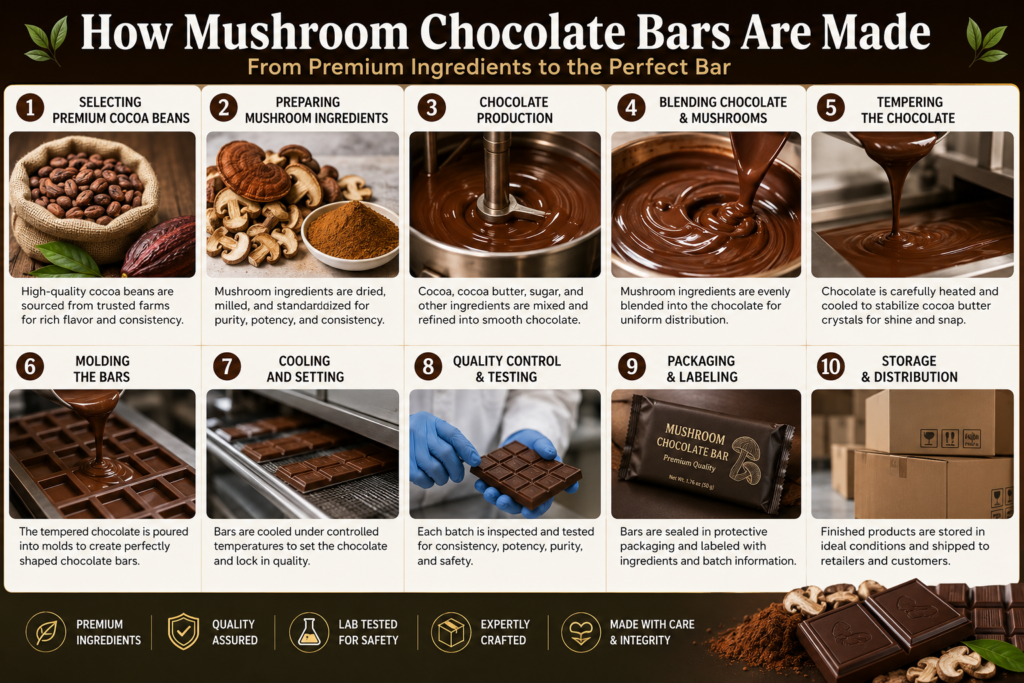
How Mushroom Chocolate Bars Are Made: Process Overview
Learning How Mushroom Chocolate Bars Are Made starts with understanding that the finished product combines traditional chocolate-making techniques with selected mushroom-derived ingredients.
Although production methods vary between manufacturers, the general process can involve several controlled stages:
- Selecting cocoa and other chocolate ingredients.
- Preparing mushroom-derived ingredients.
- Producing and refining the chocolate.
- Blending the mushroom ingredients into the formulation.
- Tempering the chocolate.
- Molding the chocolate bars.
- Cooling and setting the bars.
- Performing quality control and testing.
- Packaging and labeling the finished product.
- Storing and distributing the finished chocolate.
Each stage can affect the final characteristics of the product. This is why How Mushroom Chocolate Bars Are Made is more than simply mixing mushrooms and chocolate together.
For additional information about finished products, explore Chocolate Mushroom Bars and TRE House Mushroom Chocolate.
Step 1: Selecting Premium Cocoa Beans
The first stage in understanding How Mushroom Chocolate Bars Are Made is cocoa selection. Chocolate quality can be influenced by cocoa origin, harvesting, fermentation, drying, roasting, and subsequent processing.
Premium manufacturers may source cocoa from regions known for chocolate production, including areas of Central America, South America, and West Africa.
Cocoa selection can influence:
- Flavor intensity.
- Aroma.
- Texture.
- Color.
- Overall chocolate character.
The quality of the cocoa ingredients can therefore have a significant effect on the finished product.
Consumers comparing chocolate manufacturers can also explore Best Mushroom Chocolate Brands to learn about factors used when evaluating premium products.
Step 2: Preparing Mushroom Ingredients
Another important part of How Mushroom Chocolate Bars Are Made is preparing the mushroom-derived ingredients that will be incorporated into the chocolate.
Depending on the product, manufacturers may use culinary mushrooms, functional mushroom extracts, botanical ingredients, or proprietary mushroom blends.
The preparation method depends on the specific ingredient and manufacturer’s formulation. Factors such as particle size, moisture, concentration, and ingredient consistency may influence the final chocolate.
Careful preparation and handling can help manufacturers achieve more consistent distribution throughout the chocolate mixture.
Consumers interested in different mushroom ingredients can explore Mushroom Chocolates and Chocolate Mushrooms.
Step 3: Producing the Chocolate
To understand How Mushroom Chocolate Bars Are Made, it is also necessary to understand the traditional chocolate-making process.
Chocolate formulations can contain cocoa mass or cocoa liquor, cocoa butter, sugar, and other ingredients. Milk chocolate may contain milk solids, while dark chocolate generally contains a higher proportion of cocoa ingredients.
The chocolate mixture may be refined to improve particle size and texture. Manufacturers may also use conching, a controlled mixing process that can help develop flavor and improve the texture of chocolate.
The precise formulation, temperatures, equipment, and production times vary according to the manufacturer and the type of chocolate being produced.
These variations are one reason different mushroom chocolate products can have noticeably different textures and flavors.
Step 4: Blending Mushroom Ingredients With Chocolate
Once the chocolate reaches the desired consistency, the selected mushroom ingredients can be incorporated into the formulation.
This stage is central to How Mushroom Chocolate Bars Are Made because the manufacturer must achieve an appropriate distribution of the selected ingredients throughout the chocolate.
Depending on the recipe, manufacturers may control ingredient ratios, mixing time, temperature, and equipment speed.
Uniform blending can help create a finished Mushroom Chocolate Bar with a consistent appearance, texture, and flavor.
The exact blending method varies according to the manufacturer’s recipe and production equipment.
Step 5: Tempering the Chocolate
Tempering is one of the most important stages when considering How Mushroom Chocolate Bars Are Made. It involves carefully heating and cooling chocolate to encourage the formation of stable cocoa butter crystals.
Proper tempering can contribute to:
- A glossy appearance.
- A firm snap.
- Smooth texture.
- Improved stability.
- Reduced risk of fat bloom.
Tempering requires careful temperature control because cocoa butter changes its crystalline structure at different temperatures.
The precise temperature sequence depends on the chocolate formulation and equipment used by the manufacturer.
Proper tempering is especially important for premium chocolate because it can affect both appearance and eating texture.
Step 6: Molding the Chocolate Bars
After tempering, the chocolate is transferred into molds designed to create the desired bar size and shape.
This is another important stage in How Mushroom Chocolate Bars Are Made because consistent molding helps manufacturers produce bars with similar dimensions and appearance.
Molding can involve:
- Filling molds evenly.
- Reducing unwanted air bubbles.
- Creating consistent bar dimensions.
- Producing segmented sections.
- Adding decorative designs or branding.
Manufacturers may use manual or automated molding systems depending on production scale and equipment.
Step 7: Cooling and Setting
After molding, the chocolate needs to cool and solidify under appropriate conditions.
Controlled cooling can help the chocolate maintain its intended shape, texture, and appearance.
Some manufacturers may use dedicated cooling environments or cooling tunnels to control the temperature of the finished bars.
Temperature and humidity can be monitored during this stage because environmental conditions can influence chocolate quality.
Once the bars have fully set, they can move to quality control and packaging.
This controlled transition is another reason understanding How Mushroom Chocolate Bars Are Made is useful when evaluating product quality.
Step 8: Quality Control and Testing
Quality control is an important part of How Mushroom Chocolate Bars Are Made. Before packaging, manufacturers may perform several quality assurance procedures.
Depending on the product and manufacturing facility, checks can include:
- Visual inspections.
- Weight verification.
- Ingredient verification.
- Texture and appearance checks.
- Packaging inspections.
- Batch identification.
- Laboratory testing where appropriate.
Laboratory testing can provide additional information when appropriate tests are performed and documentation is available.
Consumers researching quality can also read Are Mushroom Chocolate Bars Legit?, which discusses transparency, testing, and responsible purchasing considerations.
It is important to understand exactly what a laboratory report tests. Testing for one characteristic does not automatically validate every marketing statement associated with a product.
Step 9: Packaging and Labeling
After quality control, the finished chocolate bars move to packaging. Proper packaging is an essential part of How Mushroom Chocolate Bars Are Made because it helps protect the product during storage and transportation.
Chocolate can be affected by moisture, heat, light, contamination, and environmental odors.
Packaging formats may include:
- Food-grade wrappers.
- Sealed pouches.
- Protective cartons.
- Inner wrappers combined with outer boxes.
Product labels may include:
- Ingredient information.
- Allergen statements.
- Serving information.
- Storage recommendations.
- Manufacturer details.
- Batch information.
- Best-by or expiration information.
Consumers should always review the current product label because formulations and labeling can change.
Step 10: Storage and Distribution
The final stage in How Mushroom Chocolate Bars Are Made involves appropriate storage and distribution after packaging.
Proper storage helps preserve the flavor, texture, appearance, and overall quality of chocolate during transportation and before consumption.
Chocolate is generally sensitive to excessive heat, humidity, and direct sunlight.
Manufacturers and retailers may therefore recommend storing chocolate in a cool, dry environment away from direct sunlight.
Consumers should follow the manufacturer’s specific storage instructions and observe the product’s best-by or expiration information.
Readers researching purchasing options can also explore Shroom Chocolate Bars Near Me.
Why Understanding How Mushroom Chocolate Bars Are Made Matters
Understanding How Mushroom Chocolate Bars Are Made helps consumers recognize why manufacturing quality can affect the finished product.
Every stage, from cocoa selection through packaging, can influence the final chocolate.
Important manufacturing considerations include:
- Carefully sourced cocoa.
- Consistent ingredient quality.
- Controlled production environments.
- Professional manufacturing practices.
- Quality assurance procedures.
- Transparent labeling.
- Product consistency.
- Appropriate packaging.
Consumers comparing products can also explore Best Mushroom Chocolate Brands and Mushroom Chocolate Bar.
How Flavor Profiles Are Developed
Flavor development begins with cocoa selection and continues throughout the chocolate manufacturing process.
Understanding How Mushroom Chocolate Bars Are Made also means recognizing how cocoa origin, fermentation, roasting, chocolate formulation, mushroom ingredients, and additional flavor ingredients can influence the final taste.
Manufacturers may combine chocolate with complementary ingredients such as:
- Toasted coconut.
- Caramel.
- Coffee.
- Vanilla.
- Nuts.
- Berries.
- Sea salt.
- Spices.
These combinations allow manufacturers to create distinctive gourmet flavor profiles.
Readers interested in different flavors can explore Mushroom Chocolates and Chocolate Mushrooms.
Research Related to Mushroom Chocolate Manufacturing
Scientific research related to How Mushroom Chocolate Bars Are Made covers several areas, including cocoa science, food chemistry, chocolate manufacturing, mushroom characterization, ingredient stability, and analytical testing.
Researchers continue to study:
- Food chemistry and analytical testing.
- Cocoa composition and processing.
- Mushroom cultivation and characterization.
- Ingredient stability during food production.
- Food quality assurance systems.
- Chocolate manufacturing practices.
However, relatively few peer-reviewed studies specifically evaluate finished mushroom chocolate products as complete consumer formulations.
Much of the available scientific literature examines mushrooms or chocolate independently rather than evaluating finished mushroom chocolate bars.
Consumers should therefore distinguish between research involving an individual ingredient and evidence specifically evaluating a finished commercial product.
Useful scientific resources include PubMed, the National Institutes of Health, and the National Center for Complementary and Integrative Health.
Frequently Asked Questions
How Mushroom Chocolate Bars Are Made
How Mushroom Chocolate Bars Are Made generally begins with selecting cocoa and preparing the mushroom ingredients. Manufacturers then produce and refine the chocolate, blend the selected ingredients, temper the chocolate, mold the bars, cool them, perform quality checks, and package the finished products.
What is the first step in making mushroom chocolate bars?
The process generally begins with selecting and preparing the chocolate ingredients, particularly the cocoa components. Mushroom ingredients are then prepared according to the manufacturer’s formulation.
Why is tempering important?
Tempering helps stabilize cocoa butter crystals and can contribute to a glossy appearance, firm snap, smooth texture, and improved chocolate stability.
How are mushroom ingredients added to chocolate?
Depending on the formulation, mushroom-derived ingredients can be incorporated into the chocolate during a controlled blending stage. The precise method varies between manufacturers.
How do manufacturers maintain consistency?
Manufacturers may use measured formulations, controlled temperatures, ingredient preparation procedures, production monitoring, quality assurance checks, weight verification, and laboratory testing where appropriate.
How are chocolate bars molded?
After tempering and blending, liquid chocolate can be transferred into molds designed to create the desired bar shape, size, and segmentation.
How are mushroom chocolate bars packaged?
Finished bars may be placed in food-grade wrappers, sealed pouches, cartons, or combinations of protective packaging designed to reduce exposure to heat, moisture, light, and contamination.
How should mushroom chocolate bars be stored?
Follow the manufacturer’s storage instructions. Chocolate is generally best protected from excessive heat, humidity, direct sunlight, and strong odors.
Where can I learn more about mushroom chocolate?
Explore our educational guides covering Mushroom Chocolate Bar, Mushroom Chocolates, Chocolate Mushrooms, Chocolate Mushroom Bars, Best Mushroom Chocolate Brands, and TRE House Mushroom Chocolate.
Where can I explore mushroom chocolate bars?
Evergreen Mushrooms has a dedicated Mushroom Chocolate Bars category for readers interested in exploring the collection.
Authoritative References
Conclusion
How Mushroom Chocolate Bars Are Made involves a series of controlled manufacturing stages rather than simply combining chocolate and mushroom ingredients.
The general process can include cocoa selection, mushroom ingredient preparation, chocolate production, blending, tempering, molding, cooling, quality control, packaging, and storage.
Understanding How Mushroom Chocolate Bars Are Made helps consumers appreciate how ingredient selection and manufacturing practices can influence the final product’s appearance, texture, flavor, consistency, and quality.
Manufacturing methods can differ substantially between brands because manufacturers may use proprietary recipes, equipment, ingredient preparations, and quality assurance procedures.
For additional educational information, continue exploring Mushroom Chocolate Bar, Mushroom Chocolates, Chocolate Mushrooms, Best Mushroom Chocolate Brands, and Are Mushroom Chocolate Bars Legit?.
To explore the available collection, visit the Mushroom Chocolate Bars category.
Disclaimer
This article is provided for educational and informational purposes only. It is not intended as medical, legal, nutritional, or professional advice. Manufacturing methods, ingredients, formulations, testing procedures, availability, and regulations may vary by manufacturer and jurisdiction. Always review current product labels and manufacturer information carefully and consult a qualified professional if you have questions regarding your health, diet, or mushroom-based products.
