
Uncategorized
Microdose Gummies vs Capsules
Aug
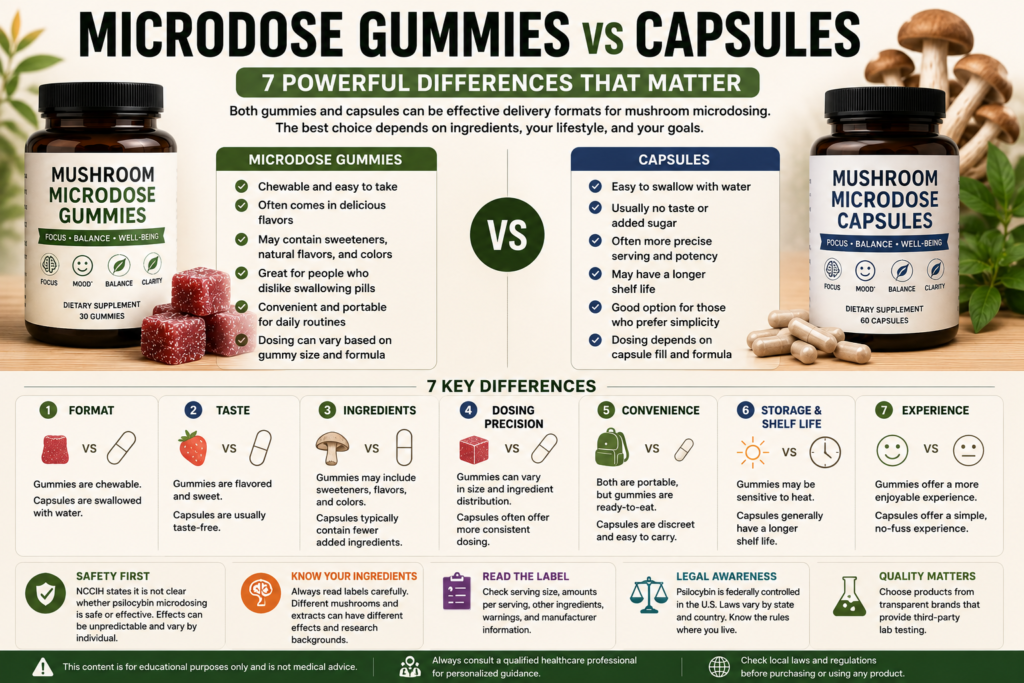
Microdose Gummies vs Capsules: 7 Powerful Differences
Microdose Gummies vs Capsules is a common comparison for people researching mushroom supplements and products marketed around microdosing. Gummies and capsules may look very different, but the most important factor is not simply the format. Ingredients, formulation, serving information, product quality, labeling, and intended use all matter.
Some gummies and capsules contain functional mushrooms such as Lion’s Mane, Reishi, Cordyceps, Chaga, or Turkey Tail. Other products may be marketed using terminology associated with psychedelic mushrooms or psychoactive compounds. These categories should not automatically be treated as equivalent.
This guide compares Microdose Gummies vs Capsules across seven important areas, including convenience, ingredients, serving information, formulation, storage, product transparency, and safety considerations.
The comparison is especially important because the word “microdose” does not establish that a product is safe or effective. The National Center for Complementary and Integrative Health (NCCIH) states that it is not clear whether psilocybin microdosing is safe or effective. Experiences can also be unpredictable and vary according to factors such as health, mood, expectations, surroundings, the mushroom involved, previous experience, and other substances being used.
For that reason, this article is educational and does not provide a psychedelic dosing protocol or instructions for using controlled substances.
For the main topic, visit our Mushroom Microdose Gummies pillar page.
Microdose Gummies vs Capsules: The Basic Comparison
The biggest difference in Microdose Gummies vs Capsules is the delivery format.
Shop Magic Mushroom GummiesGummies are chewable products that may contain mushroom powders, extracts, botanicals, sweeteners, flavors, or other ingredients. Capsules contain their ingredients inside a shell and are generally swallowed with water.
Neither format should automatically be considered better.
The appropriate comparison depends on what is actually inside the product.
For example, a functional mushroom gummy containing Lion’s Mane and a capsule containing Lion’s Mane may have similar general ingredient categories while differing considerably in formulation and serving information.
Likewise, a psychedelic product should not be compared to an ordinary functional mushroom supplement simply because both are sold as gummies or capsules.
When evaluating Microdose Gummies vs Capsules, the first question should therefore be:
What ingredients are actually present?
Gummies vs Capsules as Product Formats
Gummies and capsules offer two different ways of consuming a supplement.
| Feature | Gummies | Capsules |
|---|---|---|
| Format | Chewable | Swallowed |
| Taste | May have flavor and sweetness | Usually little or no taste |
| Ingredients | May include sweeteners, flavors, and other ingredients | Often contains a more concentrated ingredient format |
| Portability | Generally convenient | Generally convenient |
| Label comparison | Review serving and ingredient information | Review serving and ingredient information |
| Storage | Depends on formulation | Depends on formulation |
The comparison shows why the format alone does not determine product quality.
A well-labeled capsule may be preferable to a poorly labeled gummy, while a transparent gummy may be preferable to a capsule with unclear ingredients.
Product quality and transparency should therefore remain central to any discussion of Microdose Gummies vs Capsules.
Ingredients and Formulation
Ingredients are one of the most important areas to compare.
Gummies may contain:
- Mushroom powders
- Mushroom extracts
- Functional mushroom blends
- Sweeteners
- Flavoring ingredients
- Gelling agents
- Botanical ingredients
- Vitamins or minerals
Capsules may contain mushroom powders, extracts, blends, botanical ingredients, or other dietary ingredients.
Because formulations vary, two products with the same mushroom name can still be substantially different.
FDA guidance explains that dietary supplement labels generally identify the serving size, dietary ingredients, and amounts per serving, along with other ingredients. :contentReference[oaicite:1]{index=1}
That information can make a major difference when comparing Microdose Gummies vs Capsules.
Consumers should examine the complete label rather than assuming that the product format tells them everything they need to know.
Serving Size and Label Information
Serving information is another major consideration when comparing Microdose Gummies vs Capsules.
FDA guidance states that dietary supplement labels include serving size and servings per container, along with the dietary ingredients and applicable amounts per serving. :contentReference[oaicite:2]{index=2}
This means consumers should look beyond the number of gummies or capsules in the bottle.
Serving Size
Check whether the listed serving consists of one gummy, several gummies, one capsule, or several capsules.
Amount Per Serving
Review the amount of each listed dietary ingredient associated with the stated serving.
Servings Per Container
Check how many labeled servings are contained in the package.
Other Ingredients
Gummies may contain sweeteners, flavorings, colors, and other formulation ingredients. Capsules may contain capsule-shell materials and other inactive ingredients.
This information can help consumers make a more meaningful comparison than simply asking which format contains more units.
Convenience and Portability
Convenience is one of the most noticeable differences in Microdose Gummies vs Capsules.
Gummies are chewable and generally do not require water at the moment they are consumed.
Capsules are swallowed and may be easier for people who prefer supplements without flavor or sweetness.
Both formats can be portable.
However, portability also depends on storage requirements and product formulation.
A person who dislikes swallowing capsules may find gummies more convenient.
Someone who dislikes sweet flavors may prefer capsules.
These are personal preferences rather than evidence that one format is medically superior.
Convenience should therefore be treated as one factor among many when evaluating Microdose Gummies vs Capsules.
Taste and Texture
Taste and texture are another obvious difference.
Gummies are typically formulated to be chewable and may include flavoring and sweetening ingredients.
Capsules generally minimize taste because the ingredients are enclosed within the capsule shell.
This can matter for people who are sensitive to particular flavors or who prefer to avoid sweetened supplements.
On the other hand, some consumers may find gummies easier to use because they do not have to swallow a capsule.
There is no universal winner in this category.
The better format depends largely on personal preference and the actual formulation of the product.
Storage and Shelf Life Considerations
Storage is another factor to consider when comparing Microdose Gummies vs Capsules.
Different formulations can respond differently to heat, moisture, light, and air.
Consumers should follow the storage instructions supplied by the manufacturer.
Do not assume that all gummies require the same storage conditions or that all capsules have identical shelf-life characteristics.
Check the product packaging for:
- Storage temperature
- Moisture precautions
- Light exposure guidance
- Expiration or best-by information
- Container instructions
Proper storage helps preserve product quality and ensures that consumers are following the manufacturer’s directions.
Formulation and Product Flexibility
Gummies and capsules can both be formulated with different ingredients.
However, the format can influence how manufacturers design the product.
Gummies generally require a formulation capable of producing an acceptable texture, flavor, and shelf stability.
Capsules can allow manufacturers to place powdered or extracted ingredients inside a shell without requiring the same flavor profile.
This can make capsules attractive for products where taste is a concern.
Gummies may be attractive when the consumer experience is an important part of the product design.
Neither characteristic automatically establishes better effectiveness.
The important question remains what the product contains and how transparently it is labeled.
Product Quality and Transparency
Product quality is arguably more important than the format when comparing Microdose Gummies vs Capsules.
Consumers should look for clear information about:
- Product identity
- Ingredients
- Serving size
- Amounts per serving
- Other ingredients
- Manufacturer information
- Warnings
- Storage
- Testing information where available
FDA explains that dietary supplements are not approved by the agency for safety and effectiveness before being marketed in the same way that drugs are approved. :contentReference[oaicite:3]{index=3}
That makes label literacy and careful product evaluation particularly important.
Consumers should also be cautious about products making dramatic claims to diagnose, treat, cure, or prevent diseases.
The FDA provides information about health-fraud products and misleading health claims.
Functional Mushroom Gummies vs Capsules
Functional mushrooms provide a useful example of why product format should not be confused with ingredient effects.
Functional mushroom products can contain mushrooms such as:
- Lion’s Mane
- Reishi
- Cordyceps
- Chaga
- Turkey Tail
- Maitake
A functional mushroom gummy and functional mushroom capsule may contain similar mushroom species while differing in other ingredients and serving information.
For example, a gummy may include sweeteners and flavors while a capsule may contain primarily mushroom powder or extract plus capsule materials.
This makes it useful to compare the actual labels rather than simply choosing based on the format.
For more information, see our Functional Mushrooms Explained guide.
Psychedelic Products and Safety
The comparison becomes substantially more important when products are marketed around psychedelic compounds.
Psilocybin is a psychedelic compound found in certain mushrooms.
NCCIH states that it is not clear whether psilocybin microdosing is safe or effective. It also reports potential adverse effects including increased heart rate and blood pressure, headache, nausea, dizziness, fatigue, poor sleep, anxiety, paranoia, persistent psychosis, and hallucinations. :contentReference[oaicite:4]{index=4}
Microdosing may also be associated with insomnia, increased anxiety or depression, poor mood, low energy, gastrointestinal symptoms, disrupted senses, poor focus, impaired cognitive functioning, and impaired social skills. :contentReference[oaicite:5]{index=5}
These concerns apply regardless of whether a product is presented in a gummy or capsule format.
Changing the delivery format does not automatically remove the risks associated with an active psychedelic substance.
Therefore, anyone researching Microdose Gummies vs Capsules should avoid assuming that capsules are inherently safer than gummies or vice versa.
What Research Says About Microdosing
Research into psychedelic microdosing is still developing.
People have investigated potential relationships between microdosing and areas such as mood, productivity, cognition, creativity, and other outcomes.
However, NCCIH states that it remains unclear whether psilocybin microdosing is safe or effective. :contentReference[oaicite:6]{index=6}
This means the format comparison should not be presented as though gummies or capsules have been proven to deliver superior psychedelic microdosing effects.
Research involving supervised psychedelic-assisted therapy also should not automatically be applied to commercial gummies or capsules.
Clinical research can involve controlled environments, professional supervision, specific participants, carefully measured substances, and protocols that are different from consumer products.
Consequently, the most responsible comparison focuses on product format, labeling, ingredients, convenience, and safety rather than claiming that one format produces guaranteed psychological benefits.
Microdose Gummies vs Capsules Comparison Table
| Category | Microdose Gummies | Capsules |
|---|---|---|
| Consumption | Chewed | Swallowed |
| Taste | Usually flavored | Usually little or no taste |
| Sweeteners | May contain sweeteners | Usually less likely to require sweeteners |
| Ingredient flexibility | Can contain blends and extracts | Can contain powders, extracts, and blends |
| Serving information | Should be reviewed on the label | Should be reviewed on the label |
| Portability | Generally convenient | Generally convenient |
| Storage | Depends on formulation | Depends on formulation |
| Effectiveness | Cannot be assumed from format | Cannot be assumed from format |
| Safety | Depends on ingredients and individual factors | Depends on ingredients and individual factors |
The table demonstrates an important point: the format itself does not establish effectiveness or safety.
Who May Prefer Each Format?
People Who Prefer Gummies
Gummies may appeal to people who prefer chewable supplements, dislike swallowing capsules, or enjoy flavored products.
People Who Prefer Capsules
Capsules may appeal to people who prefer products with little or no taste or who want a compact supplement format.
People Comparing Both
Consumers comparing both formats should look at the ingredient list, serving information, formulation, manufacturer transparency, testing information, and applicable warnings.
The choice should not be based solely on packaging.
When evaluating Microdose Gummies vs Capsules, the best product is not automatically the one in the preferred format. Product transparency and ingredient information remain important.
Common Comparison Mistakes
Assuming Gummies Are Stronger
The format alone does not establish the amount or effect of an ingredient.
Assuming Capsules Are Safer
A capsule can contain the same type of active ingredient or a completely different ingredient from a gummy. Safety depends on the substance and individual circumstances.
Comparing Unit Counts
Ten gummies and ten capsules do not necessarily represent equivalent amounts of ingredients.
Ignoring Serving Size
Always determine how many units constitute a labeled serving.
Ignoring Other Ingredients
Gummies may contain sweeteners, flavors, colors, or other formulation ingredients that capsules may not contain.
Assuming the Word Microdose Proves Effectiveness
The term is not evidence that a product is safe or effective.
Copying Another Product’s Directions
Different products can have different formulations and label instructions.
A careful comparison avoids these assumptions.
Frequently Asked Questions About Microdose Gummies vs Capsules
What is the main difference between Microdose Gummies vs Capsules?
The main difference is the delivery format. Gummies are chewable, while capsules are swallowed. The actual ingredients and formulation are more important than the format alone.
Are gummies better than capsules?
Neither format is universally better. The better choice depends on personal preference, ingredients, formulation, label transparency, and the intended use of the product.
Are capsules safer than gummies?
Not automatically. Safety depends on the ingredients, product quality, individual health circumstances, and other factors rather than simply whether the product is a gummy or capsule.
Do gummies contain more ingredients than capsules?
Gummies may contain additional formulation ingredients such as sweeteners, flavors, colors, or gelling agents. However, formulations vary, so the complete label should be checked.
Do gummies and capsules have the same serving size?
Not necessarily. FDA guidance explains that dietary supplement labels identify serving size and servings per container, so consumers should check the specific product label. :contentReference[oaicite:7]{index=7}
Can the same mushroom be found in both gummies and capsules?
Yes. Functional mushrooms such as Lion’s Mane, Reishi, and Cordyceps can appear in multiple product formats.
Does the format change the effectiveness of a mushroom supplement?
The format alone does not establish effectiveness. Ingredient identity, formulation, amount, product quality, and scientific evidence all matter.
Are psychedelic gummies and psychedelic capsules the same?
They may contain similar or different substances depending on the product, but the format alone does not establish that they are equivalent. Ingredients and legal status must be evaluated separately.
What should I compare before buying a mushroom gummy or capsule?
Compare the ingredient list, serving size, amount per serving, other ingredients, manufacturer information, warnings, storage instructions, testing information where available, and applicable laws.
What does research say about psychedelic microdosing?
NCCIH states that it is not clear whether psilocybin microdosing is safe or effective. :contentReference[oaicite:8]{index=8}
Conclusion
The comparison of Microdose Gummies vs Capsules shows that the format is only one part of the decision.
Gummies offer a chewable format and may contain flavors, sweeteners, and other formulation ingredients. Capsules are swallowed and may provide a format with little or no taste.
Neither format is automatically more effective or safer.
The most important factors include the actual ingredients, serving information, formulation, product quality, manufacturer transparency, available testing, individual health circumstances, and applicable regulations.
FDA guidance emphasizes the importance of reviewing supplement serving sizes and ingredient information on the label. :contentReference[oaicite:9]{index=9}
For psychedelic microdosing specifically, NCCIH states that it is not clear whether psilocybin microdosing is safe or effective. :contentReference[oaicite:10]{index=10}
Consumers should therefore avoid choosing between gummies and capsules based solely on claims that one format is inherently stronger, safer, or more effective.
A careful comparison starts with the product label and the actual ingredients.
Continue with our How Long Microdose Gummies Last article for the next topic in this cluster.
You can also return to the main Mushroom Microdose Gummies pillar page.
