
Uncategorized
Functional Mushrooms Explained
Aug
7 Powerful Functional Mushrooms Explained: Complete Guide
Functional Mushrooms Explained begins with understanding what makes these mushrooms different from ordinary culinary mushrooms. Functional mushrooms are commonly used in foods, beverages, extracts, powders, capsules, and gummies because they contain naturally occurring compounds that have attracted nutritional and scientific interest.
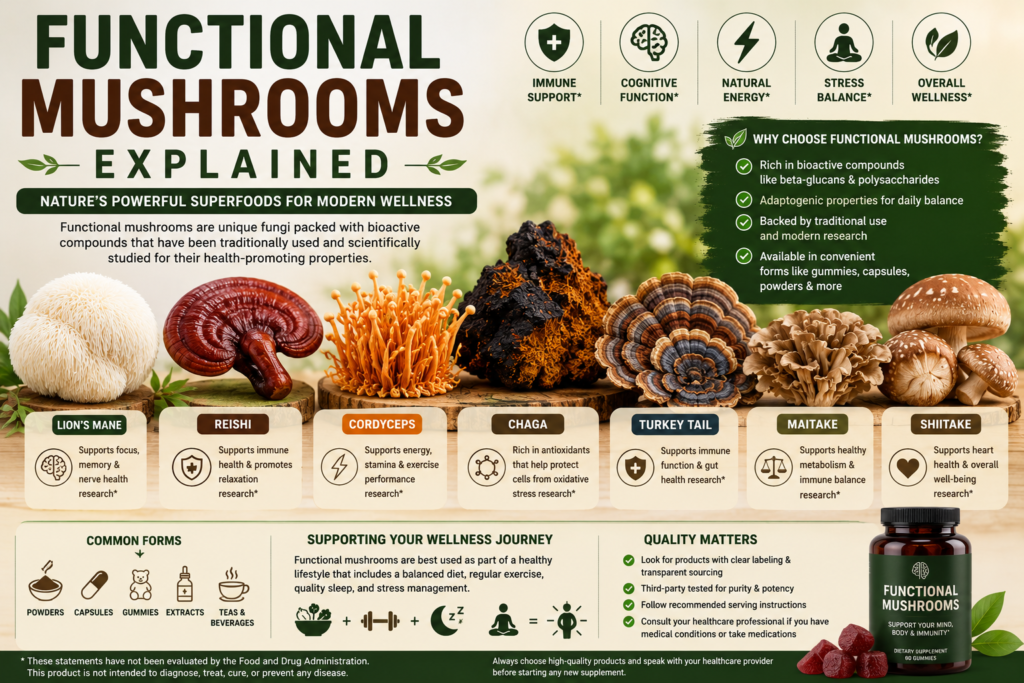
Popular functional mushrooms include Lion’s Mane, Reishi, Cordyceps, Turkey Tail, Chaga, Maitake, and Shiitake. Each mushroom has its own characteristics, traditional history, naturally occurring compounds, and areas of scientific research.
Functional mushrooms are also frequently used in modern dietary supplements. Some products contain one mushroom, while others combine several species into a single formula. The preparation can also differ, with products using whole mushroom powder, extracts, fruiting bodies, mycelium, or combinations of these materials.
This Functional Mushrooms Explained guide explores seven popular mushrooms, their common uses, research areas, supplement forms, label information, quality considerations, and safety factors.
It is important to distinguish between scientific research and proven medical benefits. Research involving a mushroom or one of its compounds does not automatically mean that every commercial supplement containing that mushroom will produce the same result.
The NIH Office of Dietary Supplements provides information about dietary supplements, their ingredients, labeling, and safety considerations.
For a broader introduction to mushroom gummies, visit our Mushroom Gummies Benefits pillar guide.
Functional Mushrooms Explained: What Are They?
Functional Mushrooms Explained is essentially an overview of mushrooms that are used not only as foods but also in wellness products because of their nutritional profiles and naturally occurring compounds.
Shop Magic Mushroom GummiesThe term “functional mushroom” is widely used in the wellness and supplement industries. It is not a strict scientific classification that means every mushroom in this category has been proven to provide a specific medical benefit.
Many functional mushrooms contain naturally occurring compounds such as beta-glucans, polysaccharides, triterpenes, antioxidants, proteins, vitamins, minerals, and other substances.
Scientists have investigated some of these compounds in laboratory, animal, and human research.
Research involving functional mushrooms has covered areas such as immune-related processes, antioxidant activity, neurological pathways, cognition, energy metabolism, and general wellness.
However, the strength of evidence can vary significantly between mushroom species, compounds, preparations, dosages, and study designs.
A particular mushroom extract used in a scientific study is not necessarily identical to a commercial gummy, capsule, or powder containing the same mushroom.
Why Functional Mushrooms Explained Matters
Understanding Functional Mushrooms Explained can help consumers look beyond marketing claims and compare mushroom products more carefully.
A product may contain one mushroom, several mushrooms, mushroom extracts, whole mushroom powder, mycelium, or a combination of ingredients.
Two products can therefore display the same mushroom name on their labels while having substantially different formulations.
Functional Mushrooms Explained should therefore include more than simply listing popular mushrooms. It should also consider the preparation, serving size, ingredient amount, and other components of the product.
Consumers can use this information to make more informed comparisons and avoid assuming that a larger ingredient list automatically means a better supplement.
It is also important to recognize the difference between a supplement being marketed for a particular wellness goal and evidence demonstrating that the product produces that outcome.
Functional Mushrooms vs Culinary Mushrooms
Many mushrooms can be both culinary and functional.
Shiitake and Maitake, for example, can be eaten as foods while also appearing in functional mushroom products.
The distinction is often based on how a mushroom is used and marketed rather than a strict biological division.
| Category | Typical Use |
|---|---|
| Culinary mushrooms | Primarily consumed as food |
| Functional mushrooms | Often used in foods, extracts, powders, beverages, and supplements |
| Mushroom extracts | Prepared to concentrate or separate selected mushroom compounds |
| Mushroom gummies | Convenient chewable supplement format |
The categories can overlap.
For example, Shiitake can be enjoyed as part of a meal while mushroom-derived ingredients may also be included in a functional supplement.
Functional Mushrooms Explained by Mushroom Type
When looking at Functional Mushrooms Explained by species, it becomes clear that popular mushrooms have different characteristics and research histories.
The most commonly discussed functional mushrooms include Lion’s Mane, Reishi, Cordyceps, Turkey Tail, Chaga, Maitake, and Shiitake.
These mushrooms should not automatically be considered interchangeable.
Each contains a different combination of naturally occurring compounds, and research may focus on different parts of each mushroom.
1. Lion’s Mane
Lion’s Mane is one of the best-known functional mushrooms.
Its scientific name is Hericium erinaceus.
Lion’s Mane has attracted scientific interest because researchers have investigated compounds associated with neurological pathways and nerve growth factor-related mechanisms.
Research has also explored Lion’s Mane in areas including cognition, mood, and nervous-system function.
These areas of research help explain why Lion’s Mane frequently appears in products marketed for cognitive wellness.
However, scientific research should not be interpreted as proof that every Lion’s Mane supplement will improve memory, concentration, or neurological health.
The preparation, amount, study population, and formulation can all affect how research findings should be interpreted.
For a dedicated guide, visit our Benefits of Lion’s Mane Gummies article.
2. Reishi
Reishi is another major mushroom discussed in functional wellness products.
Reishi commonly refers to mushrooms within the Ganoderma genus, with Ganoderma lucidum frequently discussed in scientific literature.
Reishi contains compounds including polysaccharides and triterpenes that have attracted scientific interest.
Research has investigated Reishi in relation to immune-related pathways, antioxidant activity, inflammation, and other biological processes.
Reishi also has a long history of traditional use.
However, traditional use and preliminary research should not be confused with definitive evidence that a particular product can treat or prevent disease.
Reishi can be found in powders, capsules, extracts, beverages, and functional mushroom gummies.
3. Cordyceps
Cordyceps is frequently included in functional mushroom supplements focused on energy and physical wellness.
The name Cordyceps can refer to several related fungi, while commercial products can contain different species or cultivated preparations.
Researchers have investigated Cordyceps in areas including energy metabolism, exercise performance, oxygen utilization, and physical endurance.
This research interest has contributed to Cordyceps becoming a popular ingredient in wellness products.
However, a Cordyceps supplement should not automatically be considered a treatment for fatigue or any medical condition.
Consumers should check the exact mushroom species and preparation listed on the label.
For more information about energy-focused gummies, read our Mushroom Gummies for Energy guide.
4. Turkey Tail
Turkey Tail is a distinctive mushroom recognized by its fan-shaped appearance and bands of different colors.
Its scientific name is Trametes versicolor.
Turkey Tail has received considerable scientific attention because of polysaccharide compounds associated with the mushroom.
Researchers have studied Turkey Tail in relation to immune-related biological processes.
Some research has examined particular compounds and preparations in clinical contexts.
However, findings involving a particular extract should not automatically be applied to every Turkey Tail supplement available commercially.
Turkey Tail can appear in capsules, powders, extracts, and functional mushroom gummies.
5. Chaga
Chaga is another widely discussed functional mushroom.
Its scientific name is Inonotus obliquus.
Chaga has attracted research interest because it contains compounds associated with antioxidant activity.
Laboratory and preclinical research has examined Chaga for antioxidant, immune-related, and other biological mechanisms.
However, much of the evidence in these areas remains preliminary.
Laboratory findings should therefore not automatically be interpreted as proven health benefits in humans.
Consumers should be cautious about products that make dramatic medical claims based primarily on laboratory findings.
6. Maitake
Maitake is an edible mushroom with a long history as a food and traditional wellness ingredient.
Its scientific name is Grifola frondosa.
Maitake contains polysaccharides and other compounds that researchers have investigated for biological activity.
Research has explored Maitake in areas including immune-related pathways and metabolic processes.
Because Maitake is both an edible mushroom and a functional ingredient, it demonstrates how culinary and functional mushroom categories can overlap.
Maitake can be consumed as food or included in mushroom powders, extracts, capsules, and gummies.
7. Shiitake
Shiitake is one of the world’s most widely consumed edible mushrooms.
Its scientific name is Lentinula edodes.
Shiitake provides nutritional compounds and has also been studied for various biological properties.
Because it is commonly consumed as food, Shiitake demonstrates that functional mushroom use does not necessarily require a concentrated supplement.
Shiitake can provide nutritional value as part of a balanced diet and can also appear as an ingredient in functional mushroom formulations.
Research involving concentrated extracts should not automatically be equated with the effects of ordinary dietary consumption.
Important Compounds in Functional Mushrooms
One reason Functional Mushrooms Explained requires looking beyond mushroom names is that different species contain different naturally occurring compounds.
Beta-Glucans
Beta-glucans are polysaccharides found in many mushrooms and other organisms.
They have attracted considerable research interest, particularly in relation to immune-related biological activity.
Polysaccharides
Polysaccharides are complex carbohydrates that occur naturally in mushrooms.
Some mushroom polysaccharides have been investigated for their biological properties.
Triterpenes
Triterpenes are particularly associated with mushrooms such as Reishi.
Researchers have investigated triterpenes for various biological activities.
Antioxidant Compounds
Several mushrooms contain compounds that can demonstrate antioxidant activity in laboratory research.
However, antioxidant activity measured in laboratory conditions does not automatically translate into a specific health outcome in humans.
Functional Mushrooms Explained by Supplement Form
Another important part of Functional Mushrooms Explained is understanding how these mushrooms are prepared and sold.
Common functional mushroom formats include:
- Mushroom powders
- Mushroom extracts
- Capsules
- Tablets
- Gummies
- Drink powders
- Coffee blends
- Tea products
- Liquid extracts
Different formats can contain different concentrations and preparations.
Consumers should therefore avoid assuming that two products containing the same mushroom are automatically equivalent.
Functional Mushrooms Explained should always consider both the mushroom and the form in which it is consumed.
Mushroom Powder
Mushroom powder is generally produced by drying mushroom material and processing it into a powder.
Powders can be added to smoothies, coffee, tea, soups, sauces, or other foods and beverages.
They provide flexibility but require consumers to measure or follow the manufacturer’s serving instructions.
The nutritional and chemical composition depends on the mushroom species and the material used to make the powder.
Mushroom Extracts
Mushroom extracts are produced using extraction processes intended to separate or concentrate particular mushroom compounds.
The extraction method can influence the resulting composition.
Some products may use hot-water extraction, alcohol extraction, or multiple extraction methods.
Consumers should therefore look for transparency about the type of extract used.
A research study involving a particular extract does not necessarily prove that every mushroom powder or gummy provides the same outcome.
Functional Mushroom Gummies
Functional mushroom gummies are among the most convenient modern supplement formats.
They provide a pre-portioned chewable format that can be easier to use than measuring mushroom powder.
Many products combine several mushroom species.
Some also contain vitamins, minerals, botanical extracts, sweeteners, flavors, pectin, gelatin, or other ingredients.
Understanding Functional Mushrooms Explained can help consumers read these labels more carefully instead of choosing a product based only on its front-of-package claims.
For a broader overview, visit our Mushroom Gummies Benefits guide.
Capsules and Tablets
Capsules and tablets are another common functional mushroom supplement format.
They can provide a convenient way to consume powdered or extracted mushroom ingredients.
Some consumers prefer capsules because they generally contain fewer flavoring and texturing ingredients than gummies.
However, the format itself does not determine quality or effectiveness.
The mushroom species, preparation, amount, manufacturing practices, and overall formulation remain important.
Potential Wellness Uses of Functional Mushrooms
Different functional mushrooms are marketed for different wellness goals.
| Mushroom | Common Wellness Category | Research Interest |
|---|---|---|
| Lion’s Mane | Cognitive wellness | Nervous-system and cognition research |
| Reishi | General wellness | Immune-related and antioxidant research |
| Cordyceps | Energy and physical wellness | Exercise and energy metabolism research |
| Turkey Tail | Immune wellness | Immune-related polysaccharide research |
| Chaga | General wellness | Antioxidant and preclinical research |
| Maitake | General wellness | Immune and metabolic research |
| Shiitake | Nutritional wellness | Nutritional and biological research |
These categories describe common research or marketing areas and should not be interpreted as guaranteed medical benefits.
Functional Mushrooms Explained is most useful when these research areas are presented as areas of investigation rather than promises of specific results.
How to Read Functional Mushroom Labels
Understanding the label is one of the most important parts of Functional Mushrooms Explained.
Check the Mushroom Species
Look for the specific mushroom species rather than relying only on a broad term such as “mushroom blend.”
Check the Amount
Look for the amount provided per serving.
Check the Preparation
Determine whether the ingredient is a powder, extract, fruiting body, mycelium, or another preparation.
Check the Serving Size
Determine how many gummies, capsules, or scoops constitute one serving.
Read the Other Ingredients
Check sweeteners, flavors, colors, binders, vitamins, minerals, botanical ingredients, and other substances.
Read the Warnings
Review allergy information, age recommendations, medication warnings, and storage instructions.
The NIH Office of Dietary Supplements provides additional information about interpreting dietary supplement labels.
How to Evaluate Functional Mushroom Quality
Quality and transparency are important when purchasing functional mushroom products.
Look for products that clearly identify:
- Exact mushroom species
- Scientific names where available
- Ingredient preparation
- Amount per serving
- Serving size
- Complete ingredient list
- Manufacturer information
- Directions
- Warnings
- Storage instructions
- Expiration or best-by information
- Testing information when available
Third-party testing may provide additional information about the identity and quality of a supplement.
However, testing does not prove that a supplement will produce a specific health outcome.
Consumers should also be cautious about products making dramatic claims such as curing diseases, preventing all infections, reversing aging, or providing guaranteed cognitive enhancement.
The U.S. Food and Drug Administration provides information about dietary supplement regulation.
A useful approach to Functional Mushrooms Explained is therefore to focus on transparent labeling and realistic claims rather than exaggerated promises.
Functional Mushrooms in an Everyday Wellness Routine
Functional Mushrooms Explained should also include the broader context in which people use these products.
Functional mushroom supplements are generally best viewed as one possible part of an overall wellness routine rather than the foundation of healthy living.
Important lifestyle habits include:
- Eating a varied and nutritious diet
- Getting adequate sleep
- Staying physically active
- Managing everyday stress
- Drinking adequate fluids
- Maintaining healthy social connections
- Practicing good hygiene
- Receiving appropriate healthcare
A supplement cannot compensate for consistently poor sleep, inadequate nutrition, or an untreated health condition.
When used responsibly, functional mushroom products can simply be one additional component of a person’s overall routine.
Safety and Possible Side Effects
Safety is an important part of Functional Mushrooms Explained.
Although many mushrooms are consumed as foods, concentrated supplements can contain different preparations and amounts of mushroom-derived compounds.
Possible concerns can include:
- Digestive discomfort
- Allergic reactions
- Sensitivity to mushroom ingredients
- Reactions to other ingredients in a supplement
- Potential medication interactions
- Problems associated with excessive intake
People with known mushroom allergies should avoid products containing ingredients to which they are sensitive.
Anyone experiencing concerning symptoms after using a supplement should stop using it and seek appropriate medical advice.
The National Center for Complementary and Integrative Health provides additional information about supplement safety.
Functional Mushrooms and Medications
People taking prescription or over-the-counter medications should consider potential interactions before using functional mushroom supplements.
Potential interactions can depend on the specific mushroom, preparation, amount, medication, and individual health circumstances.
Prescription Medication
Tell your doctor or pharmacist about all supplements you use.
Pregnancy and Breastfeeding
Many dietary supplements have not been adequately studied during pregnancy or breastfeeding. Speak with a healthcare professional before use.
Children
Adult functional mushroom supplements should not automatically be considered appropriate for children.
Before Surgery
Tell your healthcare team about all supplements you use before a planned surgical procedure.
The NCCIH information about medication and supplement interactions explains why this issue deserves attention.
How to Choose Functional Mushroom Supplements
When buying functional mushroom products, use the following checklist.
| Factor | What to Check |
|---|---|
| Mushroom species | Look for the exact species. |
| Preparation | Check powder, extract, fruiting body, mycelium, or combination. |
| Amount | Check the amount per serving. |
| Serving size | Determine how much constitutes one serving. |
| Other ingredients | Review vitamins, minerals, botanicals, sweeteners, and flavors. |
| Testing | Look for credible testing information where available. |
| Manufacturer | Check for clear company and contact information. |
| Claims | Avoid guaranteed disease-treatment or prevention claims. |
A product containing more mushroom species is not necessarily better.
A higher price also does not automatically indicate higher quality.
Transparent labeling and realistic claims are more useful when comparing functional mushroom products.
For gummy-specific information, visit our Mushroom Gummies for Daily Wellness guide.
Frequently Asked Questions About Functional Mushrooms Explained
What are functional mushrooms?
Functional mushrooms are mushrooms commonly used as foods, extracts, powders, beverages, or supplements because of their nutritional characteristics and naturally occurring compounds that have attracted scientific interest.
Why is Functional Mushrooms Explained important?
Functional Mushrooms Explained helps consumers understand the differences between mushroom species, preparations, supplement formats, research areas, and product labels. This can make it easier to compare products without relying entirely on marketing claims.
What is the difference between functional mushrooms and medicinal mushrooms?
The terms are sometimes used similarly in the wellness industry, although “medicinal” can imply therapeutic use. Functional mushroom is generally a broader term for mushrooms used in foods and wellness products. Neither term automatically means that a mushroom has been proven to treat disease.
Which functional mushroom is the most popular?
Lion’s Mane, Reishi, Cordyceps, Chaga, Turkey Tail, and Maitake are among the most widely discussed functional mushrooms.
What is Lion’s Mane used for?
Lion’s Mane is commonly used in products marketed for cognitive and neurological wellness. Researchers have investigated it in relation to cognition and nervous-system pathways, but evidence varies by preparation and study.
What is Reishi used for?
Reishi is commonly included in general wellness products. Research has investigated Reishi in areas including immune-related and antioxidant activity.
What is Cordyceps used for?
Cordyceps is frequently included in products marketed around energy and physical performance. Research has investigated Cordyceps in relation to exercise and energy metabolism.
Are functional mushrooms safe?
Safety depends on the specific mushroom, preparation, amount, product quality, and individual circumstances. Some people may experience side effects or medication interactions.
Are functional mushroom gummies effective?
Evidence varies by mushroom and formulation. A study involving one mushroom preparation does not necessarily establish that every commercial gummy containing the same mushroom will produce the same effect.
Are functional mushrooms the same as psychedelic mushrooms?
No. Functional mushrooms such as Lion’s Mane, Reishi, Cordyceps, Chaga, Turkey Tail, Maitake, and Shiitake are generally discussed as food or wellness ingredients. They are distinct from psychedelic mushrooms containing psychoactive compounds such as psilocybin.
Can functional mushrooms replace medication?
No. Functional mushroom supplements should not be used as substitutes for prescribed medication or appropriate medical treatment.
Can I take functional mushrooms every day?
Follow the manufacturer’s directions. If you take medication, have a medical condition, are pregnant or breastfeeding, or have another health concern, consult an appropriate healthcare professional before use.
Where can I learn more about functional mushrooms?
This Functional Mushrooms Explained guide provides an overview of the major mushroom types, supplement formats, labeling considerations, and safety factors. You can also explore our individual mushroom and mushroom gummy guides for more specific information.
Conclusion
Functional Mushrooms Explained is ultimately about understanding the differences between mushroom species, preparations, research areas, and supplement formats.
Lion’s Mane, Reishi, Cordyceps, Turkey Tail, Chaga, Maitake, and Shiitake are among the most commonly discussed functional mushrooms, but they should not be treated as identical ingredients.
Each mushroom has its own chemical composition and research history.
When choosing a functional mushroom supplement, examine the exact species, preparation, amount per serving, serving size, additional ingredients, manufacturer information, directions, warnings, and available testing information.
Most importantly, distinguish between scientific research and marketing claims. Functional mushrooms can be interesting components of a wellness routine, but supplements should not replace a balanced diet, healthy lifestyle, or appropriate medical care.
For a deeper look at mushroom gummies, visit our Mushroom Gummies Benefits pillar page.
You can also continue to our Daily Mushroom Gummies Guide for practical information about incorporating mushroom gummies into an everyday routine.
