
Uncategorized
Mushroom Gummies for Cognitive Support
Aug
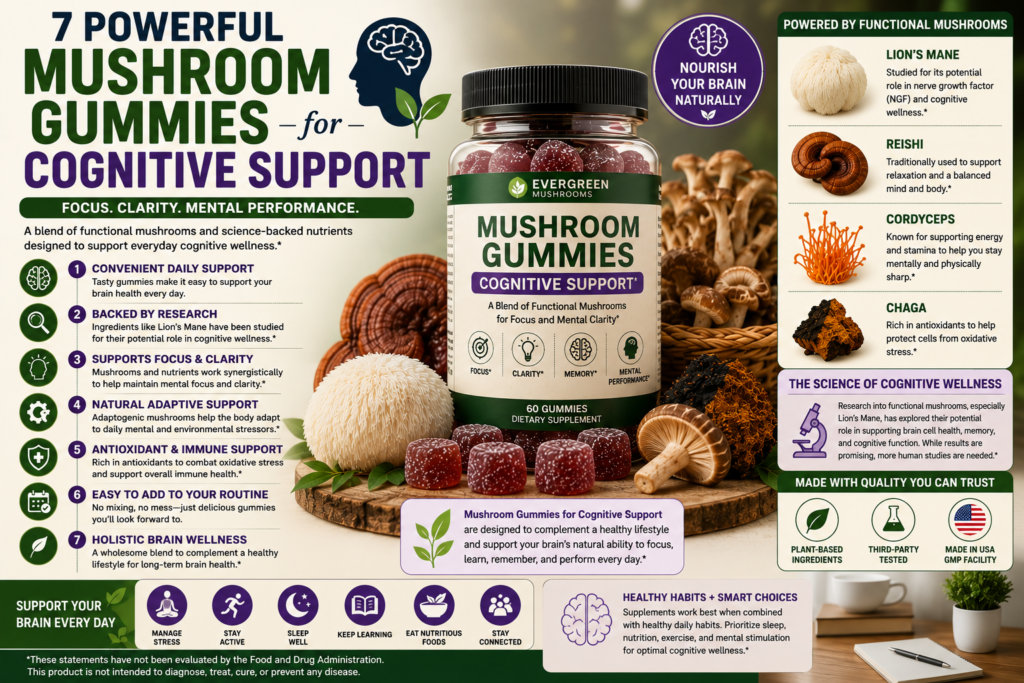
7 Powerful Mushroom Gummies for Cognitive Support: Complete Guide
Mushroom Gummies for Cognitive Support are a convenient way to incorporate functional mushroom ingredients into a broader wellness routine focused on cognition, concentration, and everyday mental performance. Lion’s Mane is particularly well known in this category because researchers have investigated it in relation to neurological pathways, cognition, and mood.
However, cognitive health is complex, and supplements should not be presented as treatments for dementia, Alzheimer’s disease, ADHD, depression, or other medical conditions. Evidence varies considerably between mushroom species, preparations, doses, and study populations.
This guide explores seven reasons people consider Mushroom Gummies for Cognitive Support, the functional mushrooms commonly found in these products, how research should be interpreted, how to evaluate supplement labels, and important safety considerations.
The NIH Office of Dietary Supplements explains that dietary supplements vary substantially in the amount of scientific evidence available for their ingredients. Human clinical research provides more direct evidence than laboratory or animal studies. Learn more about dietary supplements and evidence.
For a broader overview of the category, visit our Mushroom Gummies Benefits pillar guide.
Mushroom Gummies for Cognitive Support: What to Know
Mushroom Gummies for Cognitive Support are chewable dietary supplements containing functional mushroom ingredients marketed around cognitive wellness, focus, concentration, or general brain health.
Shop Magic Mushroom GummiesLion’s Mane is one of the most commonly discussed mushrooms in this area. It has attracted research interest because of compounds that may interact with biological pathways associated with the nervous system.
Other mushrooms, including Reishi and Cordyceps, may also appear in broader functional mushroom formulas.
It is important to distinguish scientific interest from proven clinical outcomes.
A mushroom being studied for cognitive effects does not mean that every gummy containing that mushroom has been demonstrated to improve memory, concentration, or brain function.
Commercial products can also differ in species, extraction method, concentration, serving size, and additional ingredients.
For these reasons, Mushroom Gummies for Cognitive Support should be viewed as dietary supplements rather than medications.
Understanding Cognitive Wellness
Cognitive wellness includes many aspects of everyday mental function, including attention, learning, memory, reasoning, and the ability to process information.
Cognitive performance can be influenced by sleep, nutrition, physical activity, stress, age, medications, health conditions, and many other factors.
This is why there is no single supplement that can replace the foundations of healthy cognitive function.
A person experiencing persistent memory problems, confusion, major changes in concentration, or other concerning symptoms should seek appropriate medical evaluation.
Mushroom Gummies for Cognitive Support may be considered as part of a wellness routine, but they should not be used to self-treat unexplained cognitive symptoms.
The National Center for Complementary and Integrative Health provides information about complementary approaches and cognitive health.
What Are Mushroom Gummies for Cognitive Support?
Mushroom Gummies for Cognitive Support are chewable supplements containing one or more mushroom-derived ingredients.
Depending on the product, these ingredients may be provided as mushroom powder, extract, or a combination of preparations.
Some products focus on one mushroom, while others combine several functional mushrooms.
Additional ingredients can include vitamins, minerals, botanical extracts, natural flavors, sweeteners, and other dietary ingredients.
Common Mushrooms in Cognitive Wellness Formulas
- Lion’s Mane
- Reishi
- Cordyceps
- Chaga
- Turkey Tail
- Maitake
The exact formulation matters because different mushrooms have different compositions and research histories.
Lion’s Mane and Cognitive Research
Lion’s Mane, scientifically known as Hericium erinaceus, is perhaps the most recognized functional mushroom associated with cognitive wellness.
Researchers have investigated Lion’s Mane in relation to nerve growth factor pathways, neurological function, cognition, mood, and other biological mechanisms.
Some human studies have explored cognitive and mood-related outcomes, but the overall evidence remains developing.
Importantly, research involving a specific Lion’s Mane preparation does not automatically demonstrate that every commercial gummy containing Lion’s Mane will produce the same outcome.
When evaluating Mushroom Gummies for Cognitive Support, check the actual amount and preparation of Lion’s Mane included.
For more information, read our Benefits of Lion’s Mane Gummies guide.
Reishi and Cognitive Wellness
Reishi is another widely recognized functional mushroom.
Reishi generally refers to mushrooms within the Ganoderma genus.
Research has explored Reishi in relation to immune-related pathways, antioxidant activity, inflammation, and other biological mechanisms.
Although Reishi can appear in broad wellness formulas, it should not automatically be categorized as a proven cognitive enhancer.
Some products combine Reishi with Lion’s Mane to create broader functional mushroom formulations.
Consumers should evaluate the evidence for each ingredient separately rather than assuming that a combination automatically provides a specific cognitive benefit.
Cordyceps and Mental Energy
Cordyceps is frequently associated with energy and physical performance research.
Researchers have investigated Cordyceps preparations in areas including exercise performance and energy metabolism.
Because fatigue can affect concentration and everyday productivity, Cordyceps may sometimes appear in formulas marketed around energy and cognitive wellness.
However, this does not mean that Cordyceps is a proven treatment for attention disorders or cognitive disease.
When evaluating Mushroom Gummies for Cognitive Support, consider the complete formulation and the specific purpose for which each ingredient is included.
For energy-focused information, visit our Mushroom Gummies for Energy guide.
Chaga and Functional Mushroom Research
Chaga is another mushroom used in functional mushroom products.
Research has examined Chaga for antioxidant activity and other biological properties.
Much of the evidence surrounding these mechanisms comes from laboratory and preclinical research.
Chaga is therefore better understood as one possible functional mushroom ingredient rather than a proven cognitive supplement.
Products combining Chaga with other mushrooms should be evaluated according to their complete ingredient profile.
1. Convenient Daily Supplementation
One of the most practical advantages of Mushroom Gummies for Cognitive Support is their convenience.
Gummies provide a pre-portioned format that does not require measuring powder or preparing a beverage.
This can make them easier to incorporate into an established supplement routine.
Convenience can be particularly appealing to people who dislike swallowing capsules.
However, convenience does not demonstrate effectiveness.
The product should still be evaluated according to its ingredients, serving size, preparation, and manufacturer information.
2. Interest in Cognitive Mushroom Research
Functional mushrooms have attracted scientific interest because they contain diverse compounds with biological activity.
Lion’s Mane has received particular attention in neurological and cognitive research.
Researchers have also investigated other mushrooms for biological mechanisms that may be relevant to general wellbeing.
This scientific interest is one reason people explore Mushroom Gummies for Cognitive Support.
However, laboratory findings and animal studies are not equivalent to demonstrated benefits in humans.
The strongest evidence for a health claim generally comes from well-designed human studies.
The NIH Office of Dietary Supplements explains that human studies provide more direct evidence about the effects of dietary supplements than laboratory or animal research. :contentReference[oaicite:1]{index=1}
3. Easy Integration Into a Daily Routine
A supplement can be easier to use consistently when it fits naturally into an existing routine.
Mushroom Gummies for Cognitive Support can be taken according to the manufacturer’s directions alongside a regular daily habit.
Some people may prefer taking their gummies with breakfast, while others may follow the timing recommended on the product label.
There is no universal requirement that every mushroom gummy should be taken at a particular time.
The most important consideration is following the product’s instructions and avoiding unnecessary increases in serving size.
4. Variety of Functional Mushroom Formulas
There are many formulations of Mushroom Gummies for Cognitive Support.
Some products contain primarily Lion’s Mane, while others combine several mushrooms.
| Mushroom | Common Research Area |
|---|---|
| Lion’s Mane | Cognition and nervous-system research |
| Reishi | Biological, antioxidant, and immune-related research |
| Cordyceps | Energy and exercise-related research |
| Chaga | Antioxidant and preclinical research |
| Turkey Tail | Immune-related research |
These descriptions identify broad research areas and are not guarantees of specific health outcomes.
5. Convenient Alternative to Powders
Mushroom powders can be mixed into smoothies, coffee, tea, and other foods.
Some consumers prefer the convenience of a pre-portioned gummy instead.
Mushroom Gummies for Cognitive Support provide a portable format that can be easier for travel, work, or daily routines.
However, gummies may contain additional ingredients for flavor, texture, and stability.
Consumers should therefore examine the complete ingredient list rather than focusing exclusively on the mushroom content.
6. Simple Ingredient Comparison
Comparing labels makes it easier to evaluate different Mushroom Gummies for Cognitive Support.
Important details include:
- Mushroom species
- Scientific name
- Powder or extract
- Amount per serving
- Serving size
- Additional vitamins
- Minerals
- Botanical ingredients
- Sweeteners
- Flavors
- Directions
- Warnings
The NIH explains that a Supplement Facts label identifies active ingredients, amounts per serving, serving size, and other ingredients such as fillers, binders, and flavorings. :contentReference[oaicite:2]{index=2}
7. Support for a Broader Wellness Routine
The most balanced way to approach Mushroom Gummies for Cognitive Support is to view them as one possible component of a broader wellness routine.
Important foundations of cognitive wellness include:
- Adequate sleep
- Regular physical activity
- Balanced nutrition
- Hydration
- Stress management
- Social connection
- Continued learning and mental stimulation
- Appropriate medical care
A supplement should not be expected to compensate for chronic sleep deprivation, poor nutrition, or an untreated medical condition.
If you experience persistent or worsening memory problems, confusion, changes in personality, or other concerning cognitive symptoms, professional medical evaluation is more appropriate than self-treating with supplements.
Common Ingredients in Mushroom Gummies for Cognitive Support
Formulas vary between manufacturers.
Potential ingredients include:
- Lion’s Mane
- Reishi
- Cordyceps
- Chaga
- Turkey Tail
- Vitamin B12
- Vitamin B6
- Vitamin D
- Magnesium
- Botanical extracts
- Natural flavors
- Sweeteners
- Pectin
- Gelatin
- Citric acid
Not every product contains these ingredients.
Some ingredients may be included for nutritional purposes, while others may primarily provide flavor, texture, color, or stability.
Always check the actual label of the product you are considering.
Mushroom Powder vs Extract
The preparation used in Mushroom Gummies for Cognitive Support is an important detail when comparing products.
Mushroom Powder
Mushroom powder generally consists of dried mushroom material that has been processed into a powder.
Mushroom Extract
An extract is produced through an extraction process intended to concentrate or separate certain components of the mushroom.
Why the Difference Matters
Scientific research may use a particular mushroom extract or preparation.
A commercial gummy may use a different preparation.
Therefore, the presence of the same mushroom name does not necessarily mean that the commercial product is equivalent to the preparation used in a research study.
| Feature | What to Check |
|---|---|
| Species | Exact mushroom identity |
| Preparation | Powder, extract, fruiting body, mycelium, or combination |
| Amount | Amount provided per serving |
| Serving size | Number of gummies per serving |
How to Read a Mushroom Gummy Label
Understanding the label is one of the best ways to compare Mushroom Gummies for Cognitive Support.
1. Check the Serving Size
Determine how many gummies constitute one serving.
2. Identify the Mushroom
Look for the exact mushroom species and scientific name where provided.
3. Check the Amount
Review the amount of each active ingredient per serving.
4. Determine the Preparation
Look for powder, extract, fruiting body, mycelium, or other preparation information.
5. Read the Other Ingredients
Review sweeteners, flavors, colors, binders, gelling agents, vitamins, minerals, and botanicals.
6. Check Directions
Follow the manufacturer’s recommended serving instructions.
7. Read Warnings
Check allergy information, medication warnings, pregnancy warnings, age recommendations, and storage instructions.
According to the NIH, dietary supplement labels are required to provide specific information such as serving size, dietary ingredients, amounts per serving, and other ingredients. :contentReference[oaicite:3]{index=3}
How to Evaluate Product Quality
Quality and transparency are important when choosing Mushroom Gummies for Cognitive Support.
Look for products that clearly identify:
- Mushroom species
- Ingredient preparation
- Amount per serving
- Serving size
- Complete ingredients
- Manufacturer information
- Directions
- Warnings
- Storage information
- Expiration or best-by information
- Testing information when available
Third-party testing may provide additional information about manufacturing quality and whether a product contains what its label indicates.
However, quality testing does not automatically demonstrate that a supplement is effective for cognitive support.
The NIH notes that FDA Good Manufacturing Practices are intended to help ensure the identity, purity, strength, and composition of dietary supplements. :contentReference[oaicite:4]{index=4}
Be cautious about products that promise guaranteed memory improvement, instant focus, treatment of dementia, or prevention of cognitive disease.
Building a Cognitive Wellness Routine
If you use Mushroom Gummies for Cognitive Support, consider combining supplementation with healthy lifestyle practices.
Prioritize Sleep
Consistent, adequate sleep is important for overall health and everyday cognitive performance.
Stay Physically Active
Regular physical activity supports general health and can contribute to overall wellbeing.
Eat a Balanced Diet
A varied diet supplies a broad range of nutrients needed for normal body function.
Manage Stress
Persistent stress can affect concentration and everyday wellbeing. Relaxation practices and healthy stress-management strategies can be useful.
Keep Your Mind Active
Reading, learning new skills, creative activities, and social interaction can provide opportunities for mental stimulation.
Maintain Regular Healthcare
Routine healthcare can help identify conditions or medications that may affect cognition.
Safety and Possible Side Effects
Safety should always be considered before using Mushroom Gummies for Cognitive Support.
Dietary supplements contain active ingredients and can cause side effects or interact with medications.
Possible concerns can include:
- Digestive discomfort
- Allergic reactions
- Sensitivity to mushroom ingredients
- Reactions to sweeteners or other ingredients
- Medication interactions
- Problems associated with excessive intake
The NIH Office of Dietary Supplements warns that supplements can have strong effects on the body and that some can interact with medications. :contentReference[oaicite:5]{index=5}
If you experience concerning symptoms after taking a supplement, discontinue use and seek appropriate medical advice.
Mushroom Gummies and Medications
People taking prescription or over-the-counter medication should consider potential interactions before using Mushroom Gummies for Cognitive Support.
Interactions can depend on the mushroom, preparation, amount, medication, and individual health circumstances.
Prescription Medication
Tell your doctor or pharmacist about all supplements you take.
Pregnancy and Breastfeeding
Many dietary supplements have not been adequately studied during pregnancy or breastfeeding. Professional medical advice is appropriate before use.
Children
Adult mushroom gummies should not automatically be considered appropriate for children.
Before Surgery
Tell your healthcare team about supplements you use before planned surgery.
The NIH specifically advises consumers to consider supplement safety and possible medication interactions. :contentReference[oaicite:6]{index=6}
How to Choose Mushroom Gummies for Cognitive Support
Use this checklist when comparing Mushroom Gummies for Cognitive Support.
| Factor | What to Check |
|---|---|
| Mushroom species | Look for the exact mushroom identity. |
| Preparation | Check whether it is powder, extract, fruiting body, mycelium, or another preparation. |
| Amount | Review the amount per serving. |
| Serving size | Determine how many gummies make one serving. |
| Additional ingredients | Check vitamins, minerals, botanicals, sweeteners, flavors, and colors. |
| Testing | Look for credible quality-testing information when available. |
| Manufacturer | Check for clear company and contact information. |
| Claims | Avoid guaranteed medical or disease-treatment claims. |
A longer ingredient list does not automatically make a product better.
A higher price also does not automatically indicate greater effectiveness.
Transparency is generally more useful than marketing language when comparing supplements.
For additional guidance, visit our Functional Mushroom Gummies Buying Guide.
Frequently Asked Questions
What are Mushroom Gummies for Cognitive Support?
Mushroom Gummies for Cognitive Support are chewable dietary supplements containing functional mushroom ingredients marketed around cognitive wellness, focus, concentration, or general brain health.
Which mushroom is most associated with cognitive support?
Lion’s Mane is one of the most commonly discussed functional mushrooms in cognitive wellness because it has been investigated in relation to neurological pathways and cognition.
Can mushroom gummies improve memory?
Some mushroom ingredients have been investigated for cognitive effects, but evidence varies and does not establish that every mushroom gummy improves memory. Consumers should avoid treating these products as guaranteed memory enhancers.
Are Mushroom Gummies for Cognitive Support treatments for dementia?
No. Dietary supplements should not be presented as treatments for dementia, Alzheimer’s disease, or other medical conditions.
Can Lion’s Mane gummies support cognition?
Lion’s Mane has been studied in relation to cognition and nervous-system pathways, but research is still developing. A commercial gummy should not automatically be considered equivalent to a research preparation.
Are mushroom gummies good for focus?
Some products are marketed for focus, particularly those containing Lion’s Mane. However, marketing claims should be distinguished from evidence demonstrating a specific clinical effect.
Can I take mushroom gummies every day?
Follow the manufacturer’s directions. If you take medication, have a medical condition, are pregnant or breastfeeding, or have another health concern, consult an appropriate healthcare professional.
Are mushroom gummies better than capsules?
Not necessarily. Gummies provide a convenient chewable format, while capsules may contain fewer additional ingredients. The appropriate choice depends on the specific product and individual preference.
Can mushroom gummies interact with medications?
Yes. Dietary supplements can interact with medications. Discuss supplement use with your doctor or pharmacist when appropriate.
Are mushroom gummies safe during pregnancy?
Many supplements have not been adequately studied during pregnancy. Speak with a healthcare professional before using mushroom supplements during pregnancy.
Can children take cognitive mushroom gummies?
Adult mushroom gummies should not automatically be given to children. Consult an appropriate healthcare professional before giving supplements to a child.
Where can I learn more about mushroom gummies?
Visit our Mushroom Gummies Benefits pillar guide for a broader overview.
Conclusion
Mushroom Gummies for Cognitive Support provide a convenient way to incorporate functional mushroom ingredients into a broader cognitive wellness routine.
Lion’s Mane is the most prominent mushroom in this category, while Reishi, Cordyceps, Chaga, and other mushrooms may appear in broader functional formulas.
Research into mushrooms and cognitive function is developing, but evidence varies considerably by mushroom, preparation, dosage, and study design.
Consumers should therefore avoid products that promise guaranteed memory enhancement, instant focus, prevention of dementia, or treatment of cognitive disorders.
Instead, evaluate the actual product. Check the mushroom species, preparation, amount per serving, serving size, additional ingredients, manufacturer information, directions, warnings, and available quality-testing information.
Healthy cognitive function also depends on sleep, nutrition, physical activity, stress management, social engagement, mental stimulation, and appropriate healthcare.
For the broader category, continue to our Mushroom Gummies Benefits pillar page.
For a specific look at Lion’s Mane, read Benefits of Lion’s Mane Gummies.
For concentration-focused information, continue to Mushroom Gummies for Focus.
