
Uncategorized
Mushroom Gummies for Focus
Aug
7 Powerful Mushroom Gummies for Focus: Complete Guide
Mushroom Gummies for Focus have become a popular topic among people interested in convenient functional mushroom supplements and everyday cognitive wellness. Lion’s Mane is especially well known in this category because researchers have investigated Hericium erinaceus in relation to cognition, mood, and nervous-system function.
However, understanding Mushroom Gummies for Focus requires separating scientific research from supplement marketing. Research on a particular mushroom preparation does not automatically prove that every gummy containing that mushroom will improve concentration or mental performance.
This guide explains what functional mushroom gummies are, which mushrooms are commonly associated with cognitive wellness, what current research says about Lion’s Mane, how to evaluate ingredients, and what to consider before adding a mushroom gummy to your daily routine.
The goal is to provide an evidence-conscious overview rather than promise a specific result. Dietary supplements can vary considerably in their ingredients, concentrations, preparation methods, and quality.
If you are researching broader mushroom wellness topics, start with our Mushroom Gummies Benefits guide.
Mushroom Gummies for Focus: What You Should Know
Mushroom Gummies for Focus are generally marketed as convenient functional mushroom supplements designed to fit into routines centered around cognitive wellness, productivity, or mental performance.
The most commonly discussed mushroom in this context is Lion’s Mane, scientifically known as Hericium erinaceus. Human and preclinical research has investigated Lion’s Mane in relation to cognition, mood, and neurological mechanisms.
A 2024 review published in PubMed evaluated 34 human studies examining mushrooms and neurocognition or mood. The intervention studies produced mixed results, although several studies involving Lion’s Mane reported potential improvements in mood or cognitive measures.
A 2025 systematic review of Hericium erinaceus also reviewed randomized controlled trials, pilot clinical trials, laboratory studies, and other research. The authors described promising findings while emphasizing the limitations of the available evidence.
These findings provide a reason to continue researching Lion’s Mane, but they do not establish that every commercial gummy will improve focus.
What Are Mushroom Gummies for Focus?
Mushroom Gummies for Focus are chewable dietary supplements containing one or more mushroom-derived ingredients.
Depending on the product, a gummy may contain Lion’s Mane alone or combine it with other mushrooms, vitamins, minerals, botanicals, or flavoring ingredients.
The gummy format is primarily a delivery method. It does not automatically make a mushroom more effective than a capsule or powder.
Why People Choose Gummies
- They are easy to chew.
- They are usually flavored.
- They do not require mixing.
- They can be convenient for a daily routine.
- They can provide a clearly labeled serving size.
For many consumers, convenience is one of the main reasons to consider Mushroom Gummies for Focus.
However, the actual mushroom preparation, serving amount, ingredients, and manufacturing quality are more important than the gummy format itself.
Lion’s Mane and Cognitive Research
Lion’s Mane is the mushroom most frequently associated with cognitive research in discussions about Mushroom Gummies for Focus.
Hericium erinaceus contains several compounds that have been investigated in laboratory and clinical research. Researchers have examined both fruiting-body preparations and mycelial preparations, including compounds known as erinacines.
A 2025 systematic review indexed by PubMed included five randomized controlled trials, three pilot clinical trials, a cohort study, a case report, and numerous laboratory studies.
The review examined cognitive outcomes as well as other areas including mood and neurological mechanisms. Some findings were promising, but the authors also noted the need for additional research.
This distinction is important because a study involving a particular Lion’s Mane extract cannot automatically be treated as proof that every commercial gummy produces the same effect.
When evaluating Mushroom Gummies for Focus, always consider the specific product formulation rather than the mushroom name alone.
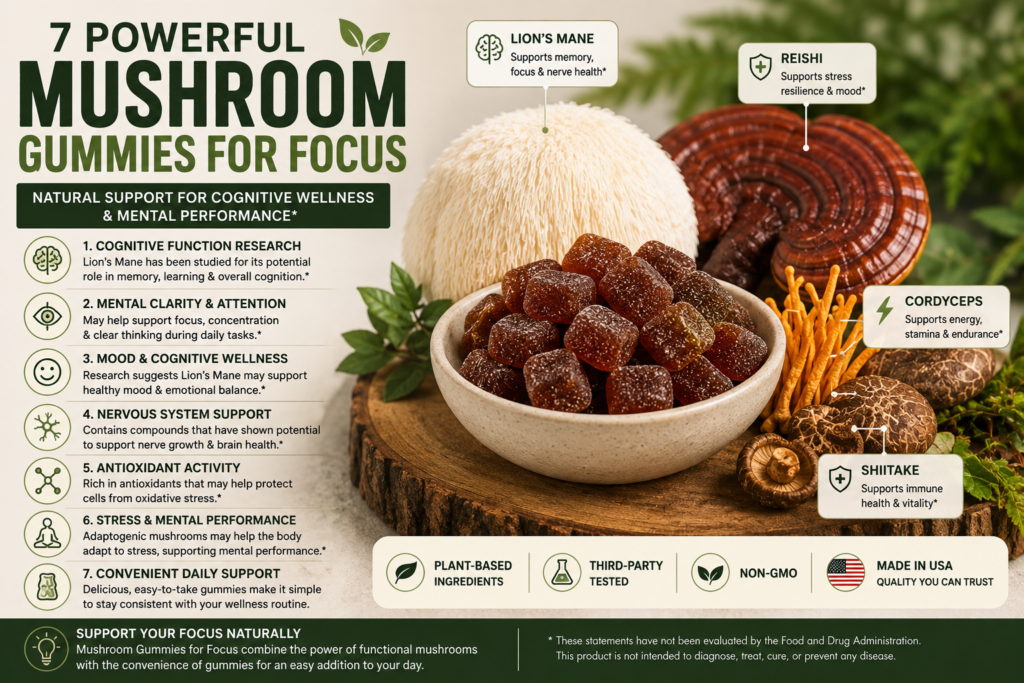
1. Cognitive Function Research
Cognitive function is the most important research area when discussing Mushroom Gummies for Focus.
Cognition includes several processes, including memory, attention, learning, processing speed, and executive function.
Human research involving Lion’s Mane has examined some of these outcomes. Results have varied between studies, and the available evidence is not large enough to establish a guaranteed cognitive benefit.
The 2024 review of mushroom research found mixed intervention results, although several Lion’s Mane studies reported potential improvements in mood and cognitive function in middle-aged and older adults.
The 2025 systematic review also identified cognitive research involving people with and without dementia.
These findings suggest that Lion’s Mane remains a worthwhile subject for cognitive research, but consumers should avoid interpreting preliminary evidence as proof of a medical effect.
For that reason, Mushroom Gummies for Focus are best viewed as dietary supplements that may complement a healthy lifestyle rather than guaranteed cognitive enhancers.
2. Mental Clarity and Attention
Mental clarity and attention are closely related to the reasons people search for Mushroom Gummies for Focus.
People may be interested in maintaining concentration while working, studying, reading, or completing everyday tasks.
However, concentration depends on many factors besides supplementation.
- Sleep quality.
- Stress levels.
- Hydration.
- Nutrition.
- Physical activity.
- Medication use.
- Underlying health conditions.
- Work environment.
A supplement should therefore not be considered a substitute for adequate sleep or healthy lifestyle habits.
Current research provides interesting reasons to investigate Lion’s Mane and cognition further, but there is not enough evidence to guarantee that Mushroom Gummies for Focus will improve attention in every person.
3. Mood and Cognitive Wellness
Mood can influence concentration, productivity, memory, and perceived mental clarity.
This is another reason researchers have examined the relationship between mushrooms and neurocognitive health.
The systematic review published in PubMed evaluated human research involving mushrooms, mood, and neurocognition. The review found mixed results among intervention studies.
Several Lion’s Mane studies reported potential improvements in mood or cognitive measures, but the researchers did not establish a universal effect.
This means Mushroom Gummies for Focus should not be marketed as a treatment for depression, anxiety, or other mental health conditions.
People experiencing persistent changes in mood or concentration should seek appropriate professional evaluation.
4. Nervous-System Research
Nervous-system research is another reason Lion’s Mane is frequently included in discussions about Mushroom Gummies for Focus.
Scientists have investigated compounds associated with Lion’s Mane for potential effects on neurological pathways.
Preclinical research has examined mechanisms involving nerve growth, neurogenesis, and neurotrophic factors.
Some laboratory and animal findings are interesting, but preclinical evidence does not automatically translate into proven benefits in humans.
The 2025 systematic review discussed evidence involving neural stimulation and neurological mechanisms, while also emphasizing the need for additional clinical evidence.
Consumers should therefore distinguish between a biological mechanism identified in laboratory research and a demonstrated health outcome in humans.
5. Antioxidant Research
Antioxidant activity is another area of interest when studying functional mushrooms.
Laboratory research has identified antioxidant activity in mushroom compounds, including compounds associated with Lion’s Mane.
Oxidative processes occur naturally in the body, and researchers study antioxidant mechanisms because of their potential relevance to cellular health.
However, laboratory antioxidant activity does not automatically mean that consuming Mushroom Gummies for Focus will produce a measurable cognitive or health benefit.
Antioxidant research should therefore be understood as part of the broader scientific investigation into functional mushrooms rather than as proof of a specific therapeutic effect.
6. Stress and Mental Performance
Stress can make it more difficult to concentrate and maintain mental performance.
Because adaptogenic and functional mushrooms are often discussed in relation to stress resilience, some people consider Mushroom Gummies for Focus as part of a broader wellness routine.
Research involving Lion’s Mane has included mood and subjective stress outcomes in some studies, although evidence remains limited.
Reducing stress can also involve non-supplement approaches such as adequate sleep, exercise, relaxation techniques, regular meals, and reasonable workload management.
Persistent or severe stress should be discussed with an appropriate healthcare professional.
7. Convenient Daily Supplementation
One practical advantage of Mushroom Gummies for Focus is convenience.
Unlike mushroom powder, gummies generally do not require preparation. Unlike capsules, they can be chewed rather than swallowed whole.
This may make the format easier for people who already have a consistent supplement routine.
Convenience should not be confused with effectiveness, however.
The nutritional or functional value of a gummy depends on its actual ingredients, preparation, amount, and quality.
A well-labeled product with transparent information is more useful than a product that relies entirely on broad claims about mental performance.
Other Mushrooms in Focus Formulas
Although Lion’s Mane is the mushroom most closely associated with cognitive research, some mushroom formulas combine several functional mushrooms.
Reishi
Reishi, commonly identified as Ganoderma lucidum, is frequently used in wellness products and has been studied in areas including immune-related pathways, inflammation, antioxidant activity, and stress.
Cordyceps
Cordyceps species have been investigated in relation to energy metabolism and physical performance. They may appear in broader wellness formulas designed for energy and endurance rather than focus alone.
Chaga
Chaga is another functional mushroom frequently included in mushroom blends. Research has investigated its antioxidant and other biological properties, although much of the evidence remains preclinical.
Combining mushrooms does not automatically make a formula more effective.
When choosing Mushroom Gummies for Focus, look at the exact formulation and the amount of each ingredient rather than simply counting how many mushrooms appear on the label.
Ingredients to Look For
The ingredients in Mushroom Gummies for Focus can vary significantly between products.
A product may contain:
- Lion’s Mane powder.
- Lion’s Mane extract.
- Reishi.
- Cordyceps.
- Chaga.
- Vitamins.
- Botanical ingredients.
- Natural flavors.
- Sweeteners.
- Pectin or gelatin.
- Citric acid.
- Natural or artificial colors.
Consumers should read the complete ingredient list before purchasing.
The National Center for Complementary and Integrative Health notes that supplements purchased online or in stores may differ in important ways from products used in research studies.
This is particularly relevant when evaluating Mushroom Gummies for Focus because the exact mushroom preparation can affect how closely a commercial product resembles a research preparation.
Powder vs Extract
One of the most important details to check when comparing Mushroom Gummies for Focus is whether the mushroom ingredient is provided as powder, extract, or both.
Mushroom Powder
Powder generally refers to dried mushroom material that has been processed into a powder.
Mushroom Extract
An extract is produced through an extraction process intended to separate or concentrate particular components of the mushroom.
Why the Difference Matters
Research may use a specific extract or preparation. A commercial gummy may use a different preparation.
Therefore, consumers should not assume that two products containing the same mushroom name are nutritionally or chemically identical.
| Feature | Powder | Extract |
|---|---|---|
| General form | Dried mushroom material | Extracted mushroom preparation |
| What to check | Species and amount | Species, extraction information, and amount |
| Research comparison | May differ from study preparations | May differ depending on extraction method |
Understanding Serving Size
Serving size is an important factor when comparing Mushroom Gummies for Focus.
A container with 60 gummies does not necessarily contain 60 servings.
If the label identifies two gummies as one serving, then 60 gummies represent 30 labeled servings.
Always check:
- Serving size.
- Servings per container.
- Amount per serving.
- Manufacturer’s directions.
- Storage instructions.
Do not assume that one gummy from one brand contains the same amount of mushroom ingredients as one gummy from another brand.
Following the manufacturer’s labeled directions is an important part of responsible supplement use.
How to Read the Label
Reading the label carefully can make it easier to compare Mushroom Gummies for Focus.
Check the Mushroom Species
Look for the exact species whenever the manufacturer provides it. Lion’s Mane is commonly identified as Hericium erinaceus.
Check the Preparation
Determine whether the mushroom is supplied as powder, extract, fruiting body, mycelium, or a combination.
Check the Amount
Look for the amount listed per serving.
Check the Serving Size
Determine how many gummies constitute one serving.
Read Other Ingredients
Review sweeteners, flavors, colors, gelling agents, vitamins, minerals, and other ingredients.
Look for Manufacturer Information
Transparent product information can make it easier to evaluate the supplement.
Third-party testing information can also be useful when available. NCCIH explains that independent testing programs can help verify that supplements contain what is listed on the label and are not contaminated or adulterated.
How to Evaluate Quality
Quality is an important consideration when choosing Mushroom Gummies for Focus.
Look for products that clearly identify:
- The mushroom species.
- The preparation type.
- The amount per serving.
- The serving size.
- All other ingredients.
- Manufacturer information.
- Storage instructions.
- Expiration or best-by information.
- Testing information when available.
Be cautious with products that make extraordinary promises.
Words such as “guaranteed,” “instant,” or “cures” should receive additional scrutiny, especially when they relate to medical conditions.
According to NCCIH, dietary supplements can vary in their evidence base and may differ from products used in scientific research.
This makes transparent labeling especially valuable when comparing Mushroom Gummies for Focus.
How to Build a Focus Routine
The best approach to cognitive wellness is broader than supplementation.
If you choose Mushroom Gummies for Focus, consider using them as one part of a healthy routine rather than the foundation of your mental-performance strategy.
Prioritize Sleep
Consistent, adequate sleep is important for attention, memory, mood, and everyday performance.
Stay Hydrated
Maintaining normal hydration can support general physical and mental function.
Eat Balanced Meals
A varied diet provides nutrients needed for normal body function.
Move Regularly
Regular physical activity is associated with broad health benefits and can be part of a healthy cognitive-wellness routine.
Manage Stress
Breaks, relaxation, social connection, and reasonable workload management can all contribute to a healthier routine.
These lifestyle factors remain important regardless of whether someone chooses to use Mushroom Gummies for Focus.
Safety and Possible Side Effects
Safety should always be considered before using Mushroom Gummies for Focus.
Dietary supplements can produce side effects, and individual responses vary.
Potential concerns include:
- Digestive discomfort.
- Allergic reactions.
- Sensitivity to other ingredients.
- Interactions with medications.
- Differences between concentrated extracts and whole mushroom preparations.
NCCIH advises consumers to consider safety for each supplement individually because the safety profile can depend on the specific product.
If you experience unusual or significant symptoms after taking a supplement, stop using it and seek appropriate medical advice.
People with known mushroom allergies should carefully review ingredients before using a mushroom product.
Mushroom Gummies and Medications
People taking prescription or over-the-counter medication should consider possible interactions before using Mushroom Gummies for Focus.
NCCIH explains that supplements can interact with medications and recommends discussing supplement use with healthcare providers.
Potential interactions may depend on the specific mushroom, medication, serving amount, and individual health circumstances.
Before Surgery
Tell your healthcare team about all supplements you use before surgery. Some supplements can affect bleeding or the response to anesthesia.
Pregnancy and Breastfeeding
Many dietary supplements have not been adequately studied during pregnancy or breastfeeding. Professional guidance is appropriate before use.
Children
Do not assume that an adult mushroom gummy is appropriate for children. Discuss supplement use with an appropriate healthcare professional.
For general supplement safety information, see the NCCIH Safe Use of Complementary Health Products and Practices resource.
How to Choose Mushroom Gummies for Focus
A simple checklist can help you compare Mushroom Gummies for Focus more carefully.
| Factor | What to Check |
|---|---|
| Mushroom species | Identify exactly which mushroom is included. |
| Preparation | Check whether it is powder, extract, fruiting body, or mycelium. |
| Amount | Check the amount per serving. |
| Serving size | Determine how many gummies constitute a serving. |
| Other ingredients | Review sweeteners, flavors, colors, and other ingredients. |
| Testing | Look for relevant testing information when available. |
| Claims | Be cautious of guaranteed medical or cognitive claims. |
Comparing products using these criteria can help you avoid choosing a supplement based entirely on attractive marketing.
The Mushroom Gummies for Focus category contains products with different formulations, so reading the label is essential.
For more information about choosing functional mushroom products, see our Functional Mushroom Gummies Buying Guide.
Frequently Asked Questions
What are Mushroom Gummies for Focus?
Mushroom Gummies for Focus are chewable dietary supplements containing one or more mushroom-derived ingredients and marketed for cognitive or mental-wellness routines.
Which mushroom is most commonly associated with focus?
Lion’s Mane, or Hericium erinaceus, is one of the mushrooms most commonly discussed in connection with cognitive research.
Can Lion’s Mane gummies improve focus?
Human research has investigated Lion’s Mane in relation to cognition and mood, but evidence remains developing. Current research does not establish that every Lion’s Mane gummy will improve focus in every person.
Are Mushroom Gummies for Focus scientifically proven?
Some mushroom ingredients have been studied in human and preclinical research, but evidence varies considerably by mushroom, preparation, dose, and outcome. A commercial gummy should not automatically be considered equivalent to a research preparation.
Are gummies better than capsules?
Not necessarily. Gummies are convenient and chewable, while capsules may provide a simpler formulation. The best choice depends on the individual and the actual product ingredients.
What should I look for in a focus gummy?
Check the mushroom species, preparation, amount per serving, serving size, complete ingredient list, manufacturer information, directions, and available testing information.
Can I take Mushroom Gummies for Focus every day?
Follow the manufacturer’s labeled directions. If you take medications, have a medical condition, are pregnant or breastfeeding, or have other health concerns, discuss supplement use with an appropriate healthcare professional.
Can Mushroom Gummies for Focus replace coffee?
There is no basis for assuming that mushroom gummies provide the same effects as caffeine. Products vary, and many mushroom gummies contain no caffeine at all.
Do focus gummies contain Lion’s Mane?
Some do, while others may contain blends of several mushrooms or additional ingredients. Always check the individual product label.
Are mushroom gummies safe?
Safety depends on the specific product and individual circumstances. Dietary supplements can cause side effects or interact with medications, so review the ingredients and seek professional advice when appropriate.
Where can I learn more about mushroom gummy benefits?
Visit our Mushroom Gummies Benefits guide for a broader overview of functional mushroom gummies.
Where can I find mushroom gummies?
You can explore the Evergreen Mushrooms mushroom gummies category and review the current product information before purchasing.
Conclusion
Mushroom Gummies for Focus are an increasingly popular way to explore functional mushroom supplements as part of a broader cognitive-wellness routine.
Lion’s Mane is the most prominent mushroom in this category because researchers have investigated Hericium erinaceus in relation to cognition, mood, and nervous-system biology.
Current human research is interesting but still developing. Some studies have reported promising cognitive or mood-related findings, while broader reviews have found mixed results.
That means consumers should avoid treating Mushroom Gummies for Focus as guaranteed cognitive enhancers or medical treatments.
Instead, look at the actual mushroom species, preparation, serving size, amount per serving, additional ingredients, and available testing information.
It is also important to remember that supplements are only one possible component of a healthy routine. Sleep, nutrition, hydration, physical activity, stress management, and appropriate medical care remain important for cognitive wellness.
NCCIH recommends that consumers consider supplement safety, potential medication interactions, and differences between commercial products and those used in research studies. You can review its Using Dietary Supplements Wisely resource for additional information.
For a broader look at the category, continue to our Mushroom Gummies Benefits pillar article.
If you are particularly interested in Lion’s Mane, read our Benefits of Lion’s Mane Gummies guide next.
You can also explore the Evergreen Mushrooms mushroom gummies category and review the current product-specific information before purchasing.
