
Uncategorized
Functional Mushroom Gummies Ingredients
Aug
Functional Mushroom Gummies Ingredients: 9 Essential Facts
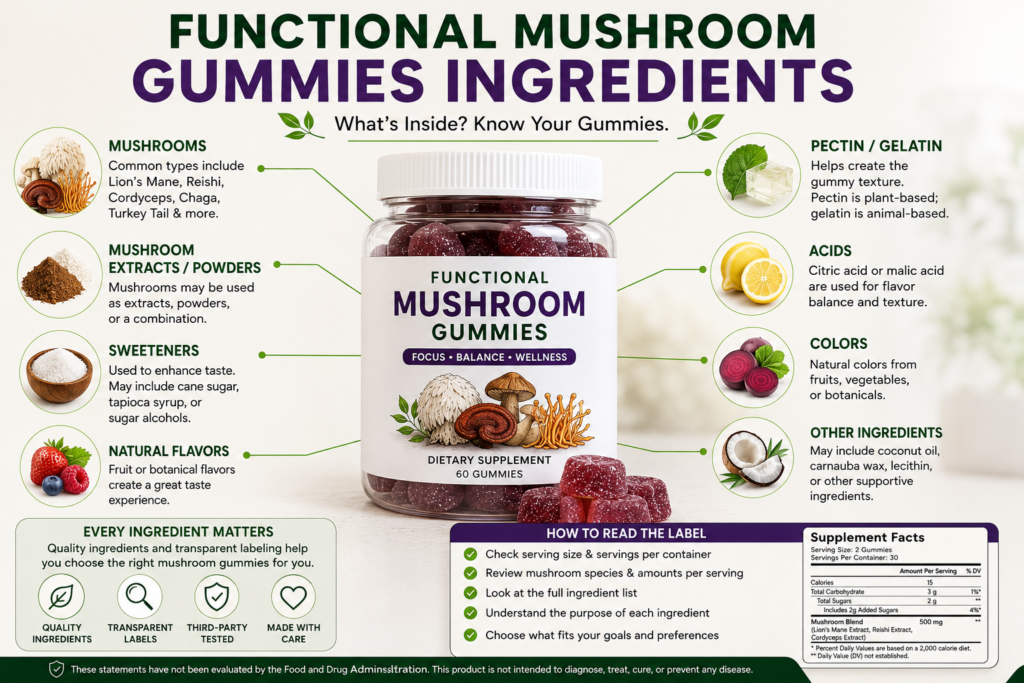
Functional Mushroom Gummies Ingredients are important to understand before choosing a mushroom gummy product. The mushroom itself is only one part of a complete formulation. Depending on the product, gummies may also contain mushroom powders or extracts, sweeteners, flavors, pectin, gelatin, acids, colors, and other ingredients.
For anyone researching Functional Mushroom Gummies Ingredients, learning how to read the complete label is much more useful than judging a product by its front packaging, flavor, or marketing claims.
Different products can contain different mushroom species, preparations, serving sizes, and supporting ingredients. Even two products featuring the same mushroom may have substantially different formulations.
This guide explains the major ingredient categories found in functional mushroom gummies, including mushroom powders, extracts, blends, sweeteners, flavors, acids, pectin, gelatin, and other formulation ingredients.
Understanding Functional Mushroom Gummies Ingredients can also help consumers compare products more carefully and recognize important differences that may not be obvious from the front of a package.
Important: Functional mushroom gummies are dietary supplements. They should not be treated as medicines or substitutes for professional medical care. Evidence varies between mushroom species, preparations, products, and intended uses.
Functional Mushroom Gummies Ingredients: An Overview
The phrase Functional Mushroom Gummies Ingredients refers to everything included in a gummy formulation, not just the mushrooms listed prominently on the front of the package.
A typical formulation can contain several categories of ingredients:
- Mushroom powders or extracts.
- Sweeteners.
- Flavoring ingredients.
- Gelling or texture ingredients.
- Acids.
- Coloring ingredients.
- Other formulation ingredients.
The exact list varies from product to product. Some gummies may focus on one mushroom species, while others contain several mushrooms in a blend.
This is why reading the complete ingredient list is an important part of evaluating a mushroom gummy. Two products can have similar names while containing significantly different formulations.
The mushroom species is also only part of the comparison. Consumers should consider the preparation, serving size, amount per serving, and additional ingredients.
For a broader introduction to the category, visit the Functional Mushroom Gummies pillar guide.
Common Mushroom Ingredients
The mushroom component is usually the most prominent ingredient category when reviewing Functional Mushroom Gummies Ingredients.
Different formulations may contain one mushroom species or several species combined into a blend. Common examples include Lion’s Mane, Reishi, Cordyceps, Chaga, and Turkey Tail.
Lion’s Mane
Lion’s Mane, commonly identified as Hericium erinaceus, is frequently included in functional mushroom products and has been investigated in scientific research.
Consumers should distinguish between research involving Lion’s Mane and evidence for a particular commercial product containing Lion’s Mane. The preparation and amount can differ between research and commercial formulations.
Reishi
Reishi generally refers to mushrooms in the Ganoderma genus. It has a history of traditional use and has also attracted modern research interest.
When comparing products, check how the mushroom is identified on the label and whether the formulation provides useful information about the preparation and serving amount.
Cordyceps
Cordyceps is another mushroom commonly found in functional formulations. The exact species and preparation should be checked on the product label.
Chaga
Chaga is another mushroom that may appear in supplement formulations. As with other mushrooms, the specific preparation and serving information are important when comparing products.
Turkey Tail
Turkey Tail, commonly known as Trametes versicolor, is another mushroom used in some supplement formulations.
The presence of a mushroom name on a label does not by itself establish a specific health outcome. The preparation, amount, product quality, and available evidence all matter.
For this reason, identifying the exact mushroom is the first step, not the final step, when evaluating Functional Mushroom Gummies Ingredients.
Mushroom Powder
Mushroom powder is one type of ingredient that may appear in functional mushroom gummies.
Generally, mushroom powder refers to dried mushroom material that has been processed into a powdered form.
When evaluating Functional Mushroom Gummies Ingredients, consumers should look for the mushroom species and the amount supplied per serving where that information is provided.
It is also useful to determine whether the powder is part of a single-mushroom formulation or included in a broader blend.
What to Check
- Mushroom species.
- Amount per serving.
- Serving size.
- Whether the powder is part of a blend.
- Any additional mushroom preparations.
Do not assume that every mushroom powder is identical simply because the same species name appears on two labels.
Differences in sourcing, preparation, serving size, and formulation can affect how products should be compared.
Mushroom Extracts
Mushroom extracts are another common ingredient category.
An extract is produced through an extraction process intended to separate or concentrate certain components of the source material.
For this reason, an extract should not automatically be treated as equivalent to a simple mushroom powder.
When reviewing Functional Mushroom Gummies Ingredients, look for any available information describing the preparation used by the manufacturer.
Why Preparation Matters
Scientific research may involve a specific mushroom preparation. A commercial gummy may use a different preparation of the same mushroom.
Therefore, consumers should avoid assuming that evidence involving one preparation automatically applies to every product containing the same mushroom species.
Where a manufacturer provides specific preparation information, that information can make product comparison easier.
Extract Information to Look For
- The mushroom species.
- The type of preparation.
- The amount per serving where disclosed.
- Serving size.
- Any additional ingredients included in the formulation.
Mushroom Blends
Some products contain several mushroom species in one formulation.
A blend may combine mushrooms such as Lion’s Mane, Reishi, Cordyceps, Chaga, or Turkey Tail.
Blends can make Functional Mushroom Gummies Ingredients more complicated because consumers need to determine whether the individual ingredients and their amounts are clearly disclosed.
| Formulation | What to Check |
|---|---|
| Single mushroom | Species, preparation, and amount per serving. |
| Mushroom blend | Individual species and amounts where provided. |
| Mushroom plus other ingredients | Complete ingredient and serving information. |
A blend is not automatically better or worse than a single-mushroom formulation. The useful comparison depends on the actual ingredients and labeling.
Beginners should avoid judging a product simply by how many mushroom names appear on the label.
Gummy Base Ingredients
Unlike a simple powder or capsule, a gummy needs a structure that allows it to remain chewable and stable.
This means Functional Mushroom Gummies Ingredients can include components that have little to do with the mushroom itself but are necessary for the physical characteristics of the product.
Depending on the formulation, these may include:
- Pectin.
- Gelatin.
- Sweeteners.
- Water.
- Acids.
- Flavoring ingredients.
- Coloring ingredients.
The exact ingredients depend on the product.
Why the Gummy Base Matters
The gummy base can affect texture, dietary suitability, flavor, and the overall ingredient profile.
For example, consumers following specific dietary preferences may want to know whether a gummy uses gelatin or a plant-based gelling ingredient.
The ingredient list should therefore be reviewed in full rather than focusing only on the mushroom component.
Sweeteners
Many gummies contain sweetening ingredients because sweetness helps create the flavor profile expected from a chewable product.
Depending on the formulation, a product may use sugar, sugar alcohols, syrups, or other sweetening ingredients.
Consumers who monitor their sugar intake should review the nutrition facts panel and ingredient list rather than assuming that every gummy has the same nutritional profile.
What Beginners Should Check
- Total sugars.
- Added sugars where listed.
- Other sweeteners.
- Serving size.
- Calories per serving.
Checking these details can help consumers choose products that better fit their dietary preferences.
Sweeteners are therefore an important but separate part of the overall Functional Mushroom Gummies Ingredients picture.
Flavors and Acids
Flavoring ingredients are common in gummy formulations.
They can help mask earthy mushroom flavors and create familiar fruit or other flavor profiles.
Acidic ingredients may also be used to influence flavor and formulation characteristics.
When examining Functional Mushroom Gummies Ingredients, flavoring ingredients should be considered part of the complete formulation rather than ignored because they are not the primary mushroom ingredient.
Consumers with specific dietary sensitivities should review the individual product label and seek professional advice when necessary.
Why Flavor Matters
Flavor can affect how appealing a gummy is to the person consuming it, but taste should not be confused with product quality.
A pleasant flavor does not tell you whether the mushroom preparation, serving size, or ingredient transparency is appropriate.
Pectin, Gelatin, and Texture
Texture ingredients help determine whether a gummy is soft, firm, chewy, or otherwise structured.
Pectin
Pectin is a plant-derived substance commonly used as a gelling agent in food products.
Gelatin
Gelatin is another gelling ingredient used in many food and confectionery products.
Consumers with dietary restrictions or preferences may want to determine which type of gelling ingredient is used.
The complete ingredient list is the best place to check this information.
This is particularly relevant for consumers following vegetarian or vegan dietary preferences, because the specific gelling ingredient can affect whether a product fits their diet.
Serving Size and Ingredient Amounts
Ingredient information is difficult to interpret without understanding the serving size.
For example, a container might contain 30 gummies but define two gummies as one serving.
In that situation, the product contains 15 labeled servings rather than 30.
This is why Functional Mushroom Gummies Ingredients should always be evaluated alongside the serving information.
| Information | Why It Matters |
|---|---|
| Serving size | Shows how many gummies make up one serving. |
| Servings per container | Shows how many labeled servings are included. |
| Ingredient amount | Shows how much of a listed ingredient is supplied per serving. |
| Directions | Explains the manufacturer’s recommended use. |
Consumers should follow the manufacturer’s labeled serving instructions rather than assuming that taking more is necessarily better.
Serving size also makes it easier to compare the cost and formulation of different products.
How to Read the Complete Label
Learning to read the complete label is one of the most useful skills for anyone researching mushroom supplements.
The U.S. Food and Drug Administration’s consumer guidance provides information about dietary supplement labels and considerations for consumers.
Step 1: Find the Serving Size
Determine how many gummies constitute one serving.
Step 2: Identify the Mushroom
Look for the exact mushroom species included.
Step 3: Check the Preparation
Determine whether the product identifies powder, extract, or another preparation.
Step 4: Review the Amount
Look for the quantity supplied per serving where it is disclosed.
Step 5: Read the Other Ingredients
Review sweeteners, flavors, gelling agents, colors, acids, and other formulation components.
Step 6: Check the Directions
Follow the manufacturer’s labeled directions and storage information.
This process makes Functional Mushroom Gummies Ingredients easier to understand and compare across products.
How to Compare Ingredient Lists
Comparing two ingredient lists can reveal differences that are not obvious from product packaging.
Start by putting the products side by side and checking the following:
- Mushroom species.
- Preparation type.
- Amount per serving.
- Serving size.
- Number of servings.
- Sweeteners.
- Flavoring ingredients.
- Gelling agents.
- Other active ingredients.
A transparent label makes this process easier.
It is also useful to compare products based on serving information rather than package size alone.
For a broader beginner-focused explanation, read Functional Mushroom Gummies for Beginners.
You can also compare the format with capsules using Functional Mushroom Gummies vs Capsules.
Ingredient Claims vs Evidence
Ingredient lists and scientific evidence answer different questions.
An ingredient list tells you what the manufacturer says is included in the product. Research investigates specific questions about ingredients, preparations, populations, and outcomes.
The National Center for Complementary and Integrative Health provides guidance on evaluating dietary supplements and considering the evidence behind supplement claims.
A study involving a particular mushroom preparation does not automatically prove that every commercial gummy containing that mushroom will produce the same result.
Be Careful With Broad Claims
Terms such as “supports wellness” can be broad and may not tell you exactly what a product contains or what evidence supports a specific claim.
Look for Specific Information
Exact mushroom species, preparation, serving size, and ingredient amounts are more useful for product comparison than vague descriptions.
Separate Ingredients From Outcomes
The presence of an ingredient does not automatically establish that consuming a particular product will produce a specific health outcome.
Ingredient and Safety Considerations
Understanding Functional Mushroom Gummies Ingredients is also important from a safety perspective.
Dietary supplements can contain active ingredients that may not be appropriate for everyone.
The NCCIH explains that dietary supplements can interact with medications and may present risks for some people.
Anyone taking prescription or over-the-counter medication, living with a medical condition, pregnant, breastfeeding, or considering a supplement for a child should discuss the product with an appropriate healthcare professional.
Consumers should also follow the labeled serving instructions and avoid assuming that increasing the amount will necessarily improve results.
Check for Allergies and Dietary Preferences
Review the complete ingredient list if you have food allergies, sensitivities, or dietary restrictions.
Follow Storage Instructions
Gummies should be stored according to the manufacturer’s instructions to help maintain product quality.
Pay Attention to Unexpected Reactions
If you experience an unexpected or concerning reaction after consuming a supplement, stop using the product and seek appropriate medical advice. Serious symptoms require prompt medical attention.
Functional Mushroom Gummies Ingredients Checklist
Use this checklist when reviewing a mushroom gummy product:
- ☐ Mushroom species are clearly identified.
- ☐ Preparation type is explained where applicable.
- ☐ Serving size is clearly stated.
- ☐ Ingredient amounts are provided where applicable.
- ☐ The complete ingredient list is available.
- ☐ Sweeteners are identified.
- ☐ Flavoring ingredients are identified.
- ☐ Gelling ingredients are identified.
- ☐ Directions are clearly provided.
- ☐ Storage instructions are available.
- ☐ Product claims are evaluated carefully.
- ☐ Potential medication or health considerations have been discussed with a professional when appropriate.
This checklist does not determine whether a specific product is right for an individual. It provides a practical framework for understanding the information available on the label.
Shop Mushroom Gummies
If you want to explore mushroom gummies after learning about their ingredients, Evergreen Mushrooms provides a dedicated category where you can review the available selection.
Keeping the commercial link at the category level allows this article to remain primarily educational while still giving readers a clear path to explore available products.
Frequently Asked Questions
What are the main Functional Mushroom Gummies Ingredients?
The main ingredients vary by product but can include mushroom powders or extracts along with sweeteners, flavors, gelling agents, acids, colors, and other formulation ingredients.
Do all mushroom gummies contain the same ingredients?
No. Products can contain different mushroom species, preparations, serving sizes, sweeteners, flavors, and other ingredients.
What is the difference between mushroom powder and extract?
Mushroom powder generally refers to dried mushroom material processed into powder, while an extract is produced through an extraction process. They should not automatically be considered equivalent.
Why do mushroom gummies contain sweeteners?
Sweeteners can be used to create the flavor profile associated with chewable gummies. The specific sweetener varies by formulation.
What is pectin used for in gummies?
Pectin can function as a gelling ingredient and help provide the desired gummy texture.
Do all gummies contain gelatin?
No. Some gummies use gelatin while others use plant-based gelling ingredients such as pectin. Check the individual ingredient list.
How can I compare mushroom gummy ingredients?
Compare the mushroom species, preparation, amount per serving, serving size, sweeteners, flavors, gelling ingredients, and complete ingredient list.
Should I choose a gummy with more mushroom ingredients?
Not necessarily. A larger number of ingredients does not automatically mean a better product. The formulation should be evaluated based on transparency, serving information, individual preferences, and available evidence.
Are mushroom gummy ingredients important for dietary preferences?
Yes. Ingredients such as gelatin, sweeteners, flavors, and other formulation components may matter to consumers following specific dietary preferences or avoiding particular ingredients.
Where can I learn more about functional mushroom gummies?
Start with the Functional Mushroom Gummies pillar guide and continue through the supporting articles in the cluster.
Conclusion
Understanding Functional Mushroom Gummies Ingredients is one of the best ways to make informed comparisons between mushroom gummy products.
The mushroom species is only one part of the equation. Consumers should also consider whether the product contains a powder or extract, how many mushrooms are included, the serving size, sweeteners, flavors, gelling agents, acids, colors, and other ingredients.
Reading the complete label can reveal important differences between products that may look similar on the front of the package.
It is also important to separate ingredient information from evidence. The presence of a particular mushroom does not automatically establish a specific health effect, and research involving one preparation may not apply directly to every commercial formulation.
A thoughtful approach is therefore to identify the mushroom species, examine the preparation, check the serving size, review the complete ingredient list, and evaluate product claims carefully.
For additional information, continue with our Functional Mushroom Gummies pillar guide or explore the Shop Magic Mushroom Gummies category.
