
Uncategorized
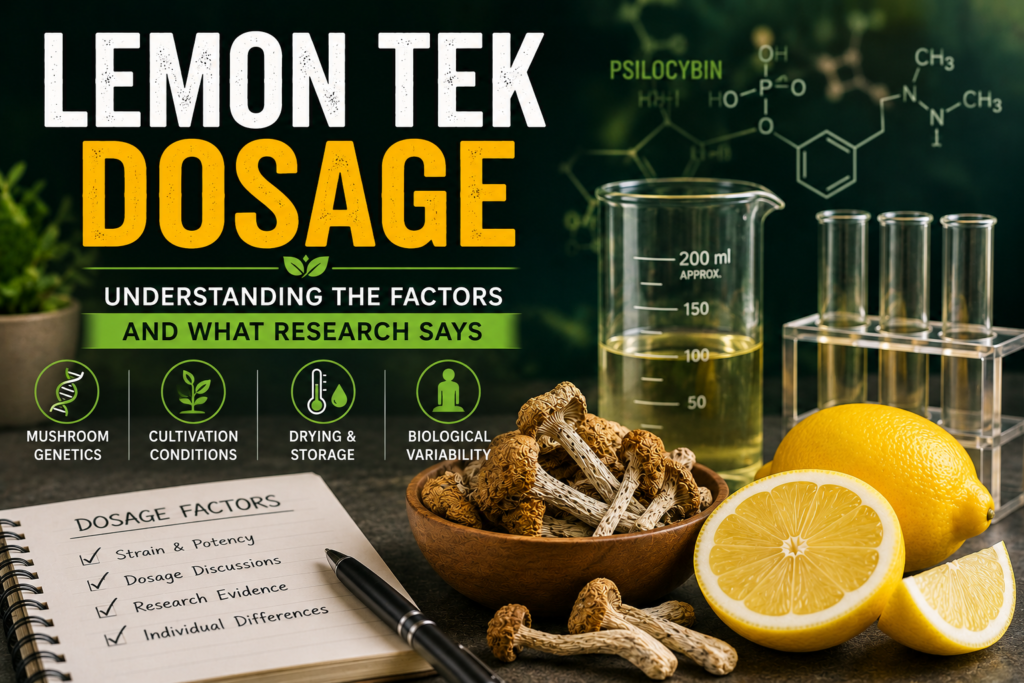
Lemon Tek Dosage: Understanding the Factors and What Research Says
Jul
Lemon Tek Dosage: What Science Actually Says
Lemon Tek Dosage is a commonly searched topic within online discussions about mushroom preparation and psilocybin research. However, there is currently no scientifically validated lemon tek dosage standard. Much of the dosage information shared online comes from personal experiences, community discussions, and informal reports rather than controlled clinical research.
This Lemon Tek Dosage guide focuses on what current science does and does not establish. Rather than providing instructions or recommending a specific amount, it examines the terminology, research limitations, biological variability, and common misconceptions surrounding the subject.
Understanding the difference between anecdotal reports and scientific evidence is particularly important when researching preparation methods involving psilocybin-containing mushrooms.
This article is intended for educational purposes only. It does not provide dosing instructions, medical advice, or recommendations for consuming psilocybin-containing substances.
Lemon Tek Dosage: An Overview
The phrase Lemon Tek Dosage generally appears in online discussions about the amount of mushrooms associated with the lemon tek preparation method.
However, there is no universally accepted scientific definition of a lemon tek dosage, and no recognized medical guideline establishes a separate dosage standard specifically for this preparation technique.
Most dosage information found online originates from community discussions, personal anecdotes, and informal reports. These sources can describe individual experiences, but they should not be confused with controlled clinical evidence.
Current scientific research primarily investigates psilocybin itself, including its chemistry, metabolism, pharmacology, neuroscience, and potential therapeutic applications.
Researchers have not established a standardized Lemon Tek Dosage through peer-reviewed clinical research.
For this reason, the most responsible way to approach the topic is through scientific education and an understanding of the limitations of available evidence.
What Is Lemon Tek Dosage?
The term Lemon Tek Dosage generally refers to online discussions about the amount of mushrooms used when people talk about the lemon tek preparation method.
There is currently no universally recognized scientific definition of lemon tek dosage and no established medical guideline that provides a separate dosage standard for the preparation method.
Much of the information available online comes from community discussions and personal reports.
Because these reports are not controlled clinical studies, individual experiences cannot establish a universal scientific standard.
The distinction between anecdotal information and scientific evidence is particularly important when a search term relates to a psychoactive substance.
Scientific research generally attempts to control variables, measure outcomes, and reproduce findings. Online discussions often involve uncontrolled differences in mushroom material, preparation, individual physiology, and other factors.
Why Is Lemon Tek Dosage Frequently Discussed?
Interest in Lemon Tek Dosage has grown alongside increasing public interest in mushroom education and renewed scientific research into psilocybin.
Search engines, social media, podcasts, and online communities have contributed to widespread curiosity about whether preparation methods influence how people describe their experiences.
Online discussions frequently attempt to compare preparation methods or describe perceived differences between them.
However, anecdotal reports do not provide enough evidence to establish a scientifically validated dosage standard.
Researchers recognize that many variables can influence outcomes, making it difficult to isolate the effect of a single preparation method.
These variables can include mushroom chemistry, cultivation conditions, storage, preparation, and individual biological differences.
As a result, different online reports can appear contradictory even when they discuss the same general preparation method.
What Does Current Science Say About Lemon Tek Dosage?
Current scientific literature has not established a standardized Lemon Tek Dosage or demonstrated that a unique dosage guideline is appropriate for this preparation method.
Most published research investigates psilocybin itself, including its chemistry, metabolism, pharmacology, neuroscience, and potential therapeutic applications.
Although laboratory and clinical research continues to expand, relatively few peer-reviewed studies specifically investigate how preparation techniques influence measurable chemical changes.
This means there is currently insufficient evidence to establish a scientifically validated preparation-specific dosage standard.
Readers looking for reliable information should prioritize peer-reviewed publications, university research, and recognized scientific organizations over anecdotal sources.
The National Center for Complementary and Integrative Health provides educational information about current scientific research involving psilocybin and mental health.
Factors That Influence Lemon Tek Dosage Discussions
When reading about Lemon Tek Dosage, it is important to understand that no single factor determines how mushrooms are discussed in scientific literature or educational resources.
Researchers recognize that multiple biological and environmental variables contribute to natural variation.
Mushroom Genetics
Different mushroom genetics can naturally contain varying concentrations of chemical compounds. Even mushrooms described using the same strain name may exhibit biological variation.
This makes direct comparisons between individual samples difficult.
Cultivation Conditions
Environmental factors such as substrate composition, humidity, temperature, air exchange, lighting, and overall cultivation practices can influence mushroom development.
These variables contribute to differences observed between harvests.
Harvesting and Storage
How mushrooms are harvested, dried, packaged, and stored can affect long-term chemical stability.
Moisture, oxygen exposure, heat, and light are among the factors researchers continue to consider when examining compound preservation.
Natural Biological Differences
Scientific research consistently recognizes that individuals have different physiology.
Body weight, metabolism, digestive processes, genetics, overall health, and numerous other biological variables can contribute to differences observed in pharmacological research.
These variables make it inappropriate to treat individual online experiences as a universal scientific dosage standard.
Current Research and Knowledge Gaps
Interest in psilocybin research has expanded significantly over the last decade.
Universities and research institutions continue studying mushroom chemistry, neuroscience, pharmacology, and potential therapeutic applications.
Despite this growing body of research, relatively few published studies specifically investigate Lemon Tek Dosage.
Most scientific literature focuses on psilocybin itself rather than comparing individual preparation techniques or establishing preparation-specific dosage standards.
Areas Scientists Continue to Investigate
- Natural variation in mushroom chemistry.
- Psilocybin stability under different environmental conditions.
- Conversion of psilocybin into psilocin.
- Laboratory standardization of mushroom analysis.
- Bioavailability of naturally occurring compounds.
- Potential clinical applications currently under investigation.
- Differences between controlled research preparations and naturally occurring mushroom material.
As additional peer-reviewed research becomes available, scientists may gain a better understanding of how preparation methods influence measurable chemical properties.
Until then, evidence-based education remains more reliable than unsupported online dosage claims.
Common Misconceptions About Lemon Tek Dosage
Online discussions can create misconceptions about what is scientifically established regarding Lemon Tek Dosage.
There Is an Official Lemon Tek Dosage
There is currently no recognized scientific guideline establishing an official lemon tek dosage standard.
Every Mushroom Has the Same Potency
Natural mushroom material can vary chemically. Genetics, cultivation, harvesting, storage, and other factors can contribute to differences.
Anecdotal Reports Are Scientific Evidence
Personal experiences can describe what happened to one person, but they cannot establish a universal scientific conclusion.
Research on Psilocybin Automatically Establishes Lemon Tek Guidelines
Research involving psilocybin does not automatically establish preparation-specific guidelines for every method discussed online.
Preparation Methods Have Been Fully Studied
Research into preparation methods remains limited compared with the broader body of research involving psilocybin chemistry and pharmacology.
Mushroom Chemistry and Natural Variability
Understanding natural chemical variability helps explain why Lemon Tek Dosage discussions can differ so significantly between sources.
Mushrooms are biological organisms, and their chemical composition can vary.
Factors discussed in the scientific literature and mushroom research community include:
- Genetics.
- Cultivation conditions.
- Substrate.
- Environmental conditions.
- Harvest timing.
- Drying conditions.
- Storage conditions.
- Moisture exposure.
- Temperature.
These variables make it difficult to assume that two mushroom samples contain identical concentrations of naturally occurring compounds.
Consequently, online claims that present a particular amount as universally predictable should be approached cautiously.
Scientific Evidence vs Community Discussions
The difference between scientific evidence and community discussions is central to understanding Lemon Tek Dosage.
| Topic | Current Scientific Evidence | Common Community Discussions |
|---|---|---|
| Lemon tek dosage | No standardized dosage has been established. | Frequently discussed in online communities. |
| Preparation methods | Limited direct research is available. | Many anecdotal claims exist. |
| Mushroom chemistry | Supported by laboratory research. | Often simplified in online discussions. |
| Biological variability | Well recognized in scientific research. | Often underestimated in anecdotal comparisons. |
| Future research | Active area of ongoing investigation. | Continued public interest. |
This distinction allows readers to understand what is currently established and what remains uncertain.
Why Scientific Context Matters
Scientific context is particularly important when researching Lemon Tek Dosage because online information can sometimes present anecdotal experiences as established fact.
Psilocybin-containing mushrooms involve psychoactive compounds, and individual responses can vary considerably.
This article therefore does not provide a recommended amount or step-by-step preparation instructions.
Instead, it focuses on the current evidence and the limitations of available research.
Anyone considering psychoactive substances should also understand the laws applicable to their location and seek appropriate professional guidance for health-related questions.
Scientific research should be distinguished from community claims, marketing language, and personal anecdotes.
Colorado Psilocybin Compliance Information
Laws and regulations concerning psilocybin-containing mushrooms can vary significantly by jurisdiction.
Colorado has established a regulated framework involving psychedelic substances, and anyone researching psilocybin should distinguish general online discussions from applicable state requirements.
For information specific to Colorado’s regulatory framework, visit the Psilocybin Mushrooms in Colorado Compliance resource.
This compliance resource is intended to provide jurisdiction-specific educational information and should not be interpreted as legal advice.
Readers should verify current laws and regulations from appropriate government sources before making decisions involving controlled or regulated substances.
Frequently Asked Questions About Lemon Tek Dosage
What is Lemon Tek Dosage?
Lemon Tek Dosage is a phrase commonly used in online discussions about the lemon tek preparation method. At present, there is no scientifically recognized dosage standard that is unique to lemon tek, and much of the information available online comes from anecdotal reports rather than controlled clinical research.
Is there an official scientific guideline for Lemon Tek Dosage?
No. Current scientific literature has not established an official Lemon Tek Dosage. Researchers continue to study psilocybin chemistry and pharmacology, but preparation-specific dosage guidelines have not been validated through peer-reviewed research.
Why do Lemon Tek Dosage discussions vary so much?
Natural biological differences, mushroom genetics, cultivation methods, harvesting, storage conditions, and chemical variability can contribute to differences between samples and individual experiences.
Does current research establish a lemon tek dosage standard?
No. Current research has not established a standardized dosage specific to the lemon tek preparation method.
What does current psilocybin research focus on?
Much of the published research investigates psilocybin itself, including its chemistry, metabolism, neuroscience, pharmacology, and potential therapeutic applications.
Why is preparation-specific research limited?
Research into preparation techniques is more limited than the broader scientific literature on psilocybin itself. More controlled research would be required to establish reliable conclusions about preparation-specific effects.
Can online dosage reports be treated as scientific evidence?
No. Personal experiences and community discussions can provide anecdotal information, but they do not replace controlled scientific research.
Where can I learn more about lemon tek research?
Evergreen Mushrooms provides educational resources about lemon tek discussions and mushroom science, including:
Key Takeaways About Lemon Tek Dosage
- Lemon Tek Dosage does not currently have a scientifically validated standard.
- Much of the dosage information available online is based on anecdotal experiences.
- Researchers recognize natural variation in mushroom chemistry.
- Genetics, cultivation, harvesting, storage, and biological differences can affect variability.
- Most published research focuses on psilocybin rather than establishing lemon tek-specific dosage standards.
- Preparation-specific research remains limited.
- Peer-reviewed research is more reliable than unsupported online dosage claims.
- Local laws and regulations should always be considered when researching psilocybin-containing substances.
Continue Learning About Mushroom Science
Readers interested in the broader scientific discussion can explore additional educational resources from Evergreen Mushrooms:
Authoritative References
Conclusion
The growing interest in Lemon Tek Dosage reflects broader public curiosity surrounding mushroom science and psilocybin research.
However, current scientific evidence has not established a standardized dosage specific to the lemon tek preparation method.
Most online dosage discussions are based on personal experiences rather than controlled clinical research. Natural differences in mushroom chemistry, cultivation, storage, preparation, and individual biology further complicate comparisons.
As universities and research institutions continue investigating psilocybin chemistry and mushroom pharmacology, future research may provide additional information about preparation methods.
Until stronger evidence becomes available, readers should distinguish anecdotal reports from peer-reviewed research and rely on credible scientific and educational resources.
For jurisdiction-specific information, review the Psilocybin Mushrooms in Colorado Compliance resource.
Disclaimer: This article is provided for educational and informational purposes only. It does not provide medical, legal, or dosing advice. Laws regarding psilocybin-containing mushrooms vary by jurisdiction. Always follow applicable laws and consult qualified professionals for health-related questions.
