
Uncategorized
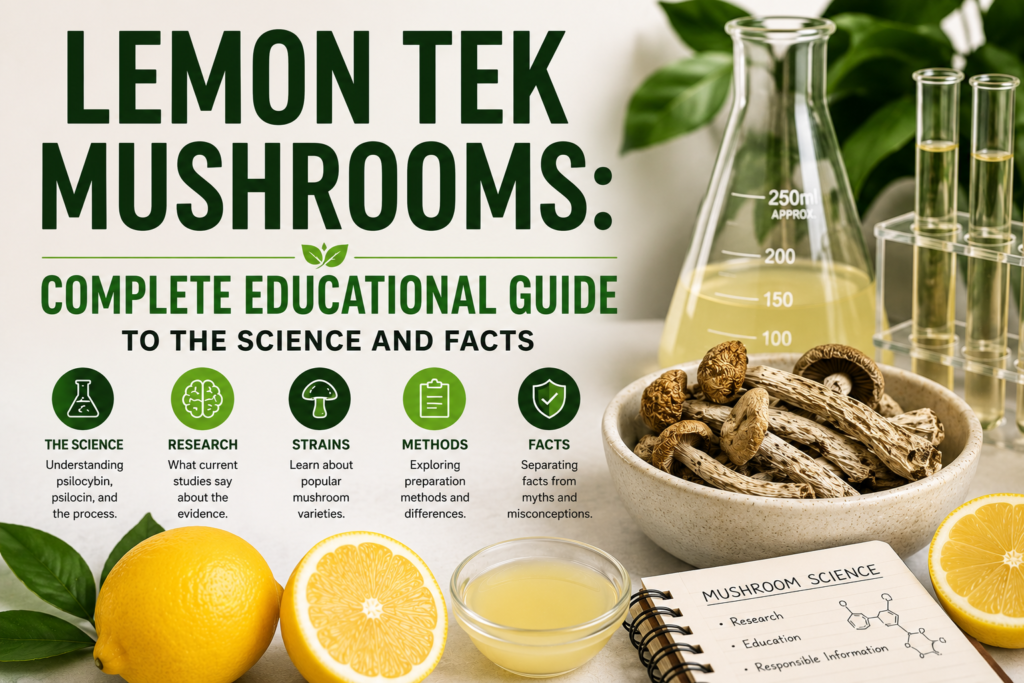
Lemon Tek Mushrooms: Complete Educational Guide to the Science and Facts
Jul
Lemon Tek Mushrooms: 7 Essential Facts & Science
Lemon Tek Mushrooms is one of the most searched phrases related to psilocybin mushroom education. The term generally refers to mushrooms discussed in connection with an acidic preparation method involving lemon juice. Although many claims are made about Lemon Tek Mushrooms, much of the available information comes from anecdotal reports rather than controlled scientific research.
This educational guide explains what Lemon Tek Mushrooms means, why the topic became popular, the chemistry researchers are investigating, what current evidence supports, and which questions still require additional research.
For a broader overview of the subject, readers can also explore our Lemon Tekking guide, which examines the terminology, proposed mechanisms, evidence, and research surrounding the topic.
Because psilocybin-containing mushrooms are regulated differently across jurisdictions, readers should also understand the laws that apply where they live. This article is provided for educational purposes and does not provide dosing or step-by-step preparation instructions.
Table of Contents
- What Are Lemon Tek Mushrooms?
- The Science Behind Lemon Tek Mushrooms
- Why Lemon Tek Mushrooms Became Popular
- Does Lemon Tek Make Mushrooms Stronger?
- What Current Research Says
- Mushroom Chemistry and Natural Variation
- Preparation Methods Compared
- Lemon Tek Mushrooms and Dried Mushrooms
- Frequently Asked Questions
- Related Lemon Tekking Guides
- Authoritative References
What Are Lemon Tek Mushrooms?
Lemon Tek Mushrooms describes mushrooms being discussed in connection with an acidic preparation method involving lemon juice. The phrase has become increasingly common across online mushroom communities, educational websites, forums, podcasts, and social media.
The scientific question behind the method involves whether an acidic environment can influence the extraction, stability, or chemical form of naturally occurring compounds found in psilocybin-containing mushrooms.
Many online explanations describe Lemon Tek Mushrooms as producing a noticeably different experience. However, these claims need to be separated from what has actually been established through laboratory and clinical research.
Biological variables such as mushroom composition, genetics, storage conditions, metabolism, digestion, individual physiology, and environmental factors can all influence reported outcomes.
Consequently, an individual experience cannot necessarily be used to establish that the preparation method itself caused a particular effect.
The Science Behind Lemon Tek Mushrooms
Psilocybin is a naturally occurring compound found in certain mushroom species. After ingestion, the body converts psilocybin into psilocin, which is primarily associated with its psychoactive effects.
Some educational discussions suggest that the acidity of lemon juice may influence this chemistry before digestion. However, the relationship between acidic conditions, chemical conversion, extraction, and human experience is more complicated than many simplified online explanations suggest.
Researchers continue to investigate the stability of psilocybin and psilocin, the effects of different environmental conditions, and how mushroom chemistry can vary between samples.
The source material similarly emphasizes that the proposed conversion associated with acidic conditions has not been conclusively demonstrated as a consistent practical process. :contentReference[oaicite:2]{index=2}
Scientific Questions Being Investigated
- How acidic environments affect psilocybin stability.
- How acidic conditions influence extraction.
- The relationship between psilocybin and psilocin.
- How digestion affects compound absorption.
- How mushroom chemistry varies between samples.
- How drying and storage influence mushroom composition.
- Whether preparation methods produce measurable chemical differences.
Why Lemon Tek Mushrooms Became Popular
The popularity of Lemon Tek Mushrooms has largely been driven by online communities, educational blogs, podcasts, videos, and social media discussions.
Interest has also increased alongside broader scientific research into psilocybin, mushroom chemistry, neuroscience, and potential therapeutic applications.
Online communities frequently share personal observations about preparation methods. These experiences can help generate questions for researchers, but they do not have the same evidentiary value as controlled laboratory studies or clinical trials.
Another reason the topic remains popular is that people often search for explanations of why different preparation methods may appear to produce different experiences. This has contributed to numerous theories surrounding Lemon Tek Mushrooms.
Readers should therefore distinguish between a commonly repeated claim and a conclusion supported by peer-reviewed research.
Does Lemon Tek Make Mushrooms Stronger?
One of the most common questions associated with Lemon Tek Mushrooms is whether the method makes mushrooms stronger.
The word “stronger” can mean several different things. Someone may use it to describe perceived intensity, onset, duration, or the overall subjective experience. Laboratory researchers, however, may be referring to measurable chemical concentrations or changes in extraction.
These concepts should not automatically be treated as the same thing.
Research into acidic mushroom extracts can provide useful information about chemistry, but chemical changes observed under laboratory conditions do not necessarily demonstrate that a person will experience a stronger effect.
For a dedicated discussion of this question, see: Does Lemon Tek Make Mushrooms Stronger?
A careful scientific interpretation therefore requires distinguishing between laboratory chemistry, pharmacology, and subjective human experience.
What Current Research Says About Lemon Tek Mushrooms
Scientific interest in psilocybin-containing mushrooms has grown substantially over the past decade. Universities and research organizations are investigating mushroom chemistry, pharmacology, neuroscience, and potential therapeutic applications.
However, research specifically examining Lemon Tek Mushrooms remains much more limited than the broader body of psilocybin research.
Many claims surrounding Lemon Tek Mushrooms originate from personal reports shared in online communities. While these reports may be useful for identifying questions worthy of scientific investigation, they cannot replace controlled laboratory studies or clinical trials.
The source material explicitly notes that research specifically focused on lemon tek remains limited and that many claims originate from personal reports rather than controlled studies. :contentReference[oaicite:3]{index=3}
Areas Scientists Are Investigating
- How acidic environments affect psilocybin stability.
- The conversion of psilocybin into psilocin.
- Differences in mushroom chemistry between varieties.
- The role of digestion in compound absorption.
- How storage and drying influence mushroom composition.
- Variability between individual mushroom samples.
As additional peer-reviewed studies become available, researchers may gain a clearer understanding of whether different preparation methods produce measurable chemical differences.
Mushroom Chemistry and Natural Variation
Another important consideration when researching Lemon Tek Mushrooms is that mushroom chemistry can vary naturally between individual samples.
Mushrooms identified by the same variety name do not necessarily contain identical concentrations of naturally occurring compounds. Genetics, cultivation conditions, harvesting, drying, storage, age, and other environmental factors may contribute to differences.
Factors That Can Influence Mushroom Composition
- Genetics
- Cultivation conditions
- Growing environment
- Substrate
- Harvest timing
- Drying conditions
- Storage conditions
- Natural biological variation
This variability makes broad conclusions based solely on mushroom names difficult to establish.
It also means that a personal report involving one mushroom sample cannot necessarily be generalized to another sample.
Preparation Methods Compared
Lemon Tek Mushrooms are discussed alongside several other mushroom preparation formats. These may include mushroom tea, capsules, chocolate products, and dried mushrooms.
| Preparation Method | Educational Summary |
|---|---|
| Lemon Tek | Frequently discussed online, but research specifically evaluating the method remains limited. |
| Mushroom Tea | A liquid preparation format frequently discussed in mushroom education. |
| Capsules | A format containing mushroom material without necessarily involving an acidic preparation. |
| Chocolate Products | A food-based format used for various mushroom-related products. |
| Dried Mushrooms | A preserved form of mushroom material frequently referenced in mushroom literature. |
No preparation method should automatically be assumed to produce identical results for every individual. Mushroom composition, physiology, environment, preparation conditions, and other variables can all contribute to differences.
Lemon Tek Mushrooms and Dried Mushrooms
Dried mushrooms are frequently mentioned in discussions surrounding Lemon Tek Mushrooms. Drying removes moisture from mushroom material and can influence preservation and storage characteristics.
The composition of dried mushroom material may vary depending on the original mushroom, drying conditions, storage environment, and duration of storage.
Readers interested in learning more about this category can explore our Dried Mushrooms category for additional educational information.
Understanding dried mushroom characteristics can provide useful context when researching broader questions about mushroom composition, preservation, and preparation.
Frequently Asked Questions About Lemon Tek Mushrooms
What are Lemon Tek Mushrooms?
Lemon Tek Mushrooms refers to mushrooms discussed in connection with an acidic preparation method involving lemon juice. The phrase is widely used in online mushroom communities and educational discussions.
Is Lemon Tek scientifically proven?
Research specifically evaluating the Lemon Tek preparation method remains limited. While scientists understand much about psilocybin and psilocin chemistry, additional controlled research is needed before definitive conclusions can be made about the commonly reported effects of the method.
Does Lemon Tek make mushrooms stronger?
There is insufficient evidence to conclude that Lemon Tek reliably makes mushrooms stronger in terms of subjective human effects. Chemical changes and perceived intensity are separate scientific questions.
Read our dedicated Does Lemon Tek Make Mushrooms Stronger? article for a deeper discussion.
What are Lemon Tek mushrooms?
Lemon Tek Mushrooms is a phrase used to describe mushrooms discussed in connection with the lemon-tek preparation method. It does not identify a separate mushroom species.
Do different mushroom varieties behave differently?
Mushroom chemistry can vary naturally between varieties and individual samples. Genetics, cultivation, harvesting, drying, and storage can all contribute to differences.
Where can I learn more about Lemon Tekking?
Our Lemon Tekking guide provides broader educational information about the terminology, proposed mechanisms, evidence, and research surrounding the topic.
Where can I learn about Lemon Tek Dosage?
Questions about dosage are separate from questions about mushroom chemistry and preparation. Readers researching that search topic can visit our Lemon Tek Dosage resource.
Key Takeaways
- Lemon Tek Mushrooms is a commonly searched educational topic.
- Many online claims about the method originate from anecdotal experiences.
- Research specifically examining Lemon Tek remains limited.
- Psilocybin and psilocin chemistry is an active area of scientific research.
- Mushroom chemistry can vary between varieties and individual samples.
- Drying and storage can contribute to differences in mushroom composition.
- Laboratory findings should not automatically be interpreted as proof of stronger subjective effects.
- Peer-reviewed scientific literature provides a stronger basis for conclusions than anecdotal reports.
Related Lemon Tekking Guides
Continue learning about Lemon Tek Mushrooms through these related educational resources:
- Does Lemon Tek Make Mushrooms Stronger?
- Lemon Tek Mushrooms
- Lemon Tekking
- Lemon Tek Dosage
- Dried Mushrooms
Continue Learning About Lemon Tek Mushrooms
If you want to explore the subject further, start with our broader Lemon Tekking guide for an overview of the science and commonly discussed claims.
For the specific question of whether the method changes perceived strength, read Does Lemon Tek Make Mushrooms Stronger? .
Readers researching the related terminology can also explore Lemon Tek Mushrooms , while those researching dosage terminology can visit Lemon Tek Dosage .
You can also explore the Dried Mushrooms category for additional educational information about dried mushroom material.
Authoritative References
For reliable information about psilocybin research, mushroom science, and related health topics, consult established scientific and government organizations.
- National Center for Complementary and Integrative Health (NCCIH)
- National Institutes of Health (NIH)
- PubMed – Scientific Research Database
Conclusion
Lemon Tek Mushrooms continues to be one of the most discussed preparation topics within mushroom education. Although numerous online sources describe potential differences associated with the method, research specifically examining Lemon Tek remains limited.
The chemistry of psilocybin and psilocin is well established as an area of scientific research, but the popular claims surrounding acidic mushroom preparation require careful interpretation. Laboratory chemistry, controlled human research, and personal experiences provide different levels of evidence.
Mushroom composition can also vary naturally between individual samples because of genetics, cultivation conditions, harvesting, drying, and storage. These variables make broad conclusions based solely on anecdotal experiences difficult to establish.
As scientific research continues to expand, future studies may provide greater insight into how acidic preparation methods influence mushroom chemistry and whether those changes have consistent implications for human experiences.
Disclaimer: This article is provided for educational and informational purposes only. It does not provide instructions for preparing, dosing, or consuming psilocybin-containing substances. Laws regarding psilocybin-containing mushrooms vary by jurisdiction. Always follow applicable laws and consult reliable scientific and medical sources when researching this subject.
