
Uncategorized
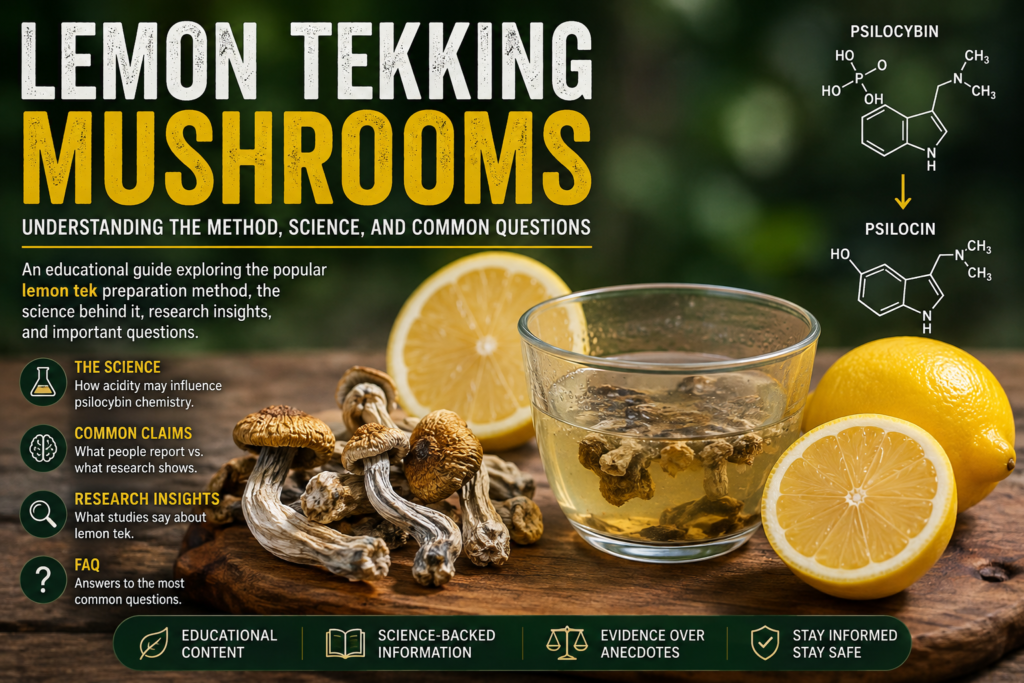
Lemon Tekking Mushrooms: Understanding the Method, Science, and Common Questions
Jul
Lemon Tekking Mushrooms: 7 Key Facts & Powerful Insights
Lemon Tekking Mushrooms is a phrase frequently encountered in online discussions about psilocybin-producing mushrooms. It generally refers to the use of an acidic liquid in connection with mushroom material before consumption. Although many online sources describe the method as potentially changing the overall experience, much of the discussion has historically been based on community reports rather than controlled human research.
This educational guide examines Lemon Tekking Mushrooms, why the method has become popular, what researchers have investigated, how mushroom composition can vary, and why it is important to distinguish anecdotal experiences from evidence-based conclusions.
For a broader overview of the subject, you can also read our Lemon Tekking guide, which covers the terminology, proposed mechanisms, evidence, and research surrounding the topic.
Important: Psilocybin-containing mushrooms are regulated differently depending on jurisdiction. This article is educational and does not provide dosing or step-by-step preparation instructions.
Table of Contents
- What Are Lemon Tekking Mushrooms?
- The Science Behind Lemon Tekking Mushrooms
- Does Lemon Tek Make Mushrooms Stronger?
- Why Lemon Tekking Became Popular
- Mushroom Varieties and Natural Variation
- Current Research
- Comparing Preparation Methods
- Lemon Tekking Mushrooms and Dried Mushrooms
- Frequently Asked Questions
- Related Lemon Tekking Guides
- Authoritative Resources
What Are Lemon Tekking Mushrooms?
The term Lemon Tekking Mushrooms describes mushrooms being discussed in connection with an acidic preparation method involving lemon juice. The topic has become increasingly popular through online communities, educational websites, videos, forums, and social media.
The basic scientific question is whether an acidic environment can influence the extraction, stability, or chemical form of compounds found in psilocybin-containing mushrooms.
Earlier online explanations often presented a simple claim that lemon juice automatically converts psilocybin into psilocin before consumption. Current evidence is more nuanced. Laboratory research has investigated acidic extraction and chemical conversion, but those findings should not automatically be interpreted as proof of a stronger or faster human experience.
This makes Lemon Tekking Mushrooms an interesting subject for scientific discussion while also highlighting the importance of separating laboratory findings from personal reports.
The Science Behind Lemon Tekking Mushrooms
Psilocybin is a naturally occurring compound found in certain mushroom species. In the human body, psilocybin is converted into psilocin, the compound primarily associated with its psychoactive effects.
Researchers have investigated whether acidic environments can influence the chemistry of psilocybin-containing mushroom extracts. Recent laboratory research has examined how psilocybin and psilocin behave under different pH conditions, while other experimental work has specifically examined acidic mushroom extracts. :contentReference[oaicite:1]{index=1}
This research suggests that acidity can affect extraction and chemical stability, but the exact relationship between acidic preparation and the subjective human experience remains more complicated.
For example, laboratory findings cannot by themselves establish that an acidic preparation will make a person’s experience stronger. Human responses depend on numerous variables, including mushroom composition, individual physiology, metabolism, environment, and other factors.
Scientific Questions Researchers Investigate
- How pH affects psilocybin and psilocin stability.
- How acidic liquids influence extraction.
- Whether chemical conversion occurs under particular conditions.
- How preparation affects compound availability.
- How mushroom composition varies between samples.
- How laboratory findings translate to human experiences.
Does Lemon Tek Make Mushrooms Stronger?
One of the most common questions surrounding Lemon Tekking Mushrooms is whether the method makes mushrooms stronger.
The answer requires careful qualification. A preparation method may change how compounds are extracted or chemically represented without increasing the total amount of psychoactive material originally present in the mushrooms.
Some laboratory research has found measurable changes in psilocybin and psilocin during acidic extraction. However, laboratory conversion or extraction results should not automatically be interpreted as evidence that a person will experience greater subjective intensity. :contentReference[oaicite:2]{index=2}
For a dedicated discussion of this question, see: Does Lemon Tek Make Mushrooms Stronger?
That distinction is important because the words “stronger,” “faster,” and “more intense” can describe subjective experiences, while laboratory measurements describe chemical concentrations or transformations. These are related but not identical concepts.
Why Lemon Tekking Became Popular
Interest in Lemon Tekking Mushrooms has expanded through educational websites, discussion forums, videos, social media, and personal experience reports.
People frequently compare different mushroom preparation approaches and share observations about perceived onset, duration, intensity, digestion, and other aspects of the experience.
These discussions can help explain why the topic has become popular, but personal experiences should not automatically be interpreted as scientific evidence.
Online communities can also repeat the same explanation many times, making an unverified claim appear more established than it actually is. For this reason, readers should look for controlled research and reputable scientific sources when evaluating claims about Lemon Tekking Mushrooms.
Mushroom Varieties and Natural Variation
Another important consideration when discussing Lemon Tekking Mushrooms is natural variation between mushroom samples.
Mushrooms identified by the same variety name do not necessarily contain identical concentrations of naturally occurring compounds. Genetics, growing conditions, harvesting, drying, storage, age, and other environmental factors can contribute to differences.
Factors That Can Influence Mushroom Composition
- Genetics
- Cultivation conditions
- Growing environment
- Harvest timing
- Drying conditions
- Storage conditions
- Age of the material
- Natural biological variation
This variability makes it difficult to draw broad conclusions from individual reports about Lemon Tekking Mushrooms.
A person reporting a particularly intense experience cannot establish that the preparation method itself caused that experience. Other variables may have contributed.
Current Research on Lemon Tekking Mushrooms
Scientific interest in psilocybin has increased significantly, and researchers continue to investigate its chemistry, pharmacology, and potential therapeutic applications.
Research specifically examining Lemon Tekking Mushrooms is more limited than the broader body of psilocybin research.
However, laboratory studies have examined acidic extraction and the behavior of psilocybin and psilocin under different conditions. A recent peer-reviewed study found that psilocybin showed high solubility across several tested media, with somewhat higher solubility under mildly acidic conditions. :contentReference[oaicite:3]{index=3}
Other experimental work has directly examined acidic mushroom extracts and reported measurable changes in psilocybin and psilocin. One important limitation is that some of this work has involved specific mushroom material and laboratory conditions that cannot automatically be generalized to every mushroom variety or real-world use. :contentReference[oaicite:4]{index=4}
Research Areas That Remain Important
- Acidic extraction efficiency.
- Psilocybin stability under different pH conditions.
- Psilocin stability and oxidation.
- Conversion mechanisms.
- Differences between mushroom varieties.
- Bioavailability.
- Relationship between laboratory chemistry and subjective effects.
As research continues, scientists may develop a clearer understanding of how acidic preparation affects mushroom chemistry and whether those chemical changes have meaningful consequences for human experiences.
Comparing Preparation Methods
Lemon Tekking Mushrooms is one of several preparation methods discussed within mushroom communities. Other commonly discussed formats include dried mushrooms, mushroom tea, capsules, and chocolate products.
| Preparation Method | General Educational Context |
|---|---|
| Lemon Tekking | An acidic preparation method that has been investigated experimentally but remains the subject of ongoing discussion. |
| Mushroom Tea | A liquid preparation format frequently discussed in mushroom communities. |
| Capsules | A format designed to provide a measured amount of mushroom material. |
| Chocolate Products | A food-based format combining mushroom-related ingredients with chocolate. |
| Dried Mushrooms | A commonly discussed form of preserved mushroom material. |
No single preparation method should automatically be assumed to produce identical results across all individuals. Differences in mushroom composition, physiology, preparation conditions, and other variables can influence outcomes.
Lemon Tekking Mushrooms and Dried Mushrooms
Dried mushrooms are frequently mentioned in discussions surrounding Lemon Tekking Mushrooms. Drying is a preservation process that removes moisture from mushroom material and can affect storage characteristics.
The chemical composition of dried mushroom material can vary depending on the original mushroom, drying conditions, storage environment, and length of storage.
Readers interested in learning more about dried mushrooms can explore the Dried Mushrooms category for additional educational information.
Understanding dried mushroom characteristics can provide useful context when researching broader questions about mushroom composition, preservation, and preparation.
Frequently Asked Questions
What does Lemon Tekking Mushrooms mean?
Lemon Tekking Mushrooms refers to mushrooms being discussed in connection with an acidic preparation method involving lemon juice. The term is commonly used in online mushroom communities.
Does Lemon Tek make mushrooms stronger?
There is not enough human evidence to say that Lemon Tekking reliably makes mushrooms stronger. Laboratory studies have investigated changes in extraction and chemical composition under acidic conditions, but chemical changes do not automatically establish a stronger subjective experience. :contentReference[oaicite:5]{index=5}
For more information, read Does Lemon Tek Make Mushrooms Stronger? .
What are Lemon Tek Mushrooms?
Lemon Tek Mushrooms is another commonly searched phrase referring to mushrooms discussed in connection with the lemon-tek preparation method. It does not describe a separate mushroom species.
Learn more in our Lemon Tek Mushrooms guide.
Is Lemon Tekking scientifically proven?
The chemistry of acidic mushroom extracts has been investigated experimentally, but the broader claims frequently made online about faster onset, greater intensity, or other subjective effects are not established with the same level of evidence.
Does mushroom variety matter?
Mushroom composition can naturally vary between varieties and individual samples. Genetics, cultivation, harvesting, drying, storage, and other factors can all contribute to variation.
Where can I learn more about Lemon Tekking?
Our broader Lemon Tekking guide provides additional information about the terminology, proposed mechanisms, scientific evidence, and research questions surrounding the topic.
Does Lemon Tek Dosage have a scientific standard?
There is no universally established scientific dosing standard specifically created for the Lemon Tek method. Individual mushroom composition can vary considerably, and dosage questions should not be inferred from laboratory extraction studies.
For educational information about this search topic, see Lemon Tek Dosage .
Key Takeaways
- Lemon Tekking Mushrooms is a widely discussed preparation topic.
- Acidic environments can influence the chemistry and extraction of mushroom compounds under certain experimental conditions.
- Laboratory findings should not automatically be interpreted as proof of stronger subjective effects.
- Natural variation exists between mushroom varieties and individual samples.
- Many popular online claims remain based on anecdotal experiences.
- More research is needed to connect laboratory chemistry with human outcomes.
- Scientific evidence and personal reports should be evaluated separately.
Related Lemon Tekking Guides
Continue exploring related educational resources about Lemon Tekking Mushrooms, mushroom chemistry, and dried mushrooms.
- Does Lemon Tek Make Mushrooms Stronger?
- Lemon Tek Mushrooms
- Lemon Tekking
- Lemon Tek Dosage
- Dried Mushrooms
Explore the Lemon Tekking Topic
Readers researching Lemon Tekking Mushrooms can move through the related articles to understand different aspects of the topic without relying on individual product pages.
Start with Lemon Tekking for the broader overview, then explore Lemon Tek Mushrooms for related terminology and scientific context.
For the specific question of perceived strength, read Does Lemon Tek Make Mushrooms Stronger? . For information related to dosage terminology, see Lemon Tek Dosage .
You can also explore the Dried Mushrooms category for additional educational information about dried mushroom material and related topics.
Authoritative Resources
For reliable information about psilocybin research, complementary health topics, and scientific developments, consult established scientific and government health organizations.
- National Center for Complementary and Integrative Health (NCCIH) – Psilocybin and Mental Health
- National Institutes of Health (NIH)
Conclusion
Lemon Tekking Mushrooms continues to attract significant interest because of claims about chemistry, extraction, onset, intensity, and the overall mushroom experience. Some aspects of the chemistry have now been investigated experimentally, but the available evidence does not justify treating every popular online claim as established fact.
Research indicates that acidic environments can influence the behavior and extraction of psilocybin-related compounds under certain laboratory conditions. However, translating these findings into predictable human experiences requires additional research. :contentReference[oaicite:6]{index=6}
The most useful approach is therefore to distinguish between laboratory findings, controlled human research, and anecdotal reports. Each provides a different level of evidence and should not be treated as interchangeable.
As scientific research continues, future studies may provide a clearer understanding of how acidic preparation affects mushroom chemistry and whether those changes have consistent implications for human experiences.
Educational disclaimer: This article is provided for informational and educational purposes only. It does not provide instructions for preparing, dosing, or consuming psilocybin-containing substances. Laws regarding psilocybin-containing mushrooms vary by jurisdiction. Always follow applicable laws and consult reputable scientific and medical sources when researching this topic.
