
Uncategorized
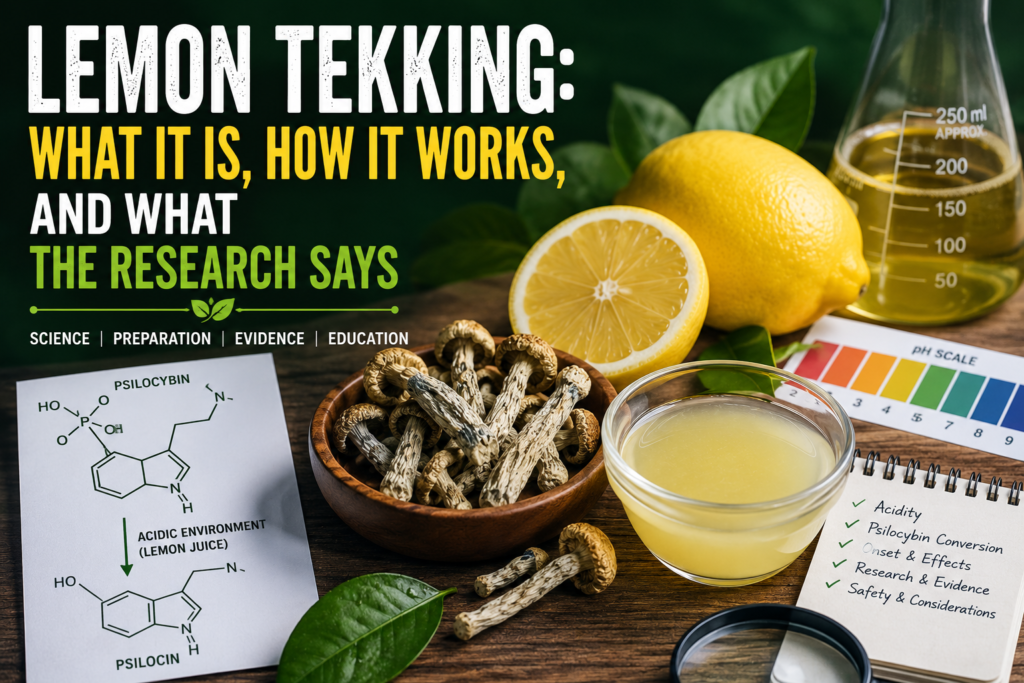
Lemon Tekking: What It Is, How It Works, and What the Research Says
Jul
Lemon Tekking: 7 Key Facts, Science & Research
Lemon Tekking is one of the most frequently discussed mushroom preparation methods in online communities and educational discussions about psilocybin mushrooms. Supporters commonly discuss whether an acidic environment can influence the chemistry of mushroom compounds, while researchers emphasize that many commonly repeated claims remain anecdotal and require further scientific investigation.
If you are new to the topic, our broader Lemon Tekking guide provides additional educational context about the terminology, proposed mechanisms, and current research surrounding this subject.
This educational guide examines Lemon Tekking from a scientific and informational perspective. It explains what the term means, explores the theory behind the method, reviews common claims, discusses potential risks and limitations, and examines what current research does and does not establish.
Understanding Lemon Tekking requires an important distinction between personal experiences shared online and evidence produced through controlled scientific research. These two types of information should not be treated as equivalent.
Because psilocybin-containing mushrooms can produce significant changes in perception, mood, thinking, and coordination, readers should approach information about preparation methods carefully and consider the laws and regulations that apply in their jurisdiction.
Table of Contents
- What Is Lemon Tekking?
- The Science Behind Lemon Tekking
- Common Claims and Current Evidence
- Potential Risks and Considerations
- Lemon Tekking Mushrooms and Related Terminology
- What Research Still Needs to Answer
- Key Educational Takeaways
- Frequently Asked Questions
- Related Lemon Tekking Guides
- Authoritative Resources
What Is Lemon Tekking?
Lemon Tekking refers to a preparation technique commonly discussed within mushroom communities in which mushroom material is combined with lemon juice before use. Discussions about the method generally focus on whether the acidic environment may influence the chemical compounds naturally present in psilocybin-containing mushrooms.
The terminology is primarily associated with online mushroom communities and personal reports. While many people describe their experiences with the method, controlled human studies specifically examining Lemon Tekking remain limited.
This distinction is important because a large number of online discussions can create the impression that a particular effect has been scientifically established when the available evidence may actually consist primarily of personal observations.
For this reason, Lemon Tekking is best understood as a community-discussed preparation approach rather than a scientifically established method with universally predictable outcomes.
Readers who want to understand the terminology in greater detail can also explore our dedicated Lemon Tekking Mushrooms resource.
The Science Behind Lemon Tekking
The theory behind Lemon Tekking centers on acidity. Psilocybin is a naturally occurring compound found in certain mushrooms and is converted within the body into psilocin, which is associated with the psychoactive effects of psilocybin-containing mushrooms.
Some discussions propose that acidic conditions may contribute to part of this conversion before ingestion. However, available evidence has not definitively established that this proposed process occurs to a meaningful or predictable degree in real-world use.
Researchers recognize that digestion, metabolism, individual physiology, stomach contents, mushroom composition, and other variables can influence how effects develop. Because these factors differ significantly between individuals, an experience reported by one person cannot reliably predict another person’s experience.
Additional laboratory research may help clarify how different preparation conditions affect chemical stability and bioavailability.
Important Scientific Questions
- How acidic environments affect psilocybin stability.
- Whether meaningful chemical conversion occurs before ingestion.
- How preparation conditions influence compound stability.
- Whether preparation affects absorption or bioavailability.
- How digestion and metabolism influence the resulting experience.
- How natural mushroom variation affects outcomes.
Common Claims and Current Evidence
Several claims about Lemon Tekking appear repeatedly across online forums and social media. These include suggestions that it changes onset time, alters duration, affects subjective intensity, or reduces digestive discomfort.
While these reports are common, many originate from self-reported experiences rather than controlled clinical research. Personal experiences can provide information about what people report, but they cannot by themselves establish cause and effect.
| Common Claim | Current Evidence |
|---|---|
| Changes the chemical profile | Limited laboratory evidence; additional research is needed. |
| Produces different subjective experiences | Primarily supported by anecdotal reports. |
| Reduces digestive discomfort | Individual reports vary and there is no strong scientific consensus. |
| Provides more predictable effects | Not supported by sufficient clinical evidence. |
| Changes the timing of effects | Frequently reported online but not adequately established through controlled research. |
Understanding the difference between anecdotal observations and peer-reviewed evidence helps readers evaluate information about Lemon Tekking more critically.
Potential Risks and Considerations
Because Lemon Tekking is widely discussed online, it is important to separate established scientific knowledge from personal reports. Individual responses to psilocybin-containing mushrooms can vary considerably.
Current scientific literature does not establish that one informal preparation method is inherently safer than another. Psilocybin-containing mushrooms can produce significant alterations in perception, mood, thinking, and coordination regardless of how they are discussed or prepared.
Factors That May Influence Individual Experiences
- Natural variation in mushroom composition.
- Differences between mushroom varieties.
- Individual metabolism and physiology.
- Food consumed before use.
- Individual tolerance.
- Psychological state.
- Physical surroundings.
- Underlying health conditions.
- Interactions with medications or other substances.
These variables make it difficult to predict how any individual will respond. Readers should therefore be cautious about broad claims suggesting that Lemon Tekking guarantees a particular result.
Anyone researching psychoactive substances should also consider the legal status of psilocybin-containing mushrooms in their jurisdiction.
Lemon Tekking Mushrooms and Related Terminology
Many online discussions about Lemon Tekking reference different mushroom varieties and use several related search terms. Understanding this terminology can make it easier to distinguish general educational information from anecdotal claims.
The phrase Lemon Tek Mushrooms is another term commonly used when searching for information about the relationship between mushroom preparation and lemon juice.
These terms should not be interpreted as referring to a unique species of mushroom. They generally describe mushrooms being discussed in the context of the lemon-tek preparation method.
Mushroom varieties can differ in genetics, appearance, cultivation history, and reported characteristics. Natural variation can also occur between individual mushrooms, even when they are identified by the same variety name.
Factors That Can Contribute to Mushroom Variation
- Genetics
- Cultivation conditions
- Growing environment
- Harvest timing
- Drying conditions
- Storage conditions
- Natural biological variation
Because of this variation, it should not be assumed that mushrooms identified by the same variety name will always have identical chemical characteristics or produce identical experiences.
Educational discussions of mushroom varieties can be useful for understanding terminology and biological diversity, but anecdotal comparisons should not be treated as a substitute for controlled scientific evidence.
What Research Still Needs to Answer
Scientific interest in psilocybin has expanded substantially over the past decade. Universities and research institutions continue to investigate psilocybin under controlled research conditions.
These studies commonly use carefully defined research protocols, screened participants, controlled environments, and standardized procedures. Informal preparation techniques such as Lemon Tekking are not necessarily represented in these studies.
At present, published research specifically evaluating Lemon Tekking is limited. Much of the information available online comes from community experiences rather than randomized clinical research.
This distinction matters because anecdotal observations cannot establish whether a particular preparation method directly causes a reported effect.
Areas Researchers Continue to Investigate
- How acidic environments affect psilocybin stability.
- The conversion of psilocybin to psilocin under different conditions.
- Potential effects on absorption.
- Chemical changes during preparation.
- Variability between mushroom samples.
- The role of digestion and metabolism.
- Individual differences in response.
As additional peer-reviewed studies become available, scientific understanding of Lemon Tekking and other preparation methods may become clearer.
Key Educational Takeaways
- Lemon Tekking is a widely discussed mushroom preparation method.
- Many claims about the method remain based on personal experiences rather than strong clinical evidence.
- The theory behind the method centers on the acidity of lemon juice.
- Available evidence has not established that the commonly claimed effects are predictable.
- Individual responses to psilocybin-containing mushrooms can vary significantly.
- Mushroom composition can vary naturally between samples.
- Preparation is only one of many factors that may influence reported experiences.
- More scientific research is needed before definitive conclusions can be made.
Key Points About Lemon Tekking
| Topic | Summary |
|---|---|
| Lemon Tekking | A commonly discussed mushroom preparation method. |
| Scientific Evidence | Currently limited and still developing. |
| Community Reports | Should not be considered equivalent to controlled clinical evidence. |
| Mushroom Variation | Natural variation exists within and between mushroom varieties. |
| Research | More studies are needed to answer many open questions. |
Frequently Asked Questions
What is Lemon Tekking?
Lemon Tekking is a term used in mushroom communities to describe a preparation approach involving mushroom material and lemon juice. Discussions about the method generally focus on whether acidity can influence mushroom chemistry before use.
Is Lemon Tekking scientifically proven?
No. Lemon Tekking has been widely discussed online, but research specifically evaluating the method remains limited. Many commonly repeated claims are based on personal reports rather than controlled clinical studies.
Why is lemon juice associated with this method?
The discussion generally centers on the acidity of lemon juice and whether acidic conditions influence naturally occurring compounds found in psilocybin-containing mushrooms. Researchers have not reached a definitive scientific consensus confirming the commonly claimed effects.
Does mushroom variety matter?
Mushroom varieties can differ in genetics and characteristics, while individual samples can also vary naturally. Environmental conditions, cultivation, harvesting, drying, and storage may influence final composition.
Are anecdotal reports scientific evidence?
No. Personal reports can describe individual experiences, but they cannot establish cause and effect on their own. Controlled laboratory and human research provide a stronger basis for scientific conclusions.
Is more research being conducted on psilocybin?
Yes. Universities and research institutions continue to study psilocybin in controlled settings to better understand its chemistry, biology, pharmacology, and potential therapeutic applications. Research specifically examining informal preparation methods remains limited.
Does Lemon Tekking guarantee a particular experience?
No. Available evidence does not support claims that Lemon Tekking guarantees a predictable outcome. Individual physiology, mushroom composition, environment, digestion, metabolism, and other factors can contribute to substantial variation.
Related Lemon Tekking Guides
Continue exploring our educational resources about lemon tekking, mushroom terminology, and related mushroom topics.
Explore Dried Mushrooms
Readers researching Lemon Tekking may also be interested in learning more about dried mushrooms. Explore our Dried Mushrooms category for additional educational information about dried mushroom products and related topics.
Authoritative Resources
For reliable information about psilocybin research, complementary health topics, and scientific developments, consult established research and government health organizations.
- National Center for Complementary and Integrative Health (NCCIH) – Psilocybin and Mental Health
- National Institutes of Health (NIH)
Conclusion
Lemon Tekking remains one of the most discussed mushroom preparation methods in online communities. Although many personal accounts describe differences compared with other preparation approaches, current scientific evidence is not sufficient to confirm many of the commonly repeated claims.
The central scientific question concerns whether acidic conditions meaningfully alter mushroom compounds before use and whether those changes translate into predictable differences in human experience. At present, available evidence does not provide definitive answers.
Readers researching Lemon Tekking should therefore distinguish carefully between anecdotal reports, laboratory findings, and controlled human research. These sources provide different levels of evidence and should not be treated as interchangeable.
As research into psilocybin and mushroom chemistry continues, future studies may provide a clearer understanding of how preparation conditions affect chemical stability, metabolism, absorption, and other factors.
Explore More Lemon Tekking Information
If you are building a broader understanding of the subject, explore the supporting articles below to move between related educational topics.
Start with Lemon Tekking Mushrooms for terminology and mushroom-related context, then explore Lemon Tek Mushrooms for the related search phrase.
You can also explore the Dried Mushrooms category for additional information about dried mushroom products and related educational topics.
Educational disclaimer: This article is provided for informational and educational purposes only. It does not provide instructions for preparing, dosing, or consuming psilocybin-containing substances. Laws regarding psilocybin-containing mushrooms vary by jurisdiction. Always follow applicable laws and consult reputable scientific and medical sources when researching this topic.
