
Uncategorized
Mushroom Chocolate Bar vs Capsules
Aug
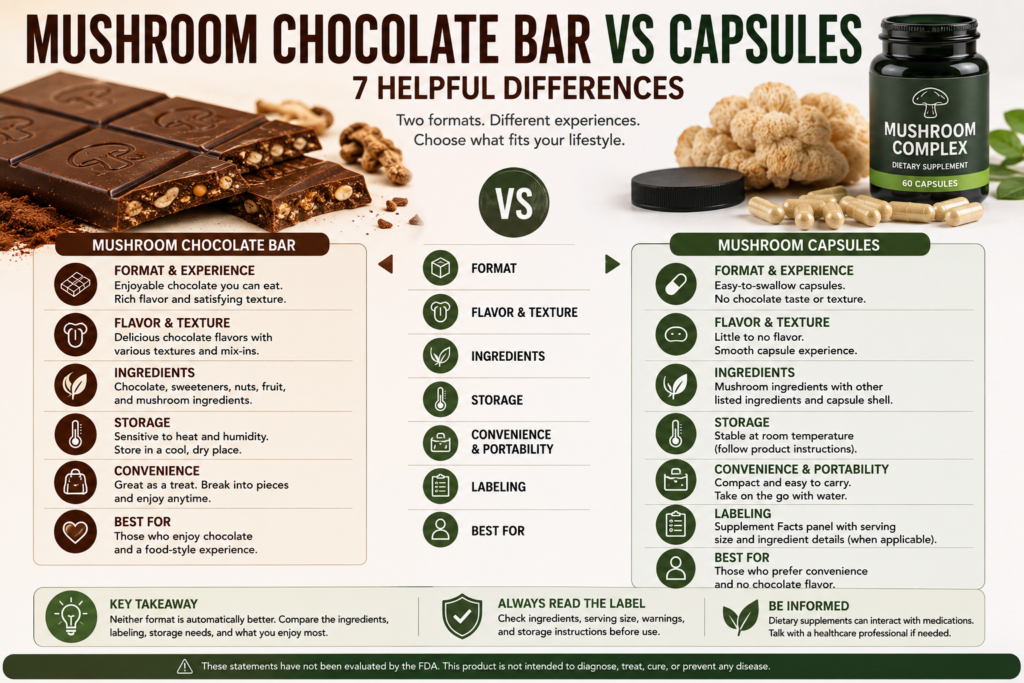
Mushroom Chocolate Bar vs Capsules: 7 Helpful Differences
Choosing between a chocolate-based mushroom product and a capsule can be confusing because the two formats are designed very differently. This Mushroom Chocolate Bar vs Capsules comparison examines the practical differences between them, including format, ingredients, texture, convenience, portability, storage, labeling, dietary considerations, and what shoppers should look for before choosing a product.
A mushroom chocolate bar is presented in a familiar food-style format, while capsules are designed to be swallowed as a measured product format. The experience of using either product can therefore be very different even when products are marketed around similar ingredients.
There is no universal rule that says one format is better than the other. The more useful approach is to examine the specific formulation, ingredient list, labeling, storage requirements, manufacturer information, and your own preferences.
This guide provides a practical Mushroom Chocolate Bar vs Capsules comparison while avoiding assumptions that all chocolate bars or capsules contain the same ingredients or provide the same characteristics.
Mushroom Chocolate Bar vs Capsules: What Is the Difference?
The most obvious difference is the physical format.
A mushroom chocolate bar combines chocolate with the other ingredients used in its formulation. Depending on the product, it may contain mushroom ingredients, flavorings, sweeteners, nuts, fruit, or other components.
Capsules are a different type of delivery format. Dietary supplements can be sold in capsule, tablet, softgel, powder, liquid, gummy, and other forms. The U.S. Food and Drug Administration explains that dietary supplement products must meet the applicable definition and labeling requirements for that category.
FDA also explains that supplement labels can include a Supplement Facts panel and an ingredient list containing information about the product’s ingredients and other components.
Therefore, the physical format alone does not tell you everything about what a product contains.
Mushroom Chocolate Bar vs Capsules: Quick Comparison
| Factor | Mushroom Chocolate Bars | Capsules |
|---|---|---|
| Format | Chocolate-based bar or pieces | Swallowed capsule format |
| Texture | Firm, creamy, smooth, or textured | No chocolate texture because the capsule is swallowed |
| Flavor | Chocolate and other flavor combinations | Usually little or no flavor when swallowed intact |
| Ingredients | Chocolate plus the other listed ingredients | Capsule contents plus capsule and other listed ingredients |
| Portability | Portable but may be sensitive to heat | Generally compact and easy to carry |
| Storage | Can be sensitive to heat and humidity | Depends on the specific product instructions |
| Label information | Depends on product type and labeling | Supplement products may have Supplement Facts and ingredient information |
1. Format and Overall Experience
The first major difference in a Mushroom Chocolate Bar vs Capsules comparison is the overall experience created by the format.
A chocolate bar is designed to be eaten. Its flavor, texture, appearance, and packaging are part of the product experience.
A capsule is designed to be swallowed. Instead of providing a chocolate or confectionery experience, the focus is on the contents inside the capsule and the information provided on the product label.
This creates a fundamental difference between the two options.
Chocolate Bar Format
- Designed to be eaten.
- Provides chocolate flavor and texture.
- May contain additional food ingredients.
- Can be divided into pieces depending on the product design.
- May be affected by heat and humidity.
Capsule Format
- Designed to be swallowed.
- Does not provide the same chocolate eating experience.
- Contains ingredients enclosed within a capsule shell.
- Is generally compact.
- Requires attention to the product’s directions and label information.
For consumers deciding between formats, this distinction can be more important than marketing language.
2. Texture and Flavor
Texture and flavor are major advantages of the chocolate format for people who enjoy chocolate products.
Depending on the formulation, a mushroom chocolate bar can have a smooth, creamy, crunchy, or other texture. It may also be combined with flavors such as vanilla, caramel, mint, fruit, nuts, or other ingredients.
Capsules provide a completely different experience because they are generally swallowed rather than eaten as a food product.
This means that someone who enjoys the taste and texture of chocolate may naturally prefer the chocolate format, while someone who wants to avoid a chocolate-based eating experience may prefer capsules.
In a Mushroom Chocolate Bar vs Capsules comparison, flavor is therefore largely a matter of personal preference rather than an objective quality measurement.
3. Ingredient Differences
Ingredient lists can vary considerably between chocolate bars and capsules.
A chocolate formulation may contain cocoa or chocolate ingredients, sweeteners, flavorings, fats, nuts, fruit, fillings, or other food ingredients.
A capsule formulation may contain the primary dietary ingredient along with capsule materials and other ingredients used during manufacturing.
FDA distinguishes between dietary ingredients and other ingredients in dietary supplements. Other ingredients can include substances such as binders, fillers, excipients, preservatives, sweeteners, and flavorings.
For that reason, consumers should never assume that a mushroom chocolate bar and a mushroom capsule contain identical ingredients simply because both products mention mushrooms.
Always compare the actual product labels.
4. Label Information Matters
Reading the label is one of the most important parts of a Mushroom Chocolate Bar vs Capsules comparison.
FDA states that dietary supplement labels are required to provide information such as the product’s identity, net quantity, nutrition labeling, ingredient information, and manufacturer, packer, or distributor information. Supplement Facts labeling also provides information about serving size and dietary ingredients when applicable.
When examining a capsule product, look for:
- Product name.
- Serving size.
- Number of servings per container.
- Dietary ingredients.
- Amount per serving when required.
- Other ingredients.
- Manufacturer or distributor information.
- Warnings and directions.
- Storage instructions.
For a chocolate product, examine the ingredient list, allergen information, storage instructions, product identity, manufacturer information, and other labeling supplied with the package.
FDA’s Questions and Answers on Dietary Supplements provides additional information about supplement forms and labeling requirements.
5. Portability and Convenience
Both formats can be convenient, but they are convenient in different ways.
Capsules are generally compact and can be carried in a container or their original packaging. They do not have the same melting concern associated with chocolate.
Chocolate bars are also portable, but temperature can become an important consideration. Exposure to excessive heat may soften or melt chocolate and can affect its appearance and texture.
When comparing portability, consider:
- How the product is packaged.
- Ambient temperature.
- Storage requirements.
- How long the product will be transported.
- Whether the original packaging will remain intact.
This makes portability an important consideration in a Mushroom Chocolate Bar vs Capsules comparison, particularly for people who regularly travel.
6. Storage Requirements
Storage requirements can be very different between the two formats.
Chocolate is particularly sensitive to excessive heat and can also be affected by humidity, sunlight, and repeated temperature fluctuations.
Capsules have their own storage requirements, which depend on the formulation, capsule material, packaging, and manufacturer’s instructions.
Consumers should always follow the storage instructions printed on the specific product.
For chocolate-specific storage information, see the Evergreen Mushrooms Mushroom Chocolate Bar Storage Guide.
When deciding between formats, storage requirements should be considered alongside ingredients and labeling rather than treated as an afterthought.
7. Dietary and Ingredient Considerations
Dietary preferences can influence which format appears more suitable.
Chocolate products may contain milk, soy, nuts, or other ingredients depending on the formulation. Some chocolate products may also contain ingredients that are important for people following particular dietary patterns.
Capsules can also contain ingredients that consumers may need to consider, including the capsule shell itself and other excipients.
Do not assume that a product is vegan, vegetarian, dairy-free, gluten-free, nut-free, or allergen-free simply because it is a chocolate bar or capsule.
Always check the specific ingredient and allergen information supplied by the manufacturer.
Mushroom Chocolate Bar vs Capsules: Ingredient Comparison
| Ingredient Category | Chocolate Bar | Capsule |
|---|---|---|
| Main base | Chocolate or cocoa-based formulation | Capsule containing the listed ingredients |
| Mushroom ingredient | Depends on individual product | Depends on individual product |
| Sweeteners | May be present | May be present depending on formulation |
| Flavorings | May be present | May be present depending on formulation |
| Texture ingredients | Chocolate-related ingredients and inclusions | Excipients or other manufacturing ingredients may be used |
| Capsule shell | Not applicable | Present depending on capsule type |
| Allergens | Depends on formulation | Depends on formulation |
Are Mushroom Chocolate Bars Better Than Capsules?
There is no universal answer.
Chocolate bars may appeal to consumers who enjoy chocolate as part of the product experience.
Capsules may appeal to consumers who prefer a compact format without the flavor and texture of chocolate.
The choice should therefore be based on the actual product, its ingredients, its labeling, and the individual’s preferences.
A thoughtful Mushroom Chocolate Bar vs Capsules comparison should not assume that one format automatically provides better quality simply because of its appearance.
Are Mushroom Capsules Better Than Chocolate Bars?
Again, there is no universal winner.
Capsules may be attractive because of their compact format and lack of a chocolate eating experience.
However, the capsule format itself does not guarantee that a product has better ingredients, stronger quality controls, or greater effectiveness.
NCCIH advises consumers to become informed about dietary supplements because products available commercially can differ from products studied in research. Its guidance also notes that dietary supplements may interact with medications or present risks for people with certain health conditions.
For this reason, evaluate the individual product rather than choosing solely on format.
Chocolate Bars vs Capsules for People Who Prefer Flavor
If flavor is important, the chocolate format naturally offers a different experience.
Chocolate bars can combine cocoa or chocolate with other flavors and textures. The product may be designed to resemble a conventional confectionery product.
Capsules are generally not selected for their flavor experience because the capsule is swallowed rather than eaten as chocolate.
Therefore, consumers who enjoy chocolate may prefer the sensory experience of a bar, while consumers who would rather avoid a flavored product may prefer capsules.
Chocolate Bars vs Capsules for Portability
Capsules can be convenient for compact storage because they generally occupy little space.
Chocolate bars can also be portable, but temperature is a consideration.
A chocolate bar exposed to excessive heat can soften or melt. A capsule product may have different storage requirements and may be less sensitive to heat, but this cannot be assumed for every formulation.
Always follow the manufacturer’s storage instructions.
How to Compare Two Mushroom Products
When comparing a chocolate bar with a capsule, use the same evaluation process for both products.
- Read the complete ingredient information.
- Check the product identity.
- Review serving information where applicable.
- Check allergen information.
- Review storage instructions.
- Look at manufacturer or distributor information.
- Read warnings and directions.
- Consider the physical format and your preferences.
- Compare the information provided by the actual products rather than relying on general assumptions.
This approach creates a much more useful Mushroom Chocolate Bar vs Capsules comparison than simply asking which format looks more appealing.
What Should You Check on a Capsule Label?
Capsule products should be evaluated using their actual labeling.
FDA’s dietary supplement labeling guidance explains that required labeling can include the statement of identity, net quantity, nutrition labeling, ingredient list, and manufacturer, packer, or distributor information.
The Supplement Facts panel can also provide serving size, number of servings, and information about dietary ingredients.
When reviewing a capsule product, check:
- Serving size.
- Servings per container.
- Listed dietary ingredients.
- Amount per serving when applicable.
- Other ingredients.
- Capsule material when provided.
- Warnings.
- Storage instructions.
- Manufacturer details.
The FDA Dietary Supplement Labeling Guide provides further information about the labeling framework for dietary supplements.
What Should You Check on a Chocolate Bar Label?
Chocolate products should also be evaluated based on the information actually supplied with the product.
Depending on the product, useful information can include:
- Ingredient list.
- Allergen information.
- Net quantity.
- Manufacturer or distributor information.
- Storage instructions.
- Date information where provided.
- Product-specific warnings.
Do not assume that all mushroom chocolate bars use the same ingredients or manufacturing process.
The exact label is the best source of product-specific information.
Mushroom Chocolate Bar vs Capsules: Pros and Cons
| Format | Potential Advantages | Potential Considerations |
|---|---|---|
| Chocolate Bar | Familiar chocolate format; variety of flavors; enjoyable texture | Can be affected by heat; may contain common allergens; ingredient lists vary |
| Capsules | Compact format; no chocolate flavor; convenient to carry | Requires swallowing; capsule ingredients vary; product-specific directions matter |
Storage Comparison
| Storage Factor | Chocolate Bar | Capsules |
|---|---|---|
| Heat | Can soften or melt | Follow product-specific instructions |
| Humidity | Can affect chocolate and packaging | May affect product depending on formulation |
| Sunlight | Best protected from direct sunlight | Follow manufacturer instructions |
| Packaging | Keep original packaging when possible | Keep container closed according to instructions |
| Travel | Temperature can be an important consideration | Compact format can be convenient, but storage requirements still apply |
Quality and Transparency
Neither format should be judged solely by its appearance.
Quality assessment should begin with the information available about the specific product.
Look for:
- Clear ingredient information.
- Manufacturer or distributor information.
- Appropriate labeling.
- Storage instructions.
- Allergen information.
- Warnings and directions.
- Relevant testing information when supplied.
NCCIH notes that the amount of scientific evidence varies widely across dietary supplements and that products purchased from stores or online may differ from products used in research studies.
Its Using Dietary Supplements Wisely resource is useful for consumers who want to understand these considerations before choosing a supplement product.
Important Safety Considerations
A comparison between chocolate bars and capsules should not be treated as a substitute for professional medical advice.
NCCIH explains that dietary supplements can interact with medications and may present risks for people with certain medical conditions or those preparing for surgery.
People who take prescription or over-the-counter medicines, have a medical condition, are pregnant or breastfeeding, or are considering supplements for a child should discuss supplement use with an appropriate healthcare professional.
NCCIH also recommends that consumers become informed about the products they use rather than assuming that “natural” automatically means safe.
Read the product label carefully and follow the manufacturer’s directions.
For additional information, consult the NCCIH Safe Use of Complementary Health Products and Practices resource.
Does the Format Tell You the Quality of a Product?
No.
The format tells you how the product is presented, but it does not by itself establish the quality of the ingredients or the overall product.
A chocolate bar can have a clear, detailed label, while another chocolate bar may provide less information.
The same principle applies to capsules.
This is why the individual product should be evaluated rather than assuming that all chocolate products or all capsules are equivalent.
Which Format Is More Suitable for Different Preferences?
| Preference | Potentially Suitable Format | Reason |
|---|---|---|
| Enjoys chocolate | Chocolate bar | Provides chocolate flavor and texture |
| Prefers compact products | Capsules | Usually small and easy to carry |
| Wants a food-style experience | Chocolate bar | Designed to be eaten as a chocolate product |
| Does not want chocolate flavor | Capsules | Capsules are swallowed rather than eaten as chocolate |
| Concerned about heat | Compare storage requirements | Product-specific instructions matter |
| Focused on ingredients | Compare both labels | Individual formulations vary |
How to Make a Better Choice
The best way to choose between the two formats is to separate personal preference from product information.
First, decide what type of format you prefer.
Then examine the actual product label.
Compare:
- Ingredients.
- Serving information.
- Allergen information.
- Storage requirements.
- Manufacturer details.
- Warnings.
- Packaging.
This method prevents the physical appearance of a product from becoming the only factor in the purchasing decision.
A well-informed Mushroom Chocolate Bar vs Capsules decision should be based on the individual product rather than broad assumptions about either format.
Related Evergreen Mushrooms Resources
For readers exploring mushroom chocolate products, the Evergreen Mushrooms Polkadot collection is available here:
Polkadot Mushroom Chocolate Bars
We recommend keeping the product-specific information available on the product page as the primary reference for ingredients, storage, and other product details.
Frequently Asked Questions About Mushroom Chocolate Bar vs Capsules
What is the main difference between mushroom chocolate bars and capsules?
The main difference is the physical format. Chocolate bars are eaten as chocolate products, while capsules are swallowed and contain their listed ingredients inside a capsule shell.
Are mushroom chocolate bars better than capsules?
There is no universal answer. The best option depends on the specific product, ingredients, labeling, storage requirements, and personal preferences.
Are mushroom capsules better than chocolate bars?
Not automatically. Capsules may be preferred by people who want a compact format without chocolate flavor, but the capsule format itself does not establish product quality or effectiveness.
Do chocolate bars and capsules contain the same ingredients?
No. The formulations can be substantially different. Chocolate products may contain cocoa, sweeteners, fats, flavors, nuts, or other food ingredients, while capsules can contain their own active and other ingredients.
Which format is easier to carry?
Capsules are generally compact, while chocolate bars can also be portable but may require more attention to temperature. The packaging and storage instructions for the specific product should be considered.
Can mushroom chocolate bars melt?
Yes. Chocolate can soften or melt when exposed to excessive heat. Proper storage can help protect the intended texture and appearance.
Do capsules have storage requirements?
Yes. Storage requirements vary by product. Always follow the manufacturer’s instructions printed on the label or packaging.
Should I compare the ingredient lists?
Yes. Ingredient lists can vary significantly between products, even when they use the same general format. Comparing labels is one of the most useful steps when evaluating products.
What should I look for on a mushroom capsule label?
Review the product identity, serving size, dietary ingredients, other ingredients, manufacturer information, warnings, storage instructions, and other required labeling information.
What should I look for on a mushroom chocolate label?
Review the complete ingredient list, allergen information, manufacturer details, storage instructions, net quantity, date information where provided, and any applicable warnings.
Does “natural” mean a mushroom supplement is automatically safe?
No. NCCIH notes that natural does not necessarily mean safe and that supplements can interact with medications or present risks for some people.
Should I speak with a healthcare professional before using a supplement?
FDA advises consumers to talk with a doctor, pharmacist, or other healthcare professional before deciding to purchase or use a dietary supplement, particularly when medications or health conditions may be involved.
Final Verdict: Mushroom Chocolate Bar vs Capsules
The Mushroom Chocolate Bar vs Capsules comparison does not produce one universal winner.
Chocolate bars can appeal to people who enjoy chocolate flavor, texture, and a food-style experience.
Capsules can appeal to people who prefer a compact format that does not involve eating chocolate.
However, format is only one part of the decision.
The individual product’s ingredients, labeling, storage requirements, manufacturer information, allergen information, directions, and warnings are all important considerations.
FDA provides detailed information about dietary supplement definitions and labeling requirements, while NCCIH recommends that consumers become informed about supplements and consider potential interactions and individual safety factors.
For that reason, the best Mushroom Chocolate Bar vs Capsules decision is one based on the actual products being compared rather than assumptions about either category.
If you are exploring mushroom chocolate products, you can visit the Polkadot Mushroom Chocolate Bars collection on Evergreen Mushrooms.
Always follow the product’s own label and manufacturer’s instructions for storage, ingredients, directions, and other product-specific information.
