
Uncategorized
Mushroom Chocolate Bar Storage Guide
Aug
Mushroom Chocolate Bar Storage Guide: 9 Easy Tips for Freshness
A good Mushroom Chocolate Bar Storage Guide starts with one simple principle: protect chocolate from conditions that can reduce its intended quality. Temperature, humidity, light, air, odors, packaging, and repeated handling can all influence how a chocolate product looks, smells, feels, and tastes over time.
Mushroom chocolate products can contain several different ingredients, depending on the formulation. Some products may contain mushroom powders, extracts, flavorings, nuts, fruit, fillings, or other components. Because formulations and packaging can differ, there is no single storage method that applies to every product.
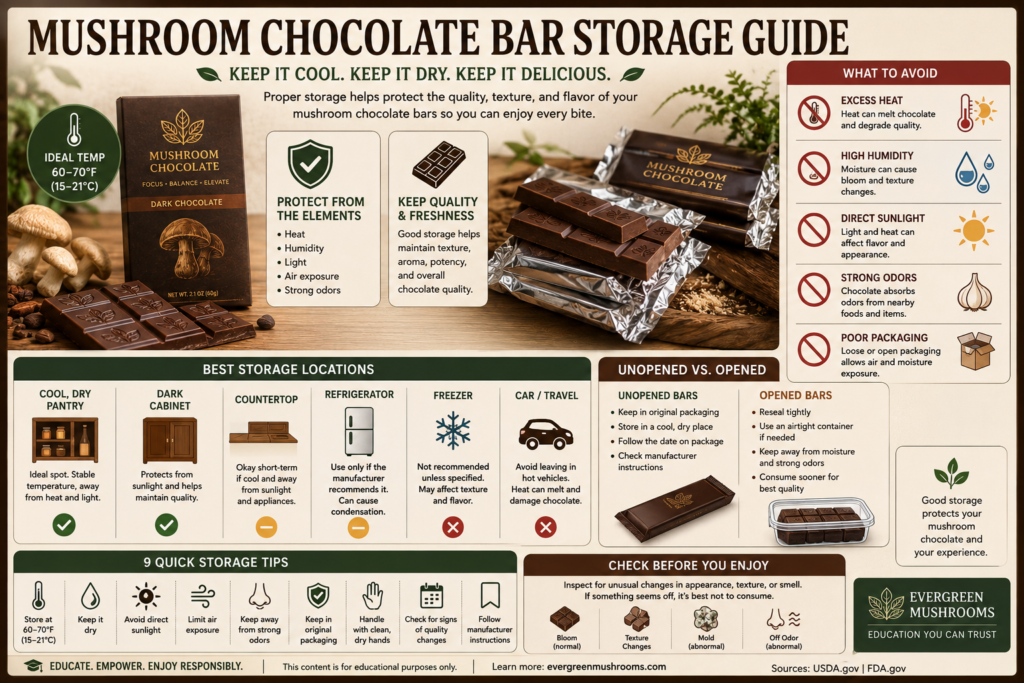
This Mushroom Chocolate Bar Storage Guide explains the major factors that can affect chocolate quality and provides practical information about storing unopened and opened bars, protecting chocolate from heat and humidity, handling products during travel, and deciding whether refrigeration or freezing is appropriate.
The manufacturer’s instructions should always take priority over general online guidance. If a product label provides a specific storage temperature or other requirement, follow those instructions.
Why a Mushroom Chocolate Bar Storage Guide Matters
Chocolate is sensitive to environmental conditions. A product can remain within its expected shelf-life period while still experiencing changes in texture or appearance if it has been exposed to excessive heat, moisture, sunlight, or repeated temperature fluctuations.
A useful Mushroom Chocolate Bar Storage Guide therefore looks at more than simply where to put a chocolate bar.
The main factors include:
- Temperature.
- Humidity.
- Direct sunlight.
- Air exposure.
- Packaging.
- Strong surrounding odors.
- Physical handling.
- Storage duration.
USDA recommends following manufacturer instructions and using appropriate storage conditions for food products. Its general guidance can be found in the USDA food safety resources.
FDA also provides consumer information concerning food storage, quality, and safety. Readers can review the FDA food storage and safety resources for additional information.
1. Keep Mushroom Chocolate in a Cool, Stable Environment
Temperature stability is one of the most important principles in this Mushroom Chocolate Bar Storage Guide.
Excessive heat can soften or melt chocolate. Repeated movement between very warm and very cool environments can also affect the chocolate’s appearance and texture.
A suitable storage location should generally be:
- Cool.
- Dry.
- Protected from direct sunlight.
- Away from ovens and other heat sources.
- Relatively stable in temperature.
Avoid placing chocolate directly beside an oven, stove, radiator, heater, or other appliance that produces substantial heat.
The manufacturer’s storage instructions should always take priority if they specify a particular temperature or storage environment.
2. Protect Mushroom Chocolate From Direct Sunlight
Direct sunlight exposes chocolate to both light and heat.
Even when the surrounding room feels comfortable, sunlight shining directly onto a package can raise the temperature of the product.
For that reason, avoid storing mushroom chocolate bars:
- On a sunny windowsill.
- In direct sunlight on a countertop.
- Inside a vehicle exposed to sunlight.
- Outside or in an uncovered location.
- Next to equipment that generates heat.
A dark cabinet, pantry, or other suitable indoor storage location can provide better protection from unnecessary light and heat exposure.
3. Keep Mushroom Chocolate Away From Moisture
Humidity is another important consideration.
Moisture can contribute to changes in the surface and texture of chocolate. Humid conditions can be especially problematic when an opened package is repeatedly exposed to the surrounding air.
For better storage:
- Keep the original package sealed whenever possible.
- Avoid damp storage locations.
- Keep chocolate away from sinks and water sources.
- Do not store it in a humid bathroom.
- Protect opened products from humid air.
A dry environment is generally preferable for chocolate products unless the manufacturer specifies another method.
4. Keep the Original Packaging
The original packaging is an important part of product protection.
Depending on its design, packaging can help limit exposure to air, moisture, light, odors, and physical damage.
Unless the manufacturer recommends another method, keeping the product in its original packaging is generally useful.
The package may also contain important information such as:
- Storage instructions.
- Best-by or other date information.
- Ingredient information.
- Allergen information.
- Manufacturer information.
- Batch or lot information.
A responsible Mushroom Chocolate Bar Storage Guide should always emphasize the product label because different formulations and packaging systems can have different requirements.
5. Reseal Opened Mushroom Chocolate Properly
Once a chocolate package is opened, the product has greater exposure to its surrounding environment.
Air, moisture, odors, and repeated handling can affect quality over time.
After opening a mushroom chocolate bar, close the original packaging securely whenever possible.
If the original package cannot be resealed effectively, a clean and dry airtight food container may provide additional protection.
The container should be suitable for food storage and should not contain moisture or strong odors from previously stored foods.
6. Protect Mushroom Chocolate From Strong Odors
Chocolate can absorb surrounding aromas, particularly when packaging has been opened.
For that reason, avoid storing opened chocolate next to foods or substances with particularly strong odors.
Examples include:
- Garlic.
- Onions.
- Strong spices.
- Highly aromatic foods.
- Strong cheeses.
- Cleaning products.
Keeping the product properly sealed provides an additional layer of protection.
7. Should You Refrigerate Mushroom Chocolate?
Refrigeration is not automatically required for every chocolate product.
The appropriate storage method depends on the formulation and the manufacturer’s instructions.
One consideration with refrigeration is condensation. When cold chocolate is moved into a warmer and more humid environment, moisture can form on the surface.
This can contribute to changes in texture and appearance.
Therefore, do not automatically refrigerate every mushroom chocolate product simply because it contains chocolate.
Check the product label first.
If the manufacturer specifically instructs consumers to refrigerate the product, follow those instructions.
8. Can You Freeze Mushroom Chocolate Bars?
Freezing is another storage method that should not automatically be applied to every chocolate product.
Freezing and thawing can affect texture and may produce condensation when a product is returned to a warmer environment.
Products containing fillings, creams, fruit, nuts, or other ingredients may react differently from simpler chocolate formulations.
Unless the manufacturer specifically recommends freezing, following the stated storage instructions is preferable to experimenting with long-term freezing.
9. Keep Mushroom Chocolate Away From Heat Sources
Heat sources are among the easiest storage problems to avoid.
Do not store chocolate directly beside:
- Ovens.
- Stoves.
- Radiators.
- Heaters.
- Hot appliances.
- Areas that become unusually warm during the day.
Even when chocolate does not visibly melt, repeated exposure to elevated temperatures can affect its texture and appearance.
Mushroom Chocolate Bar Storage Guide: Best Locations
Choosing the right location is one of the easiest ways to improve everyday storage.
| Storage Location | Suitability | Reason |
|---|---|---|
| Cool, dry pantry | Generally suitable | Protects from excessive heat and sunlight |
| Dark cabinet | Generally suitable | Reduces direct light exposure |
| Countertop | Condition dependent | Suitable only when cool, dry, and away from sunlight |
| Near an oven | Not recommended | Heat can affect chocolate quality |
| Damp location | Not recommended | Moisture can affect chocolate and packaging |
| Hot vehicle | Not recommended | Temperatures can rise significantly |
| Refrigerator | Product dependent | Follow manufacturer instructions |
| Freezer | Product dependent | Freezing and thawing can affect texture |
How to Store Unopened Mushroom Chocolate Bars
Unopened products generally have the benefit of their original sealed packaging.
For unopened mushroom chocolate, follow these basic principles:
- Keep the product in its original packaging.
- Read the manufacturer’s storage instructions.
- Choose a cool and dry location.
- Keep the product away from direct sunlight.
- Keep it away from excessive heat.
- Protect it from moisture.
- Keep it away from strong odors.
Keeping the package intact also makes it easier to reference the product date, ingredient list, allergen information, and storage instructions.
How to Store Opened Mushroom Chocolate Bars
Opened products require more attention because the original seal has been broken.
After opening:
- Reseal the original packaging whenever possible.
- Use an appropriate airtight food container if necessary.
- Keep the chocolate away from heat.
- Protect it from humidity.
- Keep it away from direct sunlight.
- Keep it away from strong odors.
- Minimize unnecessary handling.
This Mushroom Chocolate Bar Storage Guide recommends using the manufacturer’s instructions as the starting point because different products can have different storage requirements after opening.
How to Store Mushroom Chocolate During Travel
Travel can expose chocolate to temperature changes that would not occur during normal indoor storage.
For short trips, protect the product from direct sunlight and excessive heat.
Avoid leaving chocolate inside a parked vehicle, particularly during warm weather.
For longer journeys, consider the product’s storage instructions and the conditions it will experience during transportation.
The objective is to minimize unnecessary heat, moisture, physical damage, and prolonged exposure to unsuitable conditions.
Mushroom Chocolate Bar Storage Guide for Hot Climates
People living in warm or humid climates may need to pay particular attention to storage conditions.
Indoor temperatures can rise substantially during hot periods, especially in rooms without effective cooling.
When storing chocolate in a warm climate:
- Choose the coolest suitable indoor location.
- Keep chocolate away from windows receiving direct sunlight.
- Avoid storing it near cooking appliances.
- Protect it from humidity.
- Keep the original packaging intact when possible.
- Follow any temperature requirements provided by the manufacturer.
If the product label specifies a temperature range, that instruction takes priority over general storage recommendations.
What Happens When Mushroom Chocolate Gets Too Warm?
Excessive heat can cause chocolate to soften or melt.
Repeated heating and cooling can also contribute to changes in texture and appearance.
Chocolate exposed to unsuitable temperatures may develop a duller surface or other visible changes.
Not every visual change automatically means a product is unsafe, but significant changes should be considered alongside the packaging condition, storage history, smell, texture, and product date.
If a product develops an unusual odor, visible mold, unexpected moisture, or other obvious signs of deterioration, do not consume it.
What Is Chocolate Bloom?
Chocolate bloom is a common reason older or improperly stored chocolate may develop a pale or whitish surface.
Fat bloom occurs when cocoa butter moves within the chocolate and recrystallizes on the surface.
Sugar bloom can occur when moisture interacts with sugar and subsequently leaves a rough or pale surface.
Bloom can affect the appearance and texture of chocolate without automatically meaning that the product has spoiled.
However, bloom should not automatically be confused with mold or other forms of deterioration.
If a product shows unusual growth, moisture damage, an unpleasant odor, or other concerning changes, do not assume the change is simply chocolate bloom.
How Humidity Affects Mushroom Chocolate
Humidity can create problems for chocolate and its packaging.
Moisture can contribute to sugar bloom and surface changes, particularly when chocolate experiences repeated transitions between different temperatures.
Keeping chocolate sealed and away from damp environments can reduce unnecessary moisture exposure.
This is particularly important after opening a package.
How Light Affects Chocolate Storage
Light exposure is another reason to avoid storing chocolate on open countertops or sunny shelves.
Direct sunlight can increase heat exposure and may contribute to quality changes over time.
A dark cabinet or pantry can provide a more suitable environment when the manufacturer does not specify another storage method.
How Packaging Protects Mushroom Chocolate
Packaging is not simply decorative. It can form an important barrier between the product and its surrounding environment.
Depending on the packaging design, it may help protect chocolate from:
- Air.
- Moisture.
- Light.
- Foreign odors.
- Physical damage.
USDA food storage guidance recommends following manufacturer instructions and using appropriate packaging and storage practices. See the USDA food safety resources for additional information.
For this reason, keeping the original packaging is an important part of a practical Mushroom Chocolate Bar Storage Guide.
Can You Put Mushroom Chocolate in an Airtight Container?
An airtight food container can be useful after opening when the original package cannot be resealed securely.
The container should be clean, dry, and appropriate for food storage.
Do not place wet or warm chocolate into a container and assume that an airtight seal will solve every storage issue. Temperature and condensation still matter.
If the original packaging provides suitable protection and can be resealed effectively, keeping the product in its original packaging may be preferable.
What Not to Do When Storing Mushroom Chocolate
A complete Mushroom Chocolate Bar Storage Guide should also explain common mistakes that can unnecessarily affect chocolate quality.
Do Not Leave Chocolate in a Hot Car
Vehicles can become considerably hotter than the surrounding outdoor temperature. Chocolate can soften, melt, or experience repeated temperature changes.
Do Not Store Chocolate Beside a Stove
Cooking appliances can create localized heat that is unsuitable for chocolate storage.
Do Not Leave Open Chocolate Exposed
An opened package provides greater exposure to air, moisture, odors, and handling.
Do Not Store Chocolate in a Damp Area
Humidity can contribute to surface and texture changes.
Do Not Assume Refrigeration Is Always Better
Cold storage can create condensation and texture changes when chocolate is repeatedly moved between cold and warm environments.
Do Not Ignore Manufacturer Instructions
The manufacturer understands the specific formulation and packaging used for its product. Its storage instructions should take priority over generic advice.
Mushroom Chocolate Bar Storage Guide: Quick Comparison
| Storage Factor | Recommended Practice | Common Mistake |
|---|---|---|
| Temperature | Use a cool, stable environment | Leaving chocolate near heat |
| Humidity | Keep the product dry | Storing it in a damp location |
| Light | Use a dark storage location | Leaving it in direct sunlight |
| Packaging | Keep the package sealed | Leaving an opened wrapper exposed |
| Odors | Store away from strong aromas | Keeping it beside strongly scented foods |
| Travel | Protect it from heat and sunlight | Leaving it in a hot vehicle |
| Refrigeration | Follow product instructions | Refrigerating automatically |
| Freezing | Use only when appropriate | Freezing without checking instructions |
How Storage Relates to Mushroom Chocolate Shelf Life
Storage and shelf life are closely connected, but they answer different questions.
Our article on How Long Do Mushroom Chocolate Bars Last focuses on shelf life, date labels, opened versus unopened products, and signs that a chocolate product may have lost quality.
This Mushroom Chocolate Bar Storage Guide focuses specifically on the environmental conditions and storage practices that can help protect the product’s intended quality.
Proper storage cannot guarantee that a product will remain fresh indefinitely, but poor storage can contribute to avoidable changes in chocolate quality.
When Should Stored Mushroom Chocolate Be Discarded?
Storage advice cannot restore a product that has visibly deteriorated.
Before consuming an older or improperly stored chocolate product, inspect it carefully.
Potential warning signs include:
- Visible mold or unusual growth.
- Unusual or unpleasant odors.
- Unexpected moisture.
- Major texture changes.
- Damaged packaging.
- Other obvious signs of deterioration.
FDA consumer information encourages people to pay attention to noticeable changes in food appearance, consistency, and texture when considering food quality. Review the FDA food storage and safety resources for additional information.
If you are uncertain about a product’s condition, do not rely on an online article to override the manufacturer’s instructions or your own observations.
Mushroom Chocolate Storage Checklist
Use this checklist whenever you store a mushroom chocolate product:
- Read the manufacturer’s storage instructions.
- Keep the original packaging.
- Keep the product cool and dry.
- Protect it from direct sunlight.
- Keep it away from heat sources.
- Protect it from excessive humidity.
- Keep it away from strong odors.
- Reseal opened packaging.
- Use a clean airtight food container if appropriate.
- Inspect the product for unusual changes before consuming it.
Mushroom Chocolate Bar Storage Guide for Different Situations
| Situation | Storage Priority | What to Watch |
|---|---|---|
| Unopened bar | Keep packaging intact | Date, packaging condition, temperature |
| Opened bar | Reseal securely | Air, humidity, odors, handling |
| Warm climate | Choose a cool indoor location | Softening and melting |
| Humid environment | Protect from moisture | Surface changes and condensation |
| Travel | Protect from heat and sunlight | Temperature fluctuations |
| Refrigeration | Follow product instructions | Condensation and texture changes |
| Freezing | Only when recommended | Texture and thawing effects |
Related Mushroom Chocolate Resources
Continue exploring the Evergreen Mushrooms educational resources to learn more about mushroom chocolate products and related topics.
The Polkadot collection is particularly relevant for readers researching mushroom chocolate products and looking for additional product information.
Frequently Asked Questions About Mushroom Chocolate Bar Storage
What is the best way to store mushroom chocolate bars?
The best approach is to follow the manufacturer’s instructions and generally keep the product in a cool, dry environment away from direct sunlight, excessive heat, moisture, and strong odors.
Should mushroom chocolate bars be refrigerated?
Not necessarily. Refrigeration depends on the specific product and its manufacturer’s instructions. Some chocolate products can experience condensation or texture changes when repeatedly moved between cold and warm environments.
Can I store mushroom chocolate bars in a pantry?
A cool, dry, dark pantry can be an appropriate location when the product label does not specify another storage method. Keep the chocolate away from heat sources and moisture.
Can mushroom chocolate bars melt?
Yes. Chocolate can soften or melt when exposed to excessive heat. Temperature changes can also affect its texture and appearance.
How should I store an opened mushroom chocolate bar?
Reseal the original packaging when possible and keep the product protected from air, moisture, heat, light, and strong odors. If necessary, use a clean, dry airtight food container.
Can I freeze mushroom chocolate bars?
Only when the manufacturer recommends or permits it. Freezing and thawing can affect chocolate texture and may cause condensation.
How do I store mushroom chocolate in a hot climate?
Choose the coolest suitable indoor location, keep the product away from sunlight and heat sources, protect it from humidity, and follow any temperature requirements provided by the manufacturer.
What happens if mushroom chocolate gets too warm?
It may soften, melt, or develop changes in texture and appearance. Repeated heat exposure can also affect the intended quality of the chocolate.
What is the white coating on stored chocolate?
A pale or whitish coating can be chocolate bloom, which may result from fat or sugar changes. Bloom does not automatically mean the chocolate is spoiled, but unusual growth, moisture, or unpleasant odors should not be ignored.
Should I keep mushroom chocolate in its original packaging?
Generally, yes, unless the manufacturer recommends another method. Original packaging can provide useful protection and also contains important information such as storage instructions, dates, ingredients, and allergen information.
Does proper storage make mushroom chocolate last indefinitely?
No. Proper storage can help protect the product’s intended quality, but it cannot make a product last indefinitely. Always consider the manufacturer’s date, storage instructions, packaging condition, and the product’s appearance and smell.
What should I do if I am unsure about stored mushroom chocolate?
Check the manufacturer’s instructions, review the product date and storage history, and inspect the chocolate for unusual changes. If you remain uncertain about its condition, do not consume it.
Final Thoughts on Mushroom Chocolate Bar Storage Guide
A practical Mushroom Chocolate Bar Storage Guide comes down to protecting chocolate from unnecessary environmental exposure.
Keep mushroom chocolate away from excessive heat, humidity, direct sunlight, strong odors, and unnecessary handling. Keep the original packaging whenever possible and reseal opened products appropriately.
Refrigeration and freezing should not be treated as automatic solutions. Instead, check the manufacturer’s instructions because different formulations can have different storage requirements.
USDA recommends following manufacturer storage directions and using suitable conditions to maintain food quality. FDA also provides consumer resources concerning appropriate food storage and food safety.
For more information, review the USDA food safety resources and the FDA food storage and safety resources.
For the related shelf-life question, read How Long Do Mushroom Chocolate Bars Last.
You can also explore the Polkadot Mushroom Chocolate Bars collection or return to the Evergreen Mushrooms website for additional educational resources.
Following the recommendations in this Mushroom Chocolate Bar Storage Guide can help you make better storage decisions while keeping the manufacturer’s instructions as the primary reference.
